


Surgery for hemorrhagic choroidal neovascular lesions of age-related macular degeneration: quality-of-life findings: SST report no. 14
- PMID: 15522365
- PMCID: PMC1255974
- DOI: 10.1016/j.ophtha.2004.07.024
Surgery for hemorrhagic choroidal neovascular lesions of age-related macular degeneration: quality-of-life findings: SST report no. 14
Abstract
Purpose: To present and compare findings from health-related quality-of-life (HRQOL) interviews conducted with patients enrolled in the SST Group B Trial evaluating surgical removal of subfoveal choroidal neovascular lesions associated with age-related macular degeneration versus observation.
Design: Randomized clinical trial.
Participants: Eligible patients had predominantly hemorrhagic subfoveal choroidal neovascular lesions (total lesion size of >3.5 disc areas, area of blood at least 50% of the lesion area, and at least 75% of blood posterior to the equator) and best-corrected visual acuity (VA) of 20/100 to <20/1600 but at least light perception in the study eye. Three hundred thirty-six patients enrolled after baseline quality-of-life interviews, 168 assigned to each of surgery or observation.
Methods: Clinical and HRQOL data were collected before randomization and at 6, 12, 24, 36, and 48 months after enrollment. Baseline clinical evidence was used to stratify patients as having unilateral or bilateral neovascularization at the time of randomization. The HRQOL interviews included the National Eye Institute Visual Function Questionnaire (NEI-VFQ), the 36-item Short Form Health Survey, and the Hospital Anxiety and Depression Scale.
Main outcomes measure: Two-year change in NEI-VFQ.
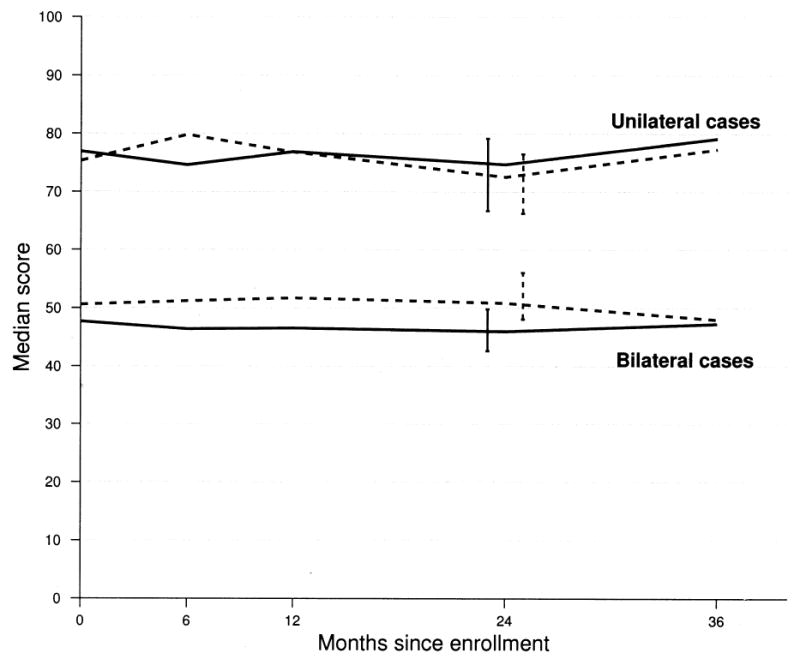
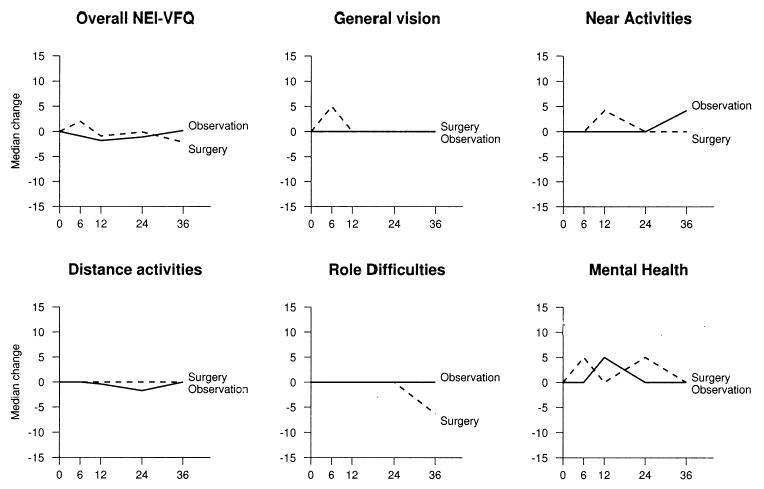
Results: At 24 months after enrollment, overall NEI-VFQ scores had a median decrease of 1 point from baseline in the observation arm (95% confidence interval [CI]: -4 to 3 points) and no change in the surgery arm (95% CI: -3 to 3 points) (P = 0.70). Changes from baseline on NEI-VFQ subscales also were similar between treatment arms. Differences in scores by unilateral or bilateral involvement seen at baseline in each treatment arm persisted throughout follow-up for most outcomes. Planned analyses stratified by VA showed trends (P = 0.17) in favor of surgery at 24 months in the patients with baseline VA greater than 20/200 for the NEI-VFQ scale (3.5-point median increase from baseline in the surgery arm [95% CI: -4 to 7] vs. a 1-point median loss from baseline in the observation arm [95% CI: -6 to 4]).
Conclusions: No difference was detected with respect to vision-targeted quality-of-life outcomes for patients randomized to surgery or observation in the SST Group B Trial. This article contains additional online-only material available at www.ophsource.com/periodicals/ophtha.
Figures

Comment in
-
Submacular Surgery Trials.Ophthalmology. 2005 Nov;112(11):2055. doi: 10.1016/j.ophtha.2005.08.006. Ophthalmology. 2005. PMID: 16271325 No abstract available.
References
-
- Brody BL, Gamst AC, Williams RA, et al. Depression, visual acuity, comorbidity, and disability associated with age-related macular degeneration. Ophthalmology. 2001;108:1893–900. discussion 1900–1. - PubMed
-
- Submacular Surgery Trials Research Group. . Health- and vision-related quality of life among patients with choroidal neovascularization secondary to age-related macular degeneration at the time of enrollment in randomized trials of sub-macular surgery: SST report no. 4. Am J Ophthalmol. 2004;138:91–108. - PubMed
-
- Submacular Surgery Trials (SST). Manual of Procedures. Springfield, VA: National Technical Information Service; 1998. NTIS Publication PB98-166648.
Publication types
MeSH terms
Grants and funding
LinkOut - more resources
Full Text Sources
Medical
