


doi: 10.1523/JNEUROSCI.3446-04.2004.
Deletion of N-type calcium channels alters ethanol reward and reduces ethanol consumption in mice
Affiliations
- PMID: 15525770
- PMCID: PMC6730245
- DOI: 10.1523/JNEUROSCI.3446-04.2004
Item in Clipboard
Deletion of N-type calcium channels alters ethanol reward and reduces ethanol consumption in mice
J Neurosci.
.
Abstract
N-type calcium channels are modulated by acute and chronic ethanol exposure in vitro at concentrations known to affect humans, but it is not known whether N-type channels are important for behavioral responses to ethanol in vivo. Here, we show that in mice lacking functional N-type calcium channels, voluntary ethanol consumption is reduced and place preference is developed only at a low dose of ethanol. The hypnotic effects of ethanol are also substantially diminished, whereas ethanol-induced ataxia is mildly increased. These results demonstrate that N-type calcium channels modulate acute responses to ethanol and are important mediators of ethanol reward and preference.
Figures
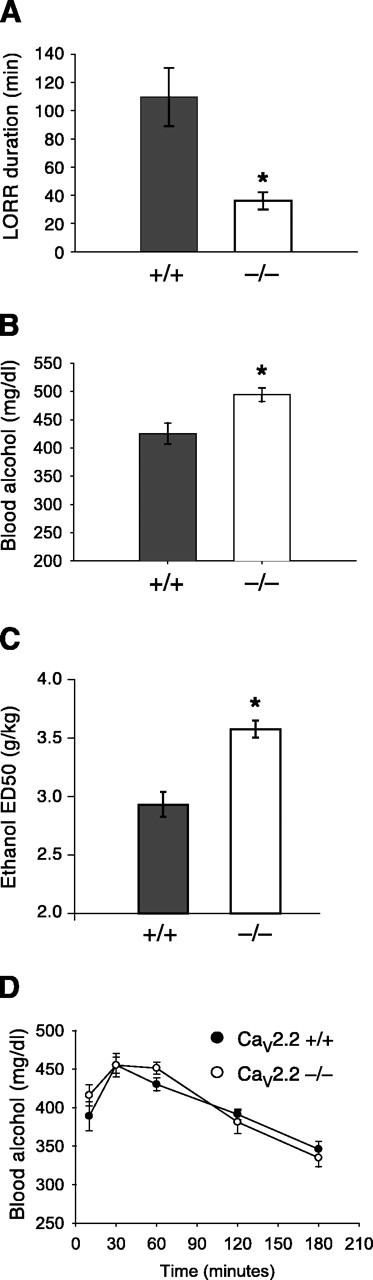
Decreased sensitivity to the hypnotic effect of ethanol in mice lacking Cav2.2. A, Loss of the righting reflex duration in mice given 3.6 gm/kg ethanol intraperitoneally (n = 11 wild-type and n = 12 CaV2.2 null mice). B, Mean blood alcohol levels at the time mice regained the righting reflex (n = 11 wild-type and n = 12 CaV2.2 null mice). C, The threshold dose of ethanol required to induce loss of righting reflex (values are mean ± 95% confidence interval; n = 6 per genotype). D, Blood alcohol clearance after an intraperitoneal injection of 4 gm/kg ethanol (n = 6 per genotype).
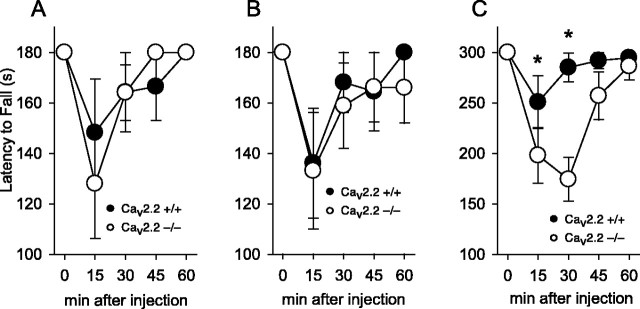
Ethanol-induced ataxia in Cav2.2 null mice. There was no difference between genotypes in the latency to fall from a rotarod rotating at a fixed rate of 20 rpm after an intraperitoneal injection of 1.5 gm/kg (A) or 2 gm/kg (B) ethanol. C, On the accelerating rotarod, Cav2,2 null mice showed a significantly increased latency to fall after 2 gm/kg ethanol. n = 10 per genotype for A-C.
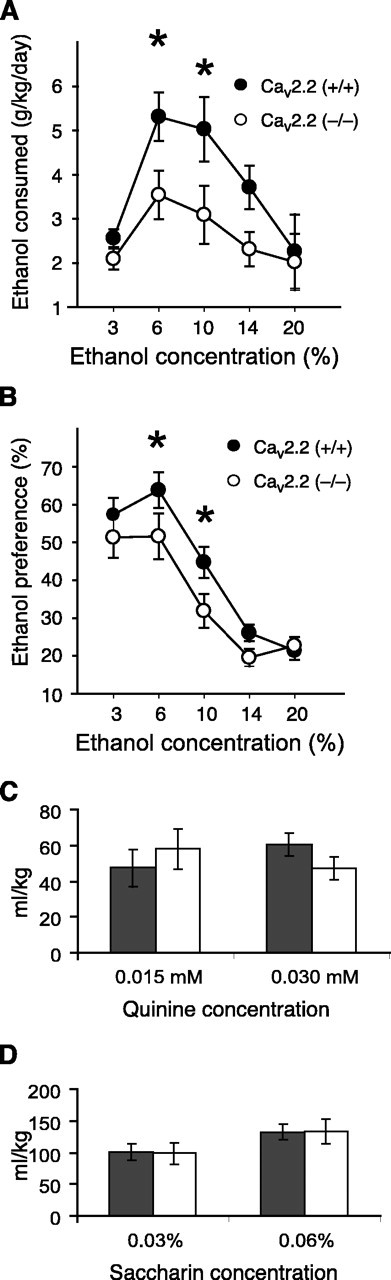
Decreased voluntary ethanol drinking in Cav2.2 null mice. A, Cav2.2 null mice (n = 15) showed decreased ethanol consumption when compared with wild-type mice (n = 21) (*p < 0.05 compared with CaV2.2 null mice given the same concentration of ethanol). B, Ethanol preference (volume of ethanol consumed/total volume of fluid consumed) was also lower for Cav2.2 null mice (*p < 0.05 compared with CaV2.2 null mice at the same concentration of ethanol). There was no difference between Cav2.2 null (□) and wild-type (▪) mice in the consumption of quinine (C) or saccharin (D) solutions (n = 12 for both genotypes).
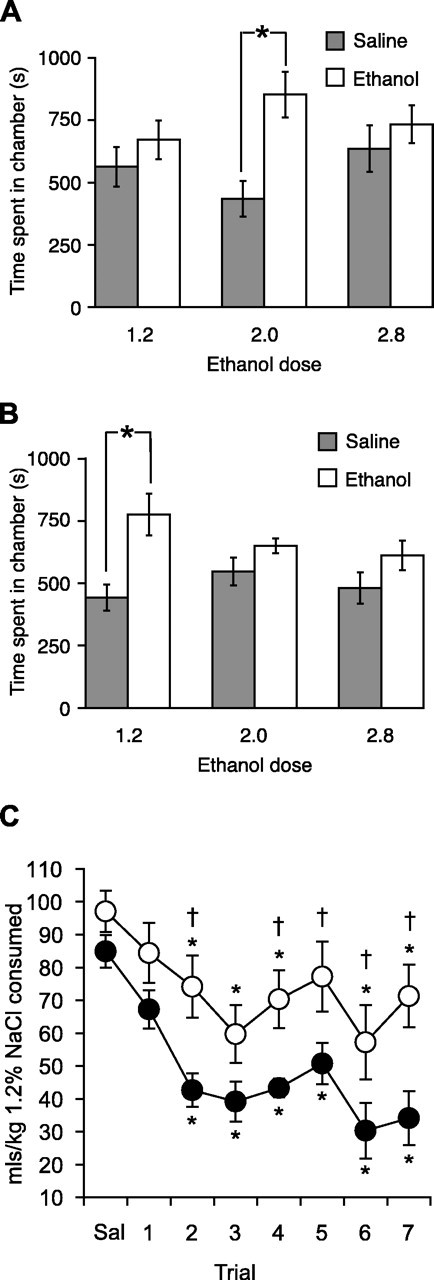
Altered motivational effects of ethanol in Cav2.2 null mice. A, Wild-type mice showed robust conditioned place preference for 2 gm/kg ethanol but not for higher (2.8 gm/kg) or lower (1.2 gm/kg) doses, whereas Cav2.2 null mice (B) showed place preference for 1.2 gm/kg ethanol but not for higher doses (n = 10-18 per genotype at each dose). C, Ethanol-conditioned taste aversion was reduced in Cav 2.2 null mice compared with wild-type mice. Data shown are mean daily consumption of 1.2% NaCl for 7 d after injection of saline and then individual trials after ethanol (2 gm/kg) injection (*p < 0.05 compared with saline; †p < 0.05 compared with wild type; n = 10 per genotype).
References
-
- Allgaier C (2002) Ethanol sensitivity of NMDA receptors. Neurochem Int 41: 377-382. - PubMed
-
- Bowers BJ, Owen EH, Collins AC, Abeliovich A, Tonegawa S, Wehner JM (1999) Decreased ethanol sensitivity and tolerance development in gamma-protein kinase C null mutant mice is dependent on genetic background. Alcohol Clin Exp Res 23: 387-397. - PubMed
-
- Brooks SP, Hennebry G, McAlpin GP, Norman G, Little HJ (2002) Nimodipine prevents the effects of ethanol in tests of memory. Neuropharmacology 42: 577-585. - PubMed
-
- Brown LM, Sims JS, Randall P, Wilcox R, Leslie SW (1993) ω-Conotoxin increases sleep time following ethanol injection. Alcohol 10: 159-162. - PubMed
Publication types
MeSH terms
Substances
Grants and funding
LinkOut - more resources
Full Text Sources
Medical
Molecular Biology Databases
