. 2005 Mar;288(3):H1314-23.
doi: 10.1152/ajpheart.00618.2004. Epub 2004 Nov 4.

PPAR-gamma activation fails to provide myocardial protection in ischemia and reperfusion in pigs

Affiliations

PPAR-gamma activation fails to provide myocardial protection in ischemia and reperfusion in pigs

Ya Xu et al. Am J Physiol Heart Circ Physiol. 2005 Mar.

Abstract

Peroxisome proliferator-activated receptor (PPAR)-gamma modulates substrate metabolism and inflammatory responses. In experimental rats subjected to myocardial ischemia-reperfusion (I/R), thiazolidinedione PPAR-gamma activators reduce infarct size and preserve left ventricular function. Troglitazone is the only PPAR-gamma activator that has been shown to be protective in I/R in large animals. However, because troglitazone contains both alpha-tocopherol and thiazolidinedione moieties, whether PPAR-gamma activation per se is protective in myocardial I/R in large animals remains uncertain. To address this question, 56 pigs were treated orally for 8 wk with troglitazone (75 mg x kg(-1) x day(-1)), rosiglitazone (3 mg x kg(-1) x day(-1)), or alpha-tocopherol (73 mg x kg(-1) x day(-1), equimolar to troglitazone dose) or received no treatment. Pigs were then anesthetized and subjected to 90 min of low-flow regional myocardial ischemia and 90 min of reperfusion. Myocardial expression of PPAR-gamma, determined by ribonuclease protection assay, increased with troglitazone and rosiglitazone compared with no treatment. Rosiglitazone had no significant effect on myocardial contractile function (Frank-Starling relations), substrate uptake, or expression of proinflammatory cytokines during I/R compared with untreated pigs. In contrast, preservation of myocardial contractile function and lactate uptake were greater and cytokine expression was attenuated in pigs treated with troglitazone or alpha-tocopherol compared with untreated pigs. Multivariate analysis indicated that presence of an alpha-tocopherol, but not a thiazolidinedione, moiety in the test compound was significantly related to greater contractile function and lactate uptake and lower cytokine expression during I/R. We conclude that PPAR-gamma activation is not protective in a porcine model of myocardial I/R. Protective effects of troglitazone are attributable to its alpha-tocopherol moiety. These findings, in conjunction with prior rat studies, suggest interspecies differences in the response to PPAR-gamma activation in the heart.


Figures
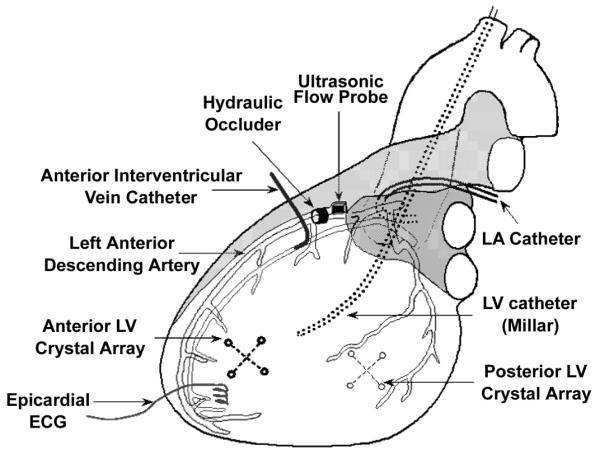
Fig. 1
Fig. 1
Instrumentation of the heart. LV, left ventricle; LA, left atrium.
Fig. 2
Fig. 2
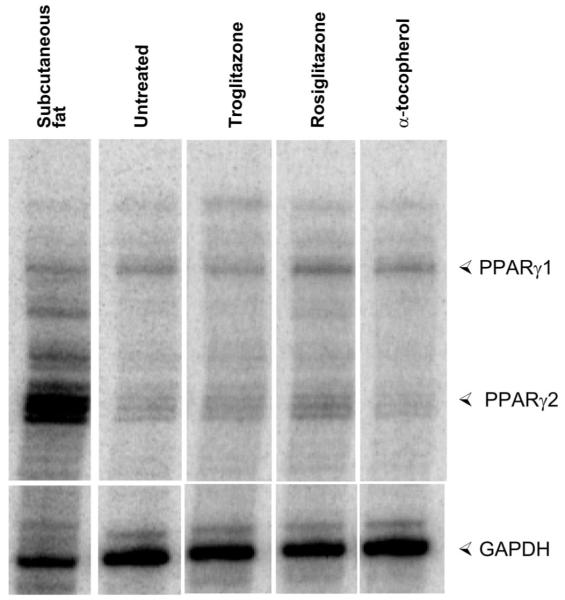
Myocardial expression of peroxisome proliferator-activated receptor (PPAR)-γ. Ribonuclease protection assay demonstrates expression of PPAR-γ1 and PPAR-γ2 mRNA in subendocardial samples from ischemic-reperfused region of 1 representative heart from each experimental group. Subcutaneous fat is a positive control. Quantitative analysis of group data is shown in Table 2.
Fig. 3
Fig. 3
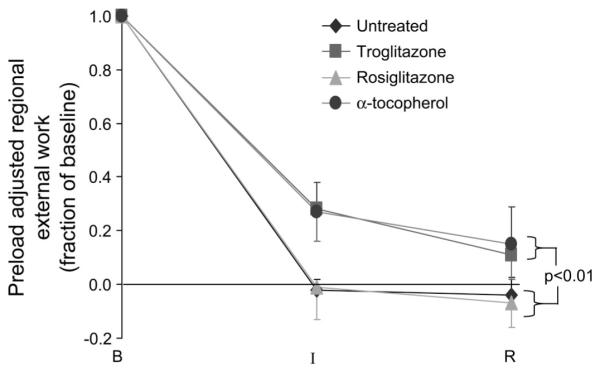
Systolic function in the ischemic region. Preload-adjusted regional external work (see text) was utilized as a load-insensitive measure of regional systolic function. Under baseline (preischemic) conditions, regional external work index did not differ among groups (25 ± 2, 26 ± 4, 26 ± 1, and 25 ± 5 mmHg/cm2 in untreated, troglitazone, rosiglitazone, and α-tocopherol groups, respectively). Therefore, data during ischemia and reperfusion are expressed as a fraction of baseline. Although each group exhibited contractile dysfunction during ischemia and reperfusion, dysfunction was less severe among troglitazone (n = 6) and α-tocopherol (n = 7) groups than among rosiglitazone (n = 12) and untreated (n = 15) groups. B, baseline; I, after 90 min of low-flow ischemia; R, after 90 min of reperfusion.
Fig. 4
Fig. 4
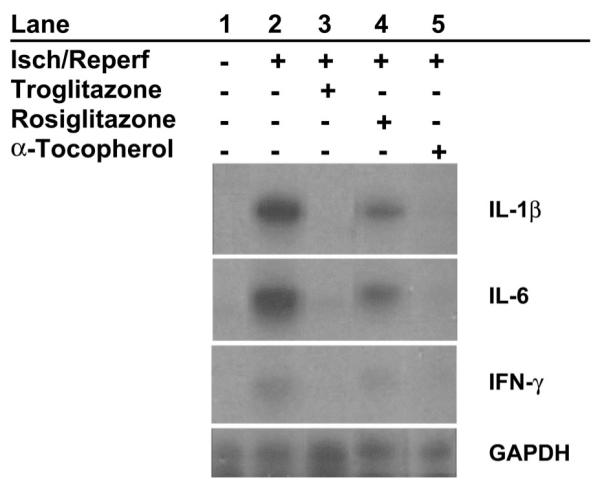
Myocardial cytokine mRNA expression. Representative ribonuclease protection assays show expression of IL-1β, IL-6, and IFN-γ in subendocardial tissue. Lane 1, minimal expression in nonischemic myocardium; lane 2, stimulation of expression of all 3 cytokines by 90 min of low-flow ischemia (Isch) and 90 min of reperfusion (Reperf); lanes 3–5, attenuation of cytokine expression in ischemic-reperfused myocardium by pretreatment with troglitazone and α-tocopherol, but not rosiglitazone.
Fig. 5
Fig. 5
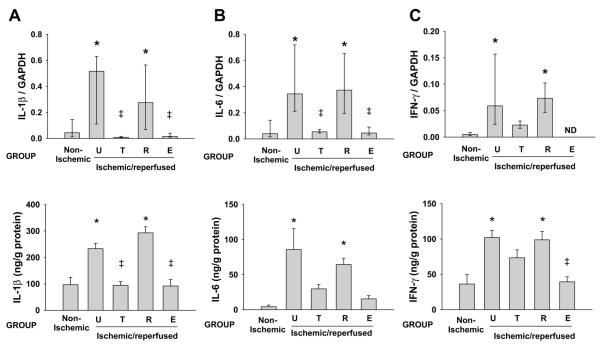
Myocardial cytokine mRNA and protein expression. Pooled data are shown for pigs pretreated with troglitazone (n = 6), rosiglitazone (n = 12), or α-tocopherol (n = 6) and untreated pigs (n = 7). Top: cytokine mRNA expression by ribonuclease protection assay, normalized to expression of GAPDH in each heart. Data are medians ± interquartile range. Bottom: cytokine protein expression by enzyme-linked immunosorbent assay. Values are means ± SE. U, untreated; T, troglitazone; R, rosiglitazone; E, α-tocopherol; ND, not detected. *P < 0.05 vs. nonischemic. ‡P < 0.05 vs. untreated.
Fig. 6
Fig. 6
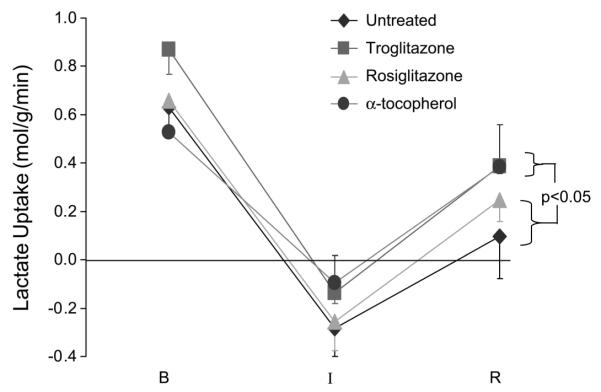
Myocardial lactate uptake. Myocardial lactate uptake becomes negative (net release) during ischemia and recovers partially with reperfusion. Over the course of the experiment, lactate uptake was greater in troglitazone and α-tocopherol groups (test compounds with an α-tocopherol moiety) than in rosiglitazone and untreated groups (no α-tocopherol moiety). P value indicates an intergroup difference over the course of the experiment.
Fig. 7
Fig. 7
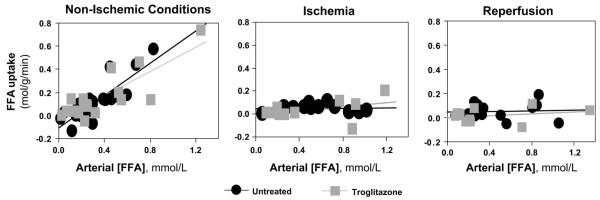
Effect of chronic troglitazone treatment on myocardial free fatty acid (FFA) uptake. Myocardial FFA uptake is plotted as a function of arterial FFA concentration ([FFA]) under nonischemic, ischemic, and reperfusion conditions for 14 untreated pigs and 12 troglitazone-pretreated pigs. In 6 pigs from each group, arterial FFA concentrations were increased by infusion of triglyceride emulsion (10% Liposyn) and heparin. Lines indicate linear regression of data. Chronic troglitazone treatment had no significant effect on myocardial FFA uptake under any condition.

References

    1. Bähr M, Spelleken M, Bock M, von Holtey M, Kiehn R, Eckel J. Acute and chronic effects of troglitazone on isolated rat ventricular cardiocytes. Diabetologia. 1996;39:766–774. - PubMed
    1. Barman Balfour JA, Plosker GL. Rosiglitazone. Drugs. 1999;57:921–930. - PubMed
    1. Cabrero A, Laguna JC, Vazquez M. Peroxisome proliferator-activated receptors and the control of inflammation. Curr Drug Targets Inflamm Allergy. 2002;1:243–248. - PubMed
    1. Cain BS, Meldrum DR, Dinarello CA, Meng X, Joo KS, Banerjee A, Harken AH. Tumor necrosis factor-α and interleukin-1β synergistically depress human myocardial function. Crit Care Med. 1999;27:1309–1318. - PubMed
    1. Camp HS, Li O, Wise SC, Hong YH, Frankowski CL, Shen X, Vanbogelen R, Leff T. Differential activation of peroxisome proliferator-activated receptor-γ by troglitazone and rosiglitazone. Diabetes. 2000;49:539–547. - PubMed

Publication types

MeSH terms

LinkOut - more resources