


Molecular bases for sensitivity to tubulin-binding herbicides in green foxtail
- PMID: 15531712
- PMCID: PMC535825
- DOI: 10.1104/pp.103.037432
Molecular bases for sensitivity to tubulin-binding herbicides in green foxtail
Abstract
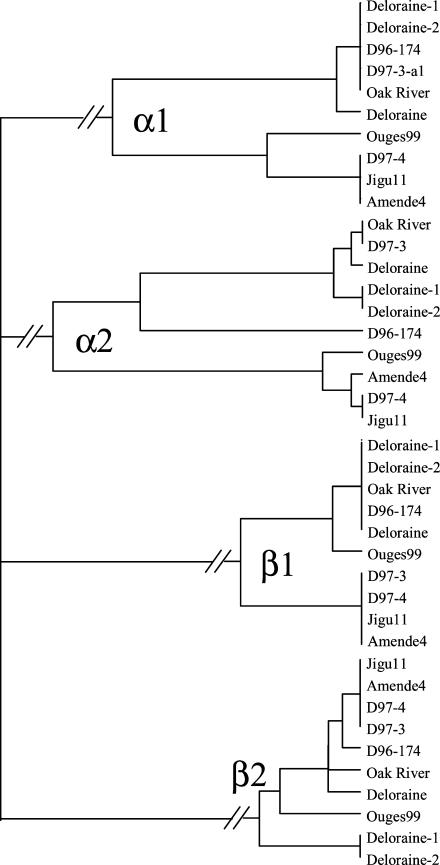
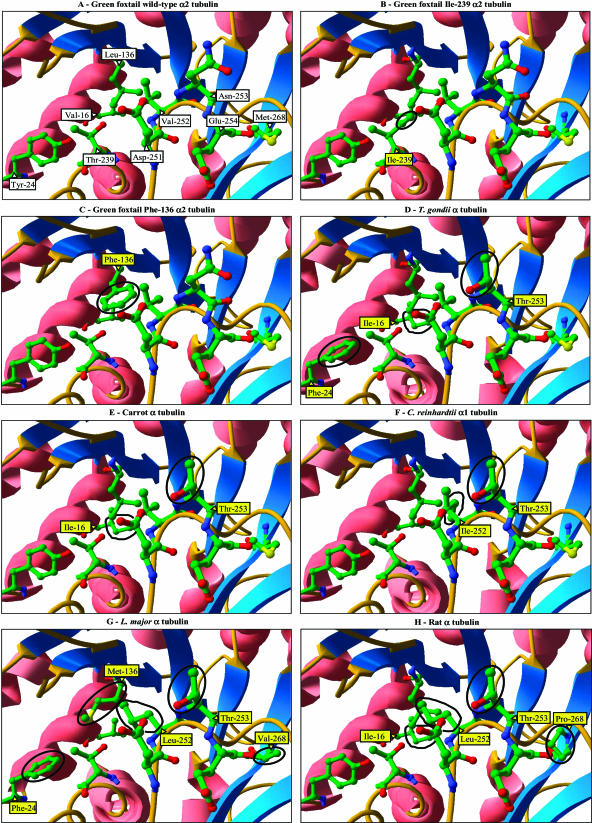
We investigated the molecular bases for resistance to several classes of herbicides that bind tubulins in green foxtail (Setaria viridis L. Beauv.). We identified two alpha- and two beta-tubulin genes in green foxtail. Sequence comparison between resistant and sensitive plants revealed two mutations, a leucine-to-phenylalanine change at position 136 and a threonine-to-isoleucine change at position 239, in the gene encoding alpha2-tubulin. Association of mutation at position 239 with herbicide resistance was demonstrated using near-isogenic lines derived from interspecific pairings between green foxtail and foxtail millet (Setaria italica L. Beauv.), and herbicide sensitivity bioassays combined with allele-specific PCR-mediated genotyping. Association of mutation at position 136 with herbicide resistance was demonstrated using herbicide sensitivity bioassays combined with allele-specific PCR-mediated genotyping. Both mutations were associated with recessive cross resistance to dinitroanilines and benzoic acids, no change in sensitivity to benzamides, and hypersensitivity to carbamates. Using three-dimensional modeling, we found that the two mutations are adjacent and located into a region involved in tubulin dimer-dimer contact. Comparison of three-dimensional alpha-tubulin models for organisms with contrasted sensitivity to tubulin-binding herbicides enabled us to propose that residue 253 and the vicinity of the side chain of residue 251 are critical determinants for the differences in herbicide sensitivity observed between organisms, and that positions 16, 24, 136, 239, 252, and 268 are involved in modulating sensitivity to these herbicides.
Figures
References
-
- Anthony RG, Hussey PJ (1999) Dinitroaniline resistance and the microtubule cytoskeleton. Trends Plant Sci 4: 112–116 - PubMed
-
- Anthony RG, Reichelt S, Hussey PJ (1999) Dinitroaniline herbicide-resistant transgenic tobacco plants generated by co-overexpression of a mutant α-tubulin and β-tubulin. Nat Biotechnol 17: 712–716 - PubMed
-
- Anthony RG, Waldin TR, Ray JA, Bright SWJ, Hussey PJ (1998) Herbicide resistance caused by spontaneous mutation of the cytoskeletal protein tubulin. Nature 393: 260–263 - PubMed
-
- Blume YB, Nyporko AY, Yemets AI, Baird WV (2003) Structural modeling of the interaction of plant α-tubulin with dinitroaniline and phosphoroamidate herbicides. Cell Biol Int 27: 171–174 - PubMed
-
- Blume YB, Strashnyuk NM, Smertenko AP, Solodushko VG, Sidorov VA, Gleba YY (1998) Alteration of β-tubulin in Nicotiana plumbaginifolia confers resistance to amiprophos-methyl. Theor Appl Genet 97: 464–472
MeSH terms
Substances
Associated data
- Actions
- Actions
- Actions
- Actions
LinkOut - more resources
Full Text Sources
Other Literature Sources
