


Elevated depressive symptoms among caregiving grandparents
- PMID: 15533181
- PMCID: PMC1361092
- DOI: 10.1111/j.1475-6773.2004.00312.x
Elevated depressive symptoms among caregiving grandparents
Abstract
Objective: To determine whether caregiving grandparents are at an increased risk for depressive symptoms.
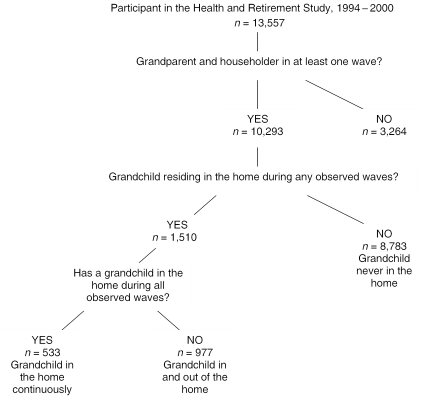
Data source: National sample (n=10,293) of grandparents aged 53-63 years in 1994, and their spouse/partners, who took part in the Health and Retirement Study (HRS).
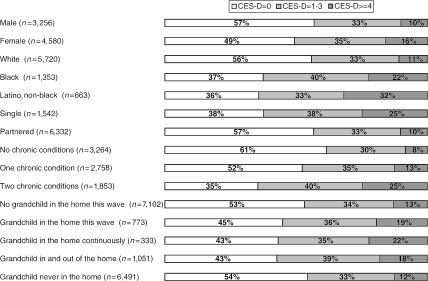
Study design: Grandparents were surveyed in 1994 and resurveyed every two years thereafter, through 2000. Over that period, 977 had a grandchild move in or out of their home. These grandparents served as their own controls to assess the impact of having a grandchild in the home. Data Extraction. Depressive symptoms were measured using an abbreviated form of the Center for Epidemiologic Studies-Depression (CES-D) scale, scored 1-8, with a score > or =4 associated with depression "caseness".
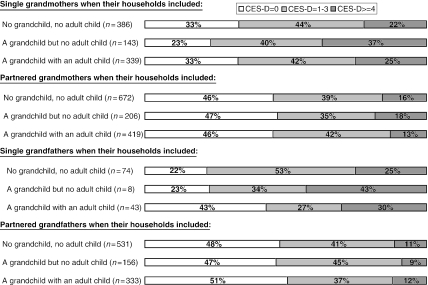
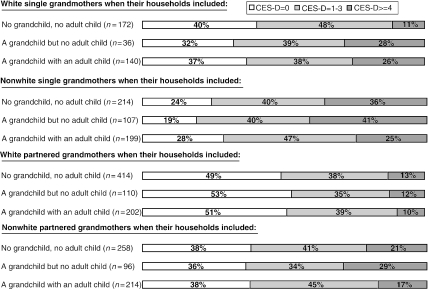
Principal findings: At the time of the 1994 interview, 8.2 percent of grandparents had a grandchild in their home. However, there was substantial variation across demographic groups (e.g., 29.4 percent of single nonwhite grandmothers, but only 2.0 percent of single white grandfathers had a grandchild in residence). The impact of having a grandchild in the home varied by grandparent demographic group, with single grandparents and those without coresident adult children experiencing the greatest probability of elevation in depressive symptoms when a grandchild was in residence. For example, single nonwhite grandmothers experienced an 8 percentage point increase in the probability of having a CES-D score > or =4 when a grandchild was in their home, compared to when a grandchild was not in their home, controlling for changes in health care, income, and household composition over time (95 percent CI=0.1 to 15.0 percentage points).
Conclusions: Grandparents have a greater probability of elevated depressive symptoms when a grandchild is in their home, versus when a grandchild is not in their home. Single women of color bear a disproportionate burden of the depression associated with caring for grandchildren. Since an increasing number of grandparents function as a de facto safety net keeping their grandchildren out of formal foster care, identifying strategies to support the health and well-being of caregiving grandparents is an emerging priority.
Figures
References
-
- American Association of Retired Persons. “Lean on Me: Support and Minority Outreach for Grandparents Raising Grandchildren”. 2003 [accessed June 2003]. Washington, DC: AARP. Available at http://research.aarp.org/general/gp_2003.html.
-
- Brown G W, Harris T O, Hepworth C. “Loss, Humiliation and Entrapment among Women Developing Depression: A Patient and Non-Patient Comparison.”. Psychological Medicine. 1995;25(1):7–22. - PubMed
-
- Burton L. “Black Grandparents Rearing Children of Drug Addicted Parents: Stressors, Outcomes and Social Needs.”. Gerontologist. 1992;32(6):744–51. - PubMed
-
- Caspar L M, Bryson K R. Co-Resident Grandparents and Their Grandchildren: Grandparent Maintained Families. Washington DC: U.S. Census Bureau; 1998. U.S. Census Bureau Population Division. Working paper no. 26.
-
- Fuller-Thomson E, Minkler D, Driver D. “A Profile of Grandparents Raising Grandchildren in the U.S.”. Gerontologist. 1997;37(3):406–11. - PubMed
Publication types
MeSH terms
Grants and funding
LinkOut - more resources
Full Text Sources
Medical
