. 2004 Nov 16;101(46):16369-73.
doi: 10.1073/pnas.0407401101. Epub 2004 Nov 8.

Long-term meditators self-induce high-amplitude gamma synchrony during mental practice

Affiliations

Long-term meditators self-induce high-amplitude gamma synchrony during mental practice

Antoine Lutz et al. Proc Natl Acad Sci U S A. .

Abstract

Practitioners understand "meditation," or mental training, to be a process of familiarization with one's own mental life leading to long-lasting changes in cognition and emotion. Little is known about this process and its impact on the brain. Here we find that long-term Buddhist practitioners self-induce sustained electroencephalographic high-amplitude gamma-band oscillations and phase-synchrony during meditation. These electroencephalogram patterns differ from those of controls, in particular over lateral frontoparietal electrodes. In addition, the ratio of gamma-band activity (25-42 Hz) to slow oscillatory activity (4-13 Hz) is initially higher in the resting baseline before meditation for the practitioners than the controls over medial frontoparietal electrodes. This difference increases sharply during meditation over most of the scalp electrodes and remains higher than the initial baseline in the postmeditation baseline. These data suggest that mental training involves temporal integrative mechanisms and may induce short-term and long-term neural changes.


Figures
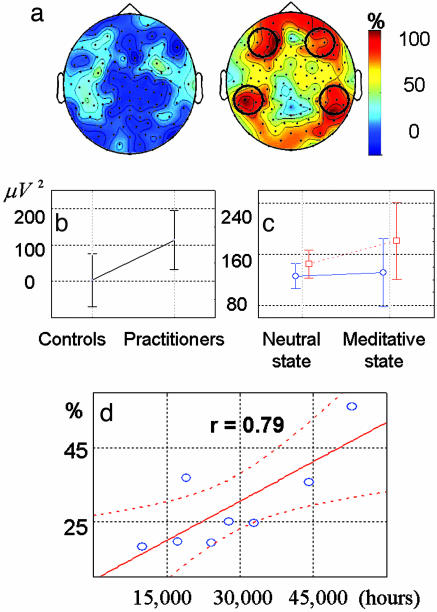
Fig. 3.
Fig. 3.
Absolute gamma power and long-distance synchrony during mental training. (a) Scalp distribution of gamma activity during meditation. The color scale indicates the percentage of subjects in each group that had an increase of gamma activity during the mental training. (Left) Controls. (Right) Practitioners. An increase was defined as a change in average gamma activity of >1 SD during the meditative state compared with the neutral state. Black circles indicate the electrodes of interest for the group analysis. (b) Adjusted gamma variation between neutral and meditative states over electrodes F3-8, Fc3-6, T7-8, Tp7-10, and P7-10 for controls and long-time practitioners [F(1, 16) = 4.6, P < 0.05; ANOVA]. (c) Interaction between the group and state variables for the number of electrode pairs between ROIs that exhibited synchrony higher than noise surrogates [F(1, 16) = 6.5, P < 0.05; ANOVA]. The blue line represents the controls; the red line represents the practitioners. (d) Correlation between the length of the long-term practitioners' meditation training and the ratio of relative gamma activity averaged across electrodes in the initial baseline (P < 0.02). Dotted lines represent 95% confidence intervals.
Fig. 1.
Fig. 1.
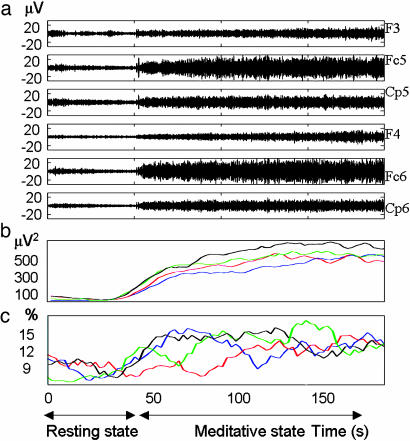
High-amplitude gamma activity during mental training. (a) Raw electroencephalographic signals. At t = 45 s, practitioner S4 started generating a state of nonreferential compassion, block 1. (b) Time course of gamma activity power over the electrodes displayed in a during four blocks computed in a 20-s sliding window every 2 s and then averaged over electrodes. (c) Time course of subjects' cross-hemisphere synchrony between 25 and 42 Hz. The density of long-distance synchrony above a surrogate threshold was calculated in a 20-s sliding window every 2 s for each cross-hemisphere electrode pair and was then averaged across electrode pairs (see Methods). Colors denote different trial blocks: blue, block 1; red, block 2; green, block 3; black, block 4.
Fig. 2.
Fig. 2.
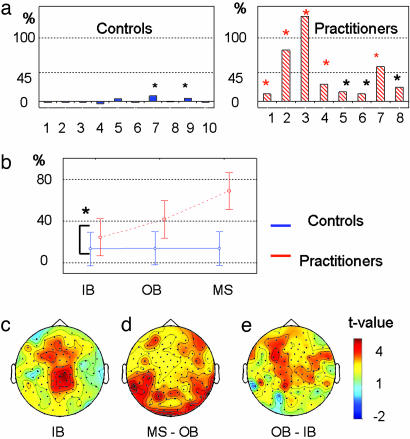
Relative gamma power during mental training. (a and b) Intraindividual analysis on the ratio of gamma (25-42 Hz) to slow (4-13 Hz) oscillations averaged through all electrodes. (a) The abscissa represents the subject numbers, the ordinate represents the difference in the mean ratio between the initial state and meditative state, and the black and red stars indicate that this increase is >2- and 3-fold, respectively, the baseline SD. (b) Interaction between the subject and the state factors for this ratio [F(2, 48) = 3.5, P < 0.05; ANOVA]. IB, initial baseline; OB, ongoing baseline; MS, meditative state. (c-e) Comparisons of this ratio between controls and practitioners over each electrode [t > 2.6, P < 0.01, scaling (-2.5, 4); t test] during the premeditative initial baseline (c), between the ongoing baseline and the meditative state (d), and between the ongoing baseline and the initial baseline (e).

References

    1. Austin, J. H. (1998) Zen and the Brain: Toward an Understanding of Meditation and Consciousness (MIT Press, Cambridge, MA).
    1. Davidson, R. J., Kabat-Zinn, J., Schumacher, J., Rosenkranz, M., Muller, D., Santorelli, S. F., Urbanowski, F., Harrington, A., Bonus, K. & Sheridan, J. F. (2003) Psychosom. Med. 65, 564-570. - PubMed
    1. Fries, P., Reynolds, J. H., Rorie, A. E. & Desimone, R. (2001) Science 291, 1560-1563. - PubMed
    1. Miltner, W. H., Braun, C., Arnold, M., Witte, H. & Taub, E. (1999) Nature 397, 434-436. - PubMed
    1. Srinivasan, R., Russell, D. P., Edelman, G. M. & Tononi, G. (1999) J. Neurosci. 19, 5435-5448. - PMC - PubMed

Publication types