


doi: 10.1073/pnas.0407188101.
Epub 2004 Nov 8.
Genes required for Drosophila nervous system development identified by RNA interference
Affiliations
- PMID: 15534205
- PMCID: PMC528945
- DOI: 10.1073/pnas.0407188101
Item in Clipboard
Genes required for Drosophila nervous system development identified by RNA interference
Proc Natl Acad Sci U S A.
.
Abstract
RNA interference was used to screen 3,314 Drosophila double-stranded RNAs, corresponding to approximately 25% of Drosophila genes, for genes that affect the development of the embryonic nervous system. RNA-interference-mediated gene silencing in Drosophila embryos resulted in loss-of-function mutant phenotypes for 43 genes, which is 1.3% of the genes that were screened. We found 18 genes that were not known previously to affect the development of the nervous system. The functions of some of the genes are unknown. Other genes encode protein kinases, transcription factors, and signaling proteins, as well as proteins with other functions.
Figures
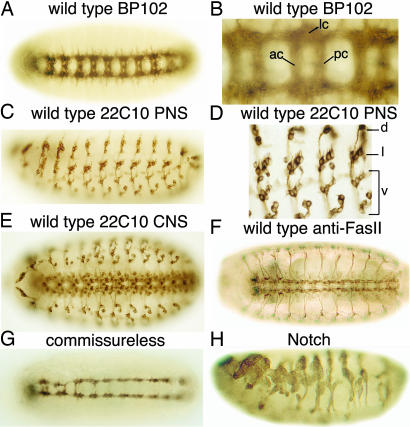
Wild-type patterns of the VNC or PNS of Drosophila embryos stained with mAb BP102 (A and B), 22C10 (C-E), or 1D4 (anti-FasII) (F). B and D show high magnifications of A and C, respectively. G shows the VNC of an embryo injected with commissureless dsRNA and stained with BP102. Most commissures are absent. H shows an embryo injected with Notch dsRNA stained with 22C10. Overproduction of PNS neurons and disorganization of the PNS can be seen. Ventral views of embryos are shown in A, B, and E--G; whereas, lateral views are shown in C, D, and H. lc, longitudinal connectives; ac, anterior commissures; pc, posterior commissures; d, dorsal cluster; l, lateral cluster; v, ventral cluster. In all images, anterior is to the left; in lateral views of embryos, dorsal is up.
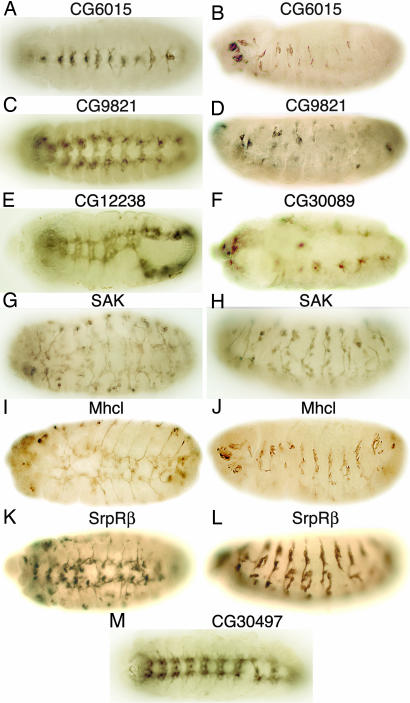
RNAi mutant phenotypes of genes with unknown functions. Stage 13 (A and B) or 15/16 (C-M) embryos were stained with BP102 (A, C, E, and M) or 22C10 (B, D, and F-L) mAb after injection of each indicated dsRNA. Ventral (A, C, E-G, I, K, and M) and lateral (B, D, H, J, and L) views of embryos are shown.
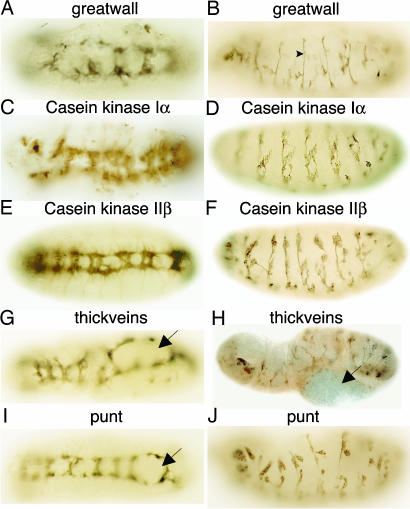
RNAi mutant phenotypes of protein kinases. Stage 15/16 embryos were stained with BP102 (A, C, E, G, and I), 22C10 (D, F, H, and J), or 1D4 (B) mAb after injection with the indicated dsRNA. Ventral (A, C, E, G, and I) or lateral (B, D, F, H and J) views of embryos are shown. The arrowhead in B indicates a segmental nerve, and arrows in G-I indicate hole-like structures.
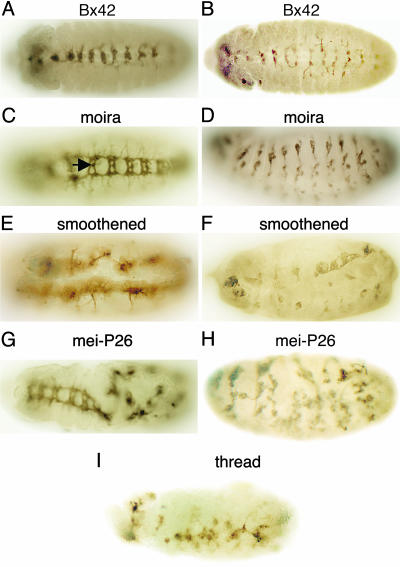
Additional RNAi mutant phenotypes. Stage 13 (A and B) or 15/16 (C-I) embryos were stained with BP102 (A, C, E, and G) or 22C10 (B, D, F, H, and I) mAb after injection of the dsRNA indicated at top of each image. Ventral (A-C, E, and G) and lateral (D, F, H, and I) views of embryos are shown. The arrow in C indicates abnormal commissures.
References
-
- Fire, A., Xu, S., Montgomery, M. K., Kostas, S. A., Driver, S. E. & Mello, C. C. (1998) Nature 391, 806-811. - PubMed
-
- Kennerdell, J. R. & Carthew, R. W. (1998) Cell 95, 1017-1026. - PubMed
-
- Hannon, G. J. (2002) Nature 418, 244-251. - PubMed
-
- Bernstein, E., Caudy, A. A., Hammond, S. M. & Hannon, G. J. (2001) Nature 409, 363-366. - PubMed
MeSH terms
Substances
LinkOut - more resources
Full Text Sources
Other Literature Sources
Molecular Biology Databases
