. 2004 Nov 16;101(46):16099-103.
doi: 10.1073/pnas.0406076101. Epub 2004 Nov 8.

Higher-order assembly of microtubules by counterions: from hexagonal bundles to living necklaces

Affiliations

Higher-order assembly of microtubules by counterions: from hexagonal bundles to living necklaces

Daniel J Needleman et al. Proc Natl Acad Sci U S A. .

Abstract

Cellular factors tightly regulate the architecture of bundles of filamentous cytoskeletal proteins, giving rise to assemblies with distinct morphologies and physical properties, and a similar control of the supramolecular organization of nanotubes and nanorods in synthetic materials is highly desirable. However, it is unknown what principles determine how macromolecular interactions lead to assemblies with defined morphologies. In particular, electrostatic interactions between highly charged polyelectrolytes, which are ubiquitous in biological and synthetic self-assembled structures, are poorly understood. We have used a model system consisting of microtubules (MTs) and multivalent cations to examine how microscopic interactions can give rise to distinct bundle phases in biological polyelectrolytes. The structure of these supramolecular assemblies was elucidated on length scales from subnanometer to micrometer with synchrotron x-ray diffraction, transmission electron microscopy, and differential interference contrast microscopy. Tightly packed hexagonal bundles with controllable diameters were observed for large trivalent, tetravalent, and pentavalent counterions. Unexpectedly, in the presence of small divalent cations, we have discovered a living necklace bundle phase, comprised of 2D dynamic assemblies of MTs with linear, branched, and loop topologies. This new bundle phase is an experimental example of nematic membranes. The morphologically distinct MT assemblies give insight into general features of bundle formation and may be used as templates for miniaturized materials with applications in nanotechnology and biotechnology.


Figures

Fig. 1.
Fig. 1.
3D schematics of higher-order assembly of nanometer-scale MTs. Large trivalent, tetravalent, and pentavalent cations lead to the formation of hexagonal bundles (Left). Small divalent cations lead to the living necklace bundles with linear, branched, and loop morphologies (Right). The distinct bundle phases allow for tailored applications in miniaturized materials requiring high volume (hexagonal bundles) or high surface area (necklace bundles).
Fig. 2.
Fig. 2.
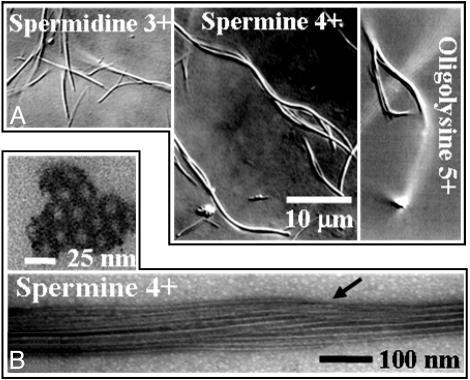
Micron and nanometer scale images of the hexagonal bundle phase of microtubules. (A) DIC optical micrographs of hexagonal MT bundles with 3+ (20 mM spermidine), 4+ (5 mM spermine), and 5+ (2.5 mM oligolysine-five) counterions. (B) Plastic-embedded TEM cross section (Upper) and whole-mount TEM side view of hexagonal MT bundles (10 mM spermine) (Lower). A 3D schematic is shown in Fig. 1 Left.
Fig. 3.
Fig. 3.
Micron and nanometer scale images of the necklace bundle phase of microtubules. (A) DIC (Right), whole-mount TEM side view (Upper Left), and plastic-embedded TEM side view (Lower Left) of MT necklace bundles with 100 mM BaCl2. (B-D) Plastic-embedded TEM cross sections of bundles with 100 mM BaCl2 showing linear (B), branched (C), and loop-like (D) morphologies. A 3D schematic is shown in Fig. 1 Right.
Fig. 4.
Fig. 4.
Synchrotron x-ray scattering data of the angstrom and nanometer scale structure of the hexagonal bundle and necklace bundle phases of microtubules. (A) Raw SAXRD scattering data for MTs with no cation, 115 mM BaCl2 (2+), 15 mM spermidine (3+), 5 mM spermine (4+), or 5 mM oligolysine-five (5+) with hexagonal bundle peaks indexed. (B) Data in A after background subtraction (dots) with fitted model scattering curves (lines); see text. (C) Raw SAXRD data of MTs with 5 mM oligolysine-five, half the standard buffer concentration, and various amounts of added KCl. (D) Data in C after background subtraction (dots) with fitted model scattering curves (lines); see text. (E) Summary of SAXRD scattering fit parameters of MT bundles with CaCl2, SrCl2, BaCl2, oligoamines (spermidine and spermine), oligolysines, and oligolysine-five with half the standard buffer concentration and various amounts of added KCl. The MT wall-to-wall distance was determined by subtracting the MT diameter from the measured MT center-to-center distance. The number of MTs in cross section per bundle, for the hexagonal bundles, was computed by dividing the measured bundle cross-sectional area, L, (see text) by the cross-sectional area of a single MT.

References

    1. Bray, D. (2001) Cell Movements (Taylor & Francis, New York).
    1. Chen, J., Kanai, Y., Cowan, N. J. & Hirokawa, N. (1992) Nature 360, 674-676. - PubMed
    1. Lida, J., Itoh, T. J., Hotani, H., Nishiyama, K., Murofushi, H., Bulinski, J. C. & Hisanaga, S. (2002) J. Mol. Biol. 320, 97-106. - PubMed
    1. White, G. M., Jr. & Love, J. C. (2001) Sci. Am. 285, 38-47. - PubMed
    1. Martin, C. R. (1994) Science 266, 1961-1966. - PubMed

Publication types

MeSH terms

LinkOut - more resources