


Clinical Trial
doi: 10.1212/01.wnl.0000142969.19465.8f.
Impact of antioxidants, zinc, and copper on cognition in the elderly: a randomized, controlled trial
Affiliations
- PMID: 15534261
- PMCID: PMC1473037
- DOI: 10.1212/01.wnl.0000142969.19465.8f
Item in Clipboard
Clinical Trial
Impact of antioxidants, zinc, and copper on cognition in the elderly: a randomized, controlled trial
Neurology.
.
Abstract
Participants in the Age-Related Eye Disease Study were randomly assigned to receive daily antioxidants (vitamin C, 500 mg; vitamin E, 400 IU; beta carotene, 15 mg), zinc and copper (zinc, 80 mg; cupric oxide, 2 mg), antioxidants plus zinc and copper, or placebo. A cognitive battery was administered to 2,166 elderly persons after a median of 6.9 years of treatment. Treatment groups did not differ on any of the six cognitive tests (p > 0.05 for all). These results do not support a beneficial or harmful effect of antioxidants or zinc and copper on cognition in older adults.
Figures
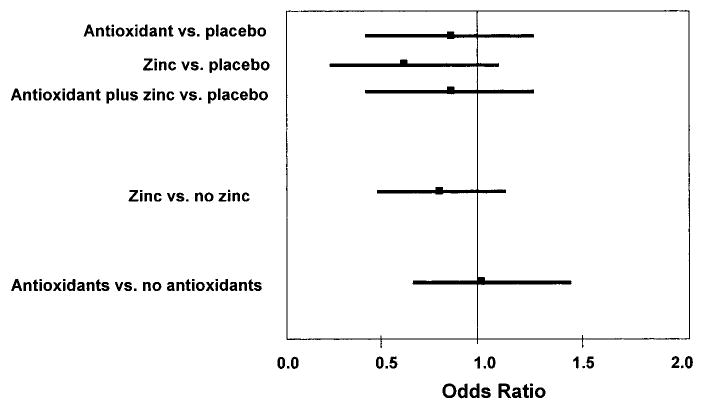
The likelihood (odds ratio and 95% CI) of developing cognitive impairment (Modified Mini-Mental State Examination score, <80) in the 2,166 Age-Related Eye Disease Study participants. Reference group is placebo (no active treatment).
References
-
- Morris MC, Evans DA, Bienias JL, et al. Dietary intake of antioxidant nutrients and the risk of incident Alzheimer disease in a biracial community study. JAMA. 2002;287:3230–3237. - PubMed
-
- Masaki KH, Losonczy KG, Izmirlian G, et al. Association of vitamin E and C supplement use with cognitive function and dementia in elderly men. Neurology. 2000;54:1265–1272. - PubMed
-
- The Age-Related Eye Disease Study Research Group. A randomized, placebo-controlled, clinical trial of high-dose supplementation with vitamins C and E, beta carotene, and zinc for age-related macular degeneration and vision loss: AREDS Report No. 8. Arch Ophthalmol. 2001;119:1417–1436. - PMC - PubMed
-
- Engelhart MJ, Geerlings MI, Ruitenberg A, et al. Dietary intake of antioxidants and risk of Alzheimer disease. JAMA. 2002;287:3223–3229. - PubMed
-
- Zandi PP, Anthony JC, Khachaturian AS, et al. Reduced risk of Alzheimer disease in users of antioxidant vitamin supplements: the Cache County Study. Arch Neurol. 2004;61:82–88. - PubMed
Publication types
MeSH terms
Substances
Grants and funding
LinkOut - more resources
Full Text Sources
Medical
Molecular Biology Databases
