Review
. 2003;27(3):220-31.

Relationships between nutrition, alcohol use, and liver disease

Affiliations
Review

Relationships between nutrition, alcohol use, and liver disease

Charles S Lieber. Alcohol Res Health. 2003.

Abstract

Many alcoholics are malnourished, either because they ingest too little of essential nutrients (e.g., carbohydrates, proteins, and vitamins) or because alcohol and its metabolism prevent the body from properly absorbing, digesting, and using those nutrients. As a result, alcoholics frequently experience deficiencies in proteins and vitamins, particularly vitamin A, which may contribute to liver disease and other serious alcohol-related disorders. Furthermore, alcohol breakdown in the liver, both by the enzyme alcohol dehydrogenase and by an enzyme system called the microsomal ethanol-oxidizing system (MEOS), generates toxic products such as acetaldehyde and highly reactive, and potentially damaging, oxygen-containing molecules. These products can interfere with the normal metabolism of other nutrients, particularly lipids, and contribute to liver cell damage. Nutritional approaches can help prevent or ameliorate alcoholic liver disease. For example, a complete balanced diet can compensate for general malnutrition. Administration of antioxidants (e.g., precursors of the endogenous antioxidant glutathione) can help the body eliminate reactive oxygen molecules and other reactive molecules generated from abnormal lipid breakdown. New agents currently are being studied as promising nutritional supplements for alcoholics with liver disease.


Figures
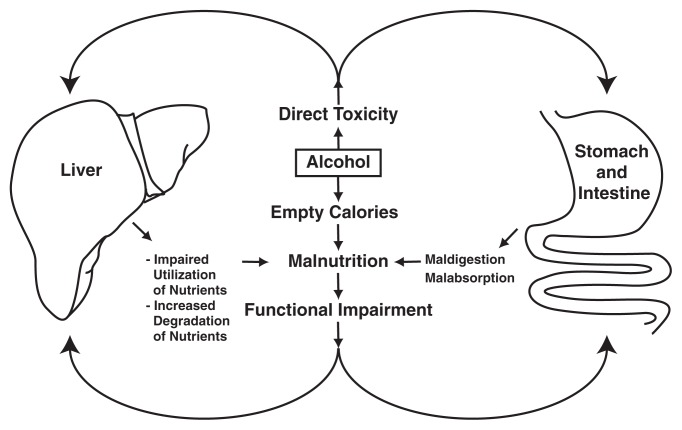
Figure 1
Figure 1
Interaction of alcohol’s direct toxic effects with malnutrition. In alcoholics, alcohol often replaces other nutrients (e.g., carbohydrates or proteins), resulting in insufficient intake of those nutrients (i.e., primary malnutrition), particularly because, under certain conditions, the calories provided by alcohol cannot be used effectively by the body—that is, they are “empty” calories. In addition, alcohol has direct toxic effects on the gastrointestinal tract and liver, leading to impaired digestion, reduced absorption of nutrients into the blood, and impaired utilization or increased degradation of those nutrients. These effects are referred to as secondary malnutrition and can contribute to the progression of liver damage. SOURCE: Lieber 1991b.
Figure 2
Figure 2
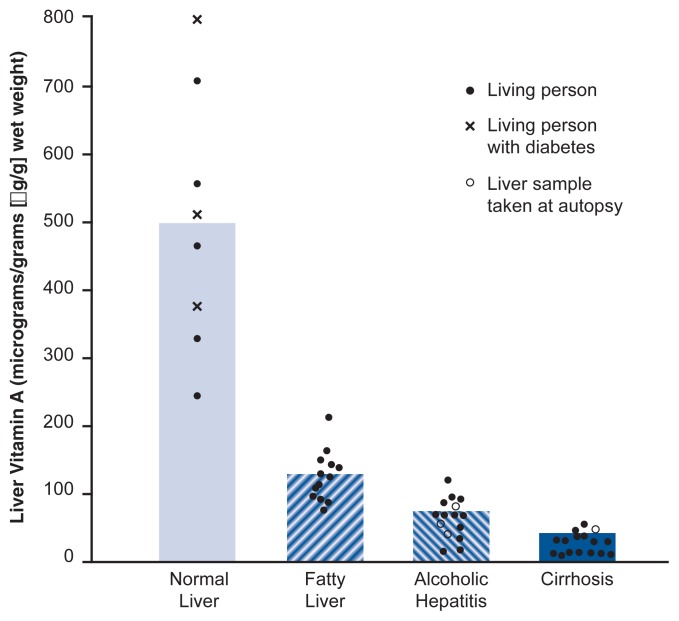
Vitamin A levels in the livers of healthy people and patients with various stages of alcoholic liver disease. The values were obtained by taking liver biopsies from study participants. Each circle or x represents one person; a filled circle represents a living participant, an open circle represents a sample taken during an autopsy of a deceased participant, and each x represents a study participant with a normal liver who had diabetes. The bars represent the mean value of all participants in each group. P values for the differences between the groups were all significant at the 0.001 level. SOURCE: Leo and Lieber 1982.
Figure 3
Figure 3
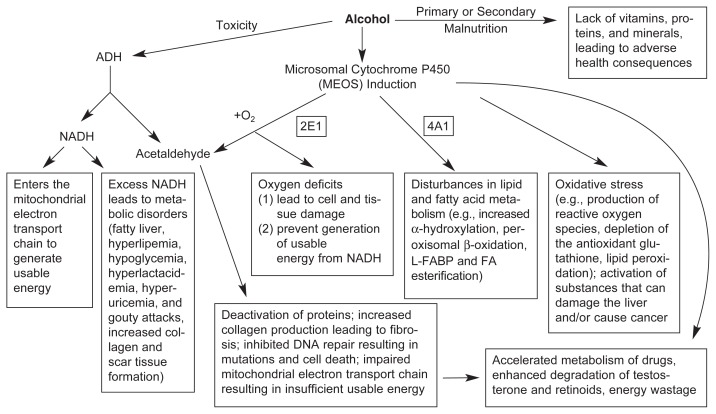
Effects of heavy alcohol consumption caused by alcohol-related malnutrition and alcohol breakdown by the enzyme alcohol dehydrogenase (ADH) and the microsomal ethanol-oxidizing system (MEOS). Alcohol consumption can lead to primary and secondary malnutrition as described in figure 1. Alcohol breakdown by ADH results in the formation of excess levels of the molecule reduced nicotinamide adenine dinucleotide (NADH), which can cause various metabolic problems. Moreover, both ADH and the MEOS convert alcohol to acetaldehyde, a toxic molecule that has numerous adverse effects. Alcohol also enhances the activity of the central enzyme of the MEOS, cytochrome P450 2E1, which exacerbates some of the toxic effects of acetaldehyde and generates a harmful condition called oxidative stress in the cells. Oxidative stress is characterized by excess levels of reactive oxygen species (ROS), abnormal lipid breakdown resulting in additional reactive molecules, and/or reduced levels of antioxidants (e.g., glutathione) which can eliminate reactive molecules. SOURCE: Modified from Lieber 1998.
Figure 4
Figure 4
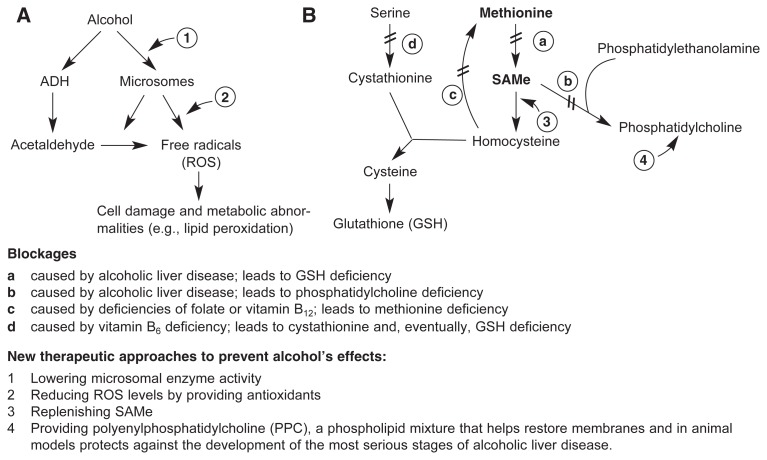
Alcohol’s effects on the levels of reactive molecules and the antioxidant glutathione (GSH) in the cell. (A) Alcohol breakdown by the enzyme alcohol dehydrogenase (ADH) and by the microsomal ethanol-oxidizing system (MEOS) generates acetaldehyde, a reactive molecule that among other harmful effects interacts with cysteine, preventing it from being used to generate GSH (see panel B). Both the MEOS and acetaldehyde also lead to the generation of reactive oxygen species (ROS) that damage the cells through various mechanisms (e.g., lipid peroxidation). ROS can be eliminated or converted to harmless substances by GSH and other antioxidants. (B) One of the precursors of GSH is the amino acid methionine, which first is converted to S-adenosylmethionine (SAMe). SAMe then is further modified to yield cysteine. Alcohol consumption and alcoholic liver disease cause the blocks labeled a and b; both folate and vitamin B12 deficiency cause block c; vitamin B6 deficiency causes block d; and all these blockages interfere with GSH production. Administration of SAMe can help raise GSH levels in the cells.

References

    1. Salmela KS, Kessova IG, Tsyrlov IB, Lieber CS. Respective roles of human cytochrome P–4502E1, 1A2 and 3A4 in the hepatic microsomal ethanol oxidizing system. Alcoholism: Clinical and Experimental Research. 1998;22:2125–2132. - PubMed
    1. Tsutsumi M, Lasker JM, Shimizu M, et al. The intralobular distribution of ethanol inducible P450IIE1 in rat and human liver. Hepatology. 1989;10:437–446. - PubMed
    1. Adibi SA, Baraona E, Lieber CS. Effects of ethanol on amino acids and protein metabolism. In: Lieber CS, editor. Medical and Nutritional Complications of Alcoholism: Mechanism and Management. New York: Plenum Press; 1992. pp. 127–155.
    1. Ahmed S, Leo MA, Lieber CS. Interactions between alcohol and beta-carotene in patients with alcoholic liver disease. American Journal of Clinical Nutrition. 1994;60:430–436. - PubMed
    1. Albanes D, Heinonen OP, Taylor PR, et al. α-tocopherol and β-carotene supplements and lung cancer incidence in the Alpha-Tocopherol Beta-Carotene Cancer Prevention Study: Effects of baseline characteristics and study compliance. Journal of the National Cancer Institute. 1996;88:1560–1571. - PubMed

Publication types

MeSH terms