


Consequences of increased neuromotor noise for reaching movements in persons with stroke
- PMID: 15536551
- PMCID: PMC3473069
- DOI: 10.1007/s00221-004-2106-8
Consequences of increased neuromotor noise for reaching movements in persons with stroke
Abstract
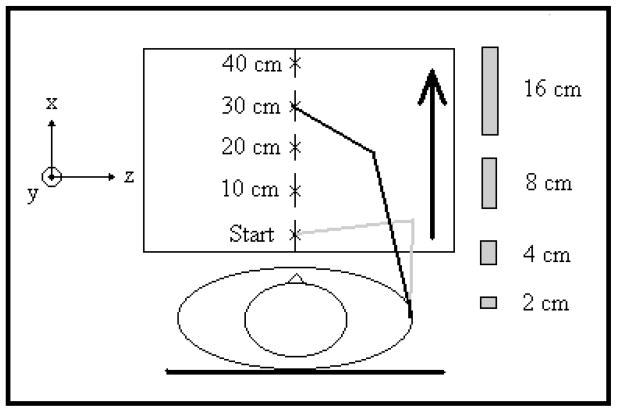
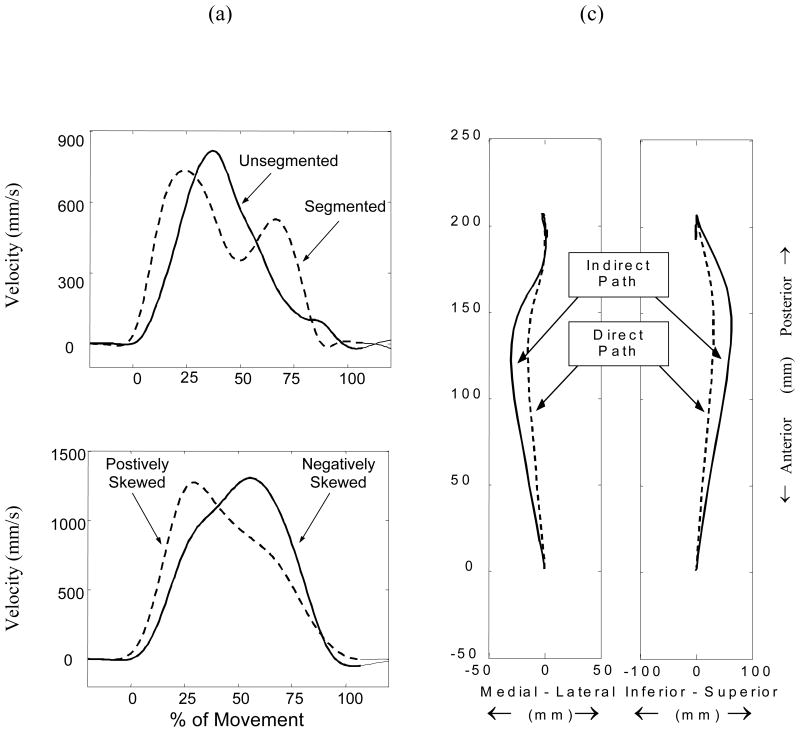
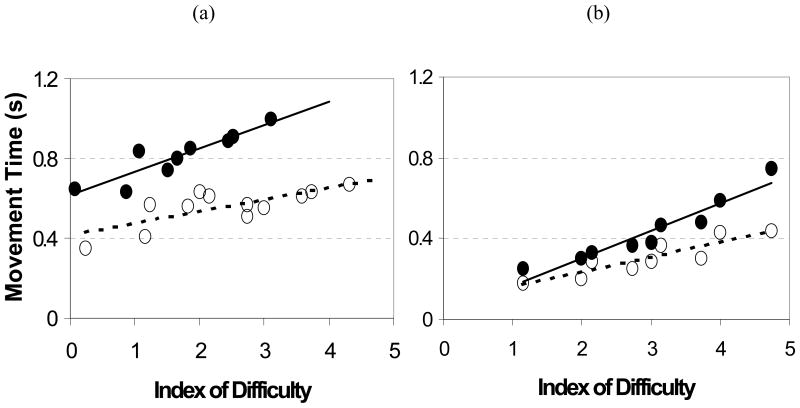
Understanding stroke-induced changes to the motor control of the more affected arm of people with stroke may lead to more effective rehabilitation interventions that improve function. Reaching movements of the more affected arm in persons with stroke are slow, segmented, and indirect. Such changes may be related to a reduced capacity to transmit motor commands in the presence of neuromotor noise. In tasks requiring both speed and accuracy, transmission capacity can be characterized by the linear relationship between movement time and task difficulty (Fitts' law). This study quantified Fitts' slope and intercept coefficients in stroke during reaching tasks and their relationship to kinematic measures of path accuracy (directness), trajectory corrections (segmentation), and planning strategy (skewness). We compared Fitts' slope and intercept and kinematics among the more and the less affected arm of 20 persons with stroke and the nondominant arm of ten healthy persons. Slope and intercept were significantly increased in the more affected arm of the group with stroke and related to clinical measurements of motor impairment and tone. For both the more and the less affected arm of the group with stroke, increased slopes and intercepts were correlated to more indirect, segmented, and positively skewed movement. Our findings suggest that stroke results in greater neuromotor noise, which has consequences for both motor execution and planning. Individuals with stroke demonstrate substantially more deviation from straight-line paths than do controls, despite using more conservative strategies (i.e., leftward shift of velocity profile) and extensive feedback control (i.e., segmentation).
Figures
References
-
- Bastian AJ, Martin TA, Keating JG, Thach WT. Cerebellar ataxia: abnormal control of interaction torques across multiple joints. J Neurophysiol. 1996;76:492–509. - PubMed
-
- Beer RF, Dewald JP, Rymer WZ. Deficits in the coordination of multijoint arm movements in patients with hemiparesis: evidence for disturbed control of limb dynamics. Exp Brain Res. 2000;131:305–319. - PubMed
-
- Bohannon RW, Smith MB. Inter rater reliability of a modified Ashworth Scale of muscle spasticity. Phys Ther. 1987;67:206–207. - PubMed
-
- Bizzi E, Polit A. Processes controlling visually evoked movements. Neuropsychologia. 1979;17:203–213. - PubMed
-
- Brunnstrom S. Movement Therapy in Hemiplegia. Harper and Row; New York: 1970.
Publication types
MeSH terms
Grants and funding
LinkOut - more resources
Full Text Sources
Medical
