


Does the 12-item General Health Questionnaire contain multiple factors and do we need them?
- PMID: 15538951
- PMCID: PMC534792
- DOI: 10.1186/1477-7525-2-63
Does the 12-item General Health Questionnaire contain multiple factors and do we need them?
Abstract
Background: The 12-item General Health Questionnaire (GHQ-12) is widely used as a unidimensional instrument, but factor analyses tended to suggest that it contains two or three factors. Not much is known about the usefulness of the GHQ-12 factors, if they exist, in revealing between-patient differences in clinical states and health-related quality of life.
Methods: We addressed this issue in a cross-sectional survey of out-patients with psychological disorders in Singapore. The participants (n = 120) completed the GHQ-12, the Beck Anxiety Inventory, and the Short-Form 36 Health Survey. Confirmatory factor analysis was used to compare six previously proposed factor structures for the GHQ-12. Factor scores of the best-fitting model, as well as the overall GHQ-12 score, were assessed in relation to clinical and health-related quality of life variables.
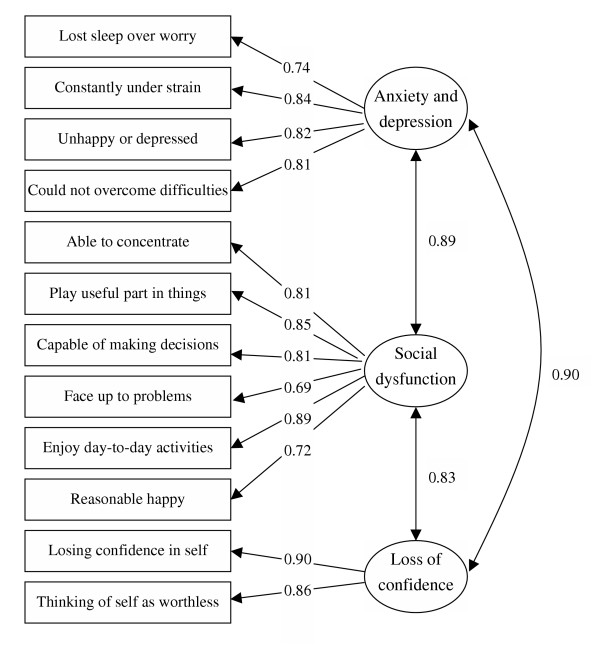
Results: The 3-factor model proposed by Graetz fitted the data better than a unidimensional model, two 2-factor models, and two other 3-factor models. However, the three factors were strongly correlated. Their values varied in a similar fashion in relation to clinical and health-related quality of life variables.
Conclusions: The 12-item General Health Questionnaire contains three factors, namely Anxiety and Depression, Social Dysfunction, and Loss of Confidence. Nevertheless, using them separately does not offer many practical advantages in differentiating clinical groups or identifying association with clinical or health-related quality of life variables.
Figures
References
-
- Corti L. For better or worse? Annual change in smoking, self-assessed health and subjective well-being. In: Buck N, Gershuny J, Rose D, Scott J, editor. In Changing Households: The British Household Panel Survey 1990–1992. Colchester: University of Essex; 1994. pp. 199–219.
-
- Politi PL, Piccinelli M, Wilkinson G. Reliability, validity and factor structure of the 12-item General Health Questionnaire among young males in Italy. Acta Psychiatr Scand. 1994;90:432–437. - PubMed
-
- Andrich D, van Schoubroeck L. The General Health Questionnaire: a psychometric analysis using latent trait theory. Psychol Med. 1989;19:469–485. - PubMed
Publication types
MeSH terms
LinkOut - more resources
Full Text Sources
Medical
