. 2005 Jun;64(6):839-44.
doi: 10.1136/ard.2004.029538. Epub 2004 Nov 11.

Pregnancy in patients with rheumatic disease: anti-inflammatory cytokines increase in pregnancy and decrease post partum

Affiliations

Pregnancy in patients with rheumatic disease: anti-inflammatory cytokines increase in pregnancy and decrease post partum

M Østensen et al. Ann Rheum Dis. 2005 Jun.

Abstract

Objective: To investigate changes in the levels of circulating cytokines with a focus on the Th1/Th2 balance during and after pregnancy in patients with rheumatoid arthritis (RA), juvenile idiopathic arthritis (JIA), and ankylosing spondylitis (AS).

Methods: Plasma and serum samples of 34 pregnant patients, 19 with RA, 6 with JIA, and 9 with AS, and of 30 healthy pregnant women, 20 non-pregnant patients, and 10 non-pregnant healthy women were analysed for levels of interferon gamma (IFNgamma), interleukin (IL) 1beta, IL10, IL1 receptor antagonist (IL1Ra), soluble tumour necrosis factor receptor (sTNFR), and soluble CD30 (sCD30) by ELISA. Clinical assessment and blood sampling in pregnant women was done once in each trimester and 6, 12, and 24 weeks post partum. Disease activity in the patients was evaluated by validated clinical instruments and correlated with circulating levels of cytokines.

Results: Low levels of IL10 were found sporadically, whereas IFNgamma and IL1beta were below detection level in the samples tested. Significantly higher concentrations of sTNFR and IL1Ra were measured in pregnant than in non-pregnant subjects. An increase of IL1Ra from the second to the third trimester correlated with improvement of disease activity in patients with RA and AS. Compared with non-pregnant patients and the other pregnant women, patients with RA showed markedly raised levels of sCD30 during pregnancy.

Conclusions: IFNgamma and IL10, markers of a Th1 and Th2 response, respectively, were either low or undetectable in the cohorts analysed. The increase of cytokine inhibitors IL1Ra and sTNFR was related to pregnancy and was independent of an underlying disease. These anti-inflammatory mediators seem to affect disease activity.


Figures
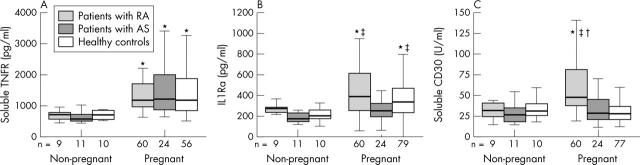
Figure 1
Figure 1
Levels of (A) sTNFR, (B) IL1Ra, and (C) sCD30 in patients with RA, patients with AS, and healthy women. Values presented in the group of non-pregnant (no pre-pregnancy or postpartum data included) and pregnant (pooled data of first, second, and third trimester) subjects. Horizontal bar within the box marks the median, the boxes represent the range of ±25% around the median (interquartile range). Vertical bars indicate 95% confidence interval. *Significant difference compared with the non-pregnant control group (p<0.05 by Mann-Whitney U test); †significant difference compared with healthy pregnant women (p<0.05 by Mann-Whitney U test); ‡significant difference compared with pregnant patients with AS (p<0.05 by Mann-Whitney U test).
Figure 2
Figure 2
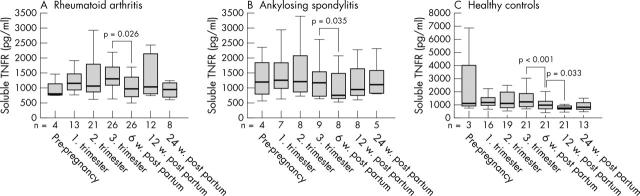
Levels of sTNFR before, during (first, second, and third trimester), and after pregnancy (6, 12, and 24 weeks post partum) in patients with (A) RA or (B) AS, and (C) in healthy controls. Horizontal bar within the box marks the median, the boxes represent a range of ±25% around the median (interquartile range). Vertical bars indicate 95% confidence interval. Significant changes indicated by p values (Wilcoxon test for paired data).
Figure 3
Figure 3
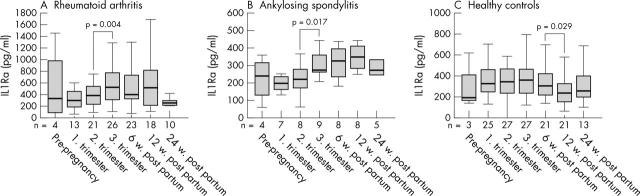
Levels of IL1Ra before, during (first, second, and third trimester), and after pregnancy (6, 12, and 24 weeks post partum) in patients with (A) RA or (B) AS, and (C) in healthy controls. Horizontal bar within the box marks the median, the boxes represent a range of ±25% around the median (interquartile range). Vertical bars indicate 95% confidence interval. Significant changes indicated by p values (Wilcoxon test for paired data).
Figure 4
Figure 4
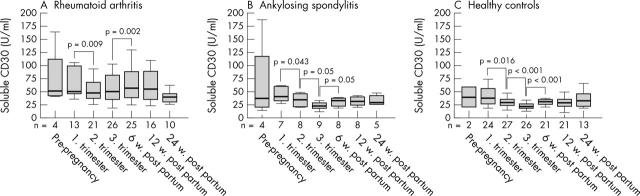
Levels of sCD30 before, during (first, second, and third trimester), and after pregnancy (6, 12, and 24 weeks post partum) in patients with (A) RA or (B) AS, and (C) in healthy controls. Horizontal bar within the box marks the median, the boxes represent a range of ±25% around the median (interquartile range). Vertical bars indicate 95% confidence interval. Significant changes indicated by p values (Wilcoxon test for paired data).

Comment in

  • Benefit of pregnancy in inflammatory arthritis.
    Straub RH, Buttgereit F, Cutolo M. Straub RH, et al. Ann Rheum Dis. 2005 Jun;64(6):801-3. doi: 10.1136/ard.2005.037580. Ann Rheum Dis. 2005. PMID: 15897301 Free PMC article. Review. No abstract available.

References

    1. Arthritis Rheum. 1988 Mar;31(3):315-24 - PubMed
    1. J Rheumatol. 2003 Oct;30(10):2133-9 - PubMed
    1. J Reprod Fertil. 1990 Jul;89(2):447-58 - PubMed
    1. Arthritis Rheum. 1991 Oct;34(10):1218-27 - PubMed
    1. Proc Natl Acad Sci U S A. 1992 May 1;89(9):4076-80 - PubMed

Publication types