. 2004 Dec;16(12):3386-99.
doi: 10.1105/tpc.104.026609. Epub 2004 Nov 11.

Phosphorylation of 1-aminocyclopropane-1-carboxylic acid synthase by MPK6, a stress-responsive mitogen-activated protein kinase, induces ethylene biosynthesis in Arabidopsis

Affiliations

Phosphorylation of 1-aminocyclopropane-1-carboxylic acid synthase by MPK6, a stress-responsive mitogen-activated protein kinase, induces ethylene biosynthesis in Arabidopsis

Yidong Liu et al. Plant Cell. 2004 Dec.

Abstract

Mitogen-activated protein kinases (MAPKs) are implicated in regulating plant growth, development, and response to the environment. However, the underlying mechanisms are unknown because of the lack of information about their substrates. Using a conditional gain-of-function transgenic system, we demonstrated that the activation of SIPK, a tobacco (Nicotiana tabacum) stress-responsive MAPK, induces the biosynthesis of ethylene. Here, we report that MPK6, the Arabidopsis thaliana ortholog of tobacco SIPK, is required for ethylene induction in this transgenic system. Furthermore, we found that selected isoforms of 1-aminocyclopropane-1-carboxylic acid synthase (ACS), the rate-limiting enzyme of ethylene biosynthesis, are substrates of MPK6. Phosphorylation of ACS2 and ACS6 by MPK6 leads to the accumulation of ACS protein and, thus, elevated levels of cellular ACS activity and ethylene production. Expression of ACS6(DDD), a gain-of-function ACS6 mutant that mimics the phosphorylated form of ACS6, confers constitutive ethylene production and ethylene-induced phenotypes. Increasing numbers of stress stimuli have been shown to activate Arabidopsis MPK6 or its orthologs in other plant species. The identification of the first plant MAPK substrate in this report reveals one mechanism by which MPK6/SIPK regulates plant stress responses. Equally important, this study uncovers a signaling pathway that modulates the biosynthesis of ethylene, an important plant hormone, in plants under stress.


Figures
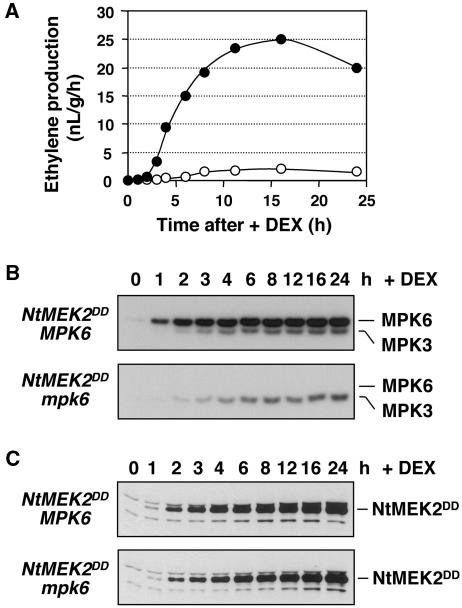
Figure 1.
Figure 1.
Endogenous MPK6 Is Required for NtMEK2DD-Induced Ethylene Production in Arabidopsis. (A) MPK6 is required for NtMEK2DD-induced ethylene production. Twelve-day-old NtMEK2DD (closed circles) and NtMEK2DD/mpk6 (open circles) seedlings grown in 50-mL gas chromatography (GC) vials were treated with DEX (2 μM). Ethylene levels in the headspace were determined at various times. The seedlings were harvested and used for analyses in (B) and (C). (B) Activation of endogenous MAPKs by NtMEK2DD in wild-type and mpk6 mutant Arabidopsis. Proteins were extracted from NtMEK2DD and NtMEK2DD/mpk6 seedlings treated with DEX for various times. In-gel kinase assays were performed using myelin basic protein (MBP) as a substrate. (C) NtMEK2DD expression after DEX treatment is similar in wild-type and mpk6 mutant backgrounds. Flag-tagged NtMEK2DD in the protein extracts was detected by immunoblot analysis using anti-Flag antibody.
Figure 2.
Figure 2.
MPK6-Induced Ethylene Production in NtMEK2DD Transgenic Arabidopsis Is Associated with the Increase in ACS Activity. (A) Induction of ACS activity in NtMEK2DD transgenic plants after DEX treatment. ACS activity in total protein extracts from NtMEK2DD (closed circles) and NtMEK2KR negative control (open circles) plants was determined at various times after DEX treatment. NtMEK2KR is an inactive mutant of NtMEK2 with the catalytically essential Lys in the kinase domain mutated to Arg. The induction of NtMEK2KR expression does not activate downstream MPK6 and MPK3 (Ren et al., 2002). (B) ACO activity is not the limiting step in the MAPK-induced ethylene biosynthesis as determined by an in vivo ACO activity assay. Two sets of NtMEK2DD seedlings grown in 50-mL GC vials were treated with DEX (2 μM). At various times, ACC (1 mM final concentration) was added to one set of the vials (open circles), and the other set received no ACC and was used as controls (closed circles). The GC vials were flushed and then capped. Ethylene levels in the GC vial were determined 1.5 h later. Similar levels of ethylene production in the presence of ACC before (0 time point) and after DEX treatment indicate constitutively high ACO activity. No ethylene generation was detected in vials with only medium plus ACC. In addition, ethylene production stopped in ACC-treated vials after the seedlings were removed, demonstrating that the ethylene production is a result of ACO activity in the seedlings.
Figure 3.
Figure 3.
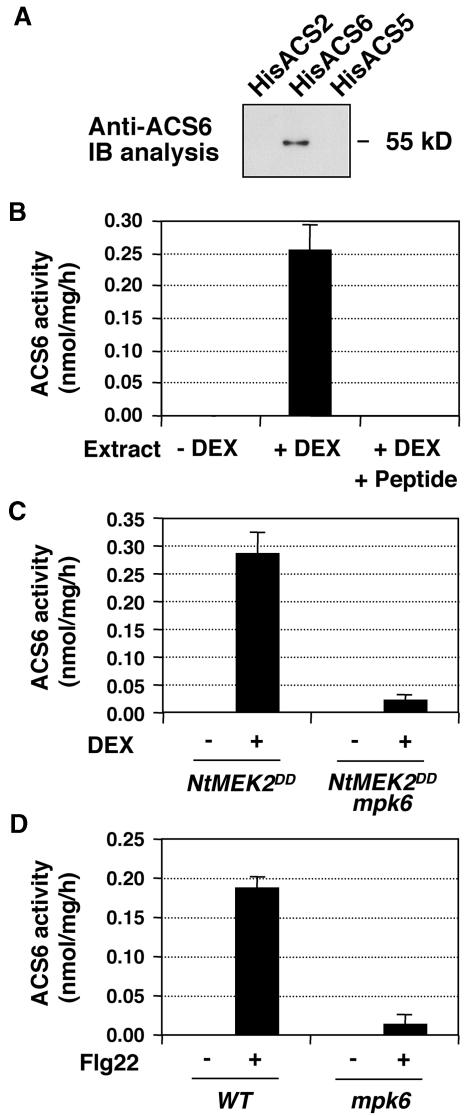
Elevated ACS6 Activity in Col-0 Seedlings after Flg22 Treatment or NtMEK2DD Seedlings after DEX Treatment Requires MPK6. (A) Anti-ACS6 raised against the C-terminal peptide of ACS6 specifically recognized the ACS6 protein. Five nanograms each of recombinant HisACS2, HisACS6, and HisACS5 were subjected to immunoblot (IB) analysis with anti-ACS6. After incubation with a horseradish peroxidase–conjugated secondary antibody, the complex was visualized. (B) Increase in ACS6 activity after MPK6 activation in NtMEK2DD plants. ACS6 activity in NtMEK2DD transgenic plants before and after DEX treatment (final concentration of 2 μM for 6 h) was determined by the immune complex ACS assay using an ACS6-specific antibody. The specificity of the assay was assessed by the addition of peptide (6 μg/mL), to which the antibody was raised. Error bars indicate standard deviation (n = 3). (C) MPK6 is required for the induction of ACS6 activity in NtMEK2DD plants after DEX treatment. Total protein extracts were prepared from NtMEK2DD and NtMEK2DD/mpk6 seedlings without DEX treatment (−) or treated with DEX for 6 h (+). ACS6 activity was determined by the immune complex ACS assay using an ACS6-specific antibody. (D) MPK6 is required for the induction of ACS6 activity in wild-type seedlings treated with Flg22. Total protein extracts were prepared from wild-type and mpk6 mutant seedlings without Flg22 treatment (−) or treated with 0.2 μM of Flg22 for 1 h (+). ACS6 activity was determined by the immune complex ACS assay using ACS6-specific antibody.
Figure 4.
Figure 4.
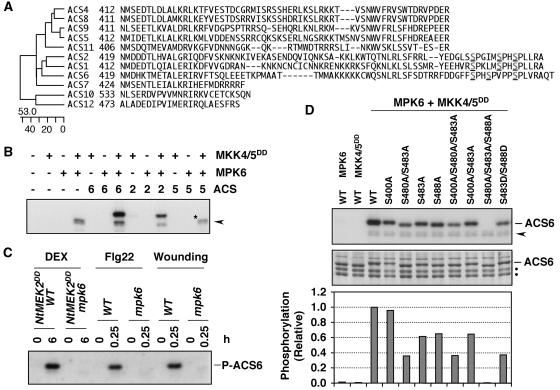
Phosphorylation of ACS2 and ACS6 by MPK6. (A) One group of Arabidopsis ACS isoforms represented by ACS1, ACS2, and ACS6 contains conserved MAPK phosphorylation sites (underlined) at their C termini. (B) Phosphorylation of recombinant ACS2 and ACS6 by MPK6 in vitro. Recombinant MPK6 was first activated as described in Methods. Active MPK6 was then used to phosphorylate His-tagged ACS2, ACS5, and ACS6 in the presence of [γ-32P]ATP. After electrophoresis, the phosphorylated proteins were visualized by autoradiography. Reactions with various components omitted (−) were used as controls. The lower band (indicated by an arrowhead) was a result of phosphorylation of MPK6 by MKK4DD/MKK5DD. The asterisk indicates the position of ACS5 protein. (C) Phosphorylation of ACS6 by native MPK6. ACS6 phosphorylation activity in extracts from NtMEK2DD Arabidopsis after DEX treatment (2 μM for 6 h) or nontransgenic plants after Flg22 (0.2 μM for 0.25 h) or wounding treatment (0.25 h) in both wild-type and mpk6 mutant backgrounds was determined by an in-gel kinase assay with recombinant ACS6 as the embedded substrate. (D) S480, S483, and S488 at the C terminus of ACS6 are three independent MPK6 phosphorylation sites. Phosphorylation of ACS6 proteins with single, double, and triple mutations by MPK6 was performed as in (B). The levels of phosphorylation were quantitated using a Fuji Film FLA-5000 imaging system (top). The lower band (indicated by an arrowhead) was the phosphorylated MPK6 as in (B). After being normalized to the amount of proteins as determined by Coomassie blue staining (middle), the relative levels of phosphorylation were plotted (bottom). Dots indicate the partially degraded ACS6 with the phosphorylation sites missing.
Figure 5.
Figure 5.
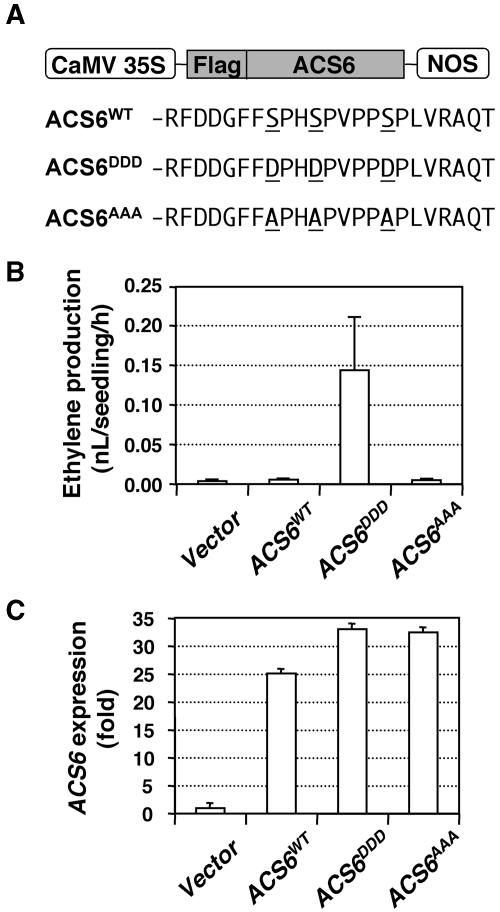
Gain-of-Function ACS6DDD Transgenic Seedlings Constitutively Overproduce Ethylene. (A) ACS6 constructs used for transformation. The C-terminal sequences of ACS6 and its mutants are shown. MPK6 phosphorylation sites and mutated amino acid residues are underlined. CaMV 35S, 35S promoter of Cauliflower mosaic virus. (B) Gain-of-function ACS6DDD transgenic seedlings constitutively overproduce ethylene. After selection on kanamycin plates, T1 transgenic seedlings were transferred to 50-mL GC vials with 6 mL of medium (20 seedlings/vial). When the seedlings were 12 d old, the GC vials were flushed and capped. Ethylene levels in the headspace were determined 24 h later. Error bars indicate standard deviation (n = 6). (C) Transgene expression in pooled T1 ACS6WT, ACS6DDD, and ACS6AAA seedlings is similar. The levels of ACS6 mRNA (endogenous plus transgene) in pooled seedlings (>100) from (A) were determined by quantitative RT-PCR, which were normalized to that in vector control transgenic seedlings. Error bars indicate standard deviation (n = 3).
Figure 6.
Figure 6.
Phosphorylation of ACS6 by MPK6 Results in the Accumulation of ACS6 Protein and the Increase in Cellular ACS Activity. (A) Elevated levels of ACS6 activity and protein in ACS6DDD plants and ACS6WT plants after Flg22 treatment. The activity of Flag-tagged ACS6 and its mutants in protein extracts prepared from pooled seedlings before and after Flg22 treatment was determined by the anti-Flag immune complex ACS assay. Error bars indicate standard deviation (n = 3). ACS6 protein was detected by coupled immunoprecipitation and immunoblot analysis. Anti-Flag antibody and anti-ACS6 antibody were used for immunoprecipitation and immunoblot analysis, respectively. (B) Elevated levels of ACS6 activity and protein in ACS6DDD plants and ACS6WT plants in NtMEK2DD transgenic background before and after DEX treatment. The activity of Flag-tagged ACS6 and its mutants in protein extracts prepared from pooled seedlings in NtMEK2DD transgenic background before and after DEX treatment was determined by immune complex ACS assay using anti-Flag antibody. Error bars indicate standard deviation (n = 3). ACS6 protein was detected by coupled immunoprecipitation and immunoblot analysis as in (A).
Figure 7.
Figure 7.
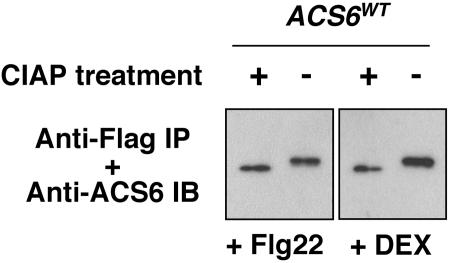
Phosphatase Treatment Reverses the Upshift of ACS6WT Protein from Seedlings after MPK6 Activation. Flag-tagged ACS6WT protein was immunoprecipitated from ACS6WT transgenic seedlings treated with DEX (in NtMEK2DD background) or Flg22 (in Col-0 background). Half of the immune complex was treated with calf intestinal alkaline phosphatase (CIAP), which was then resolved in a 10% SDS-polyacryamide gel along with the untreated portion. The ACS6WT protein was detected by immunoblot analysis using an ACS6-specific antibody.
Figure 8.
Figure 8.
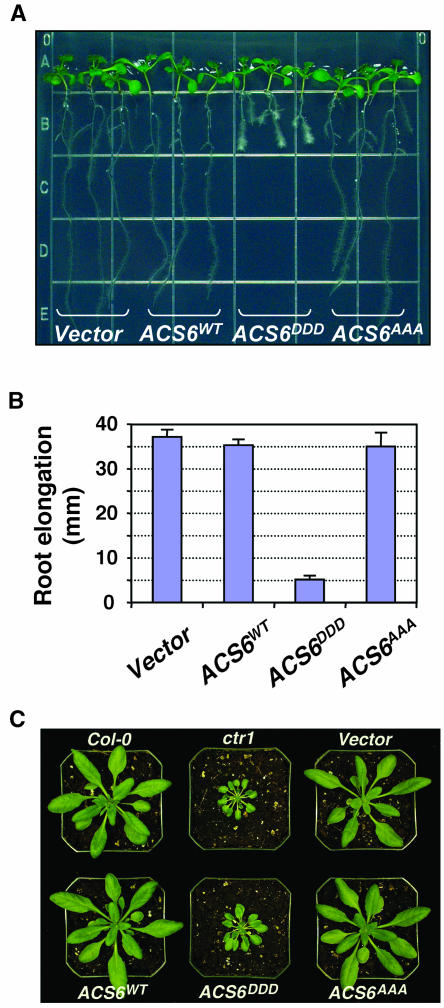
Ethylene-Induced Morphology in Gain-of-Function ACS6DDD Transgenic Plants. (A) Hairy root phenotype of ACS6DDD transgenic seedlings. (B) Reduced root elongation of ACS6DDD transgenic seedlings. Error bars indicate standard deviation (n = 12). (C) Soil-grown ACS6DDD transgenic plants showed a ctr1-like phenotype.
Figure 9.
Figure 9.
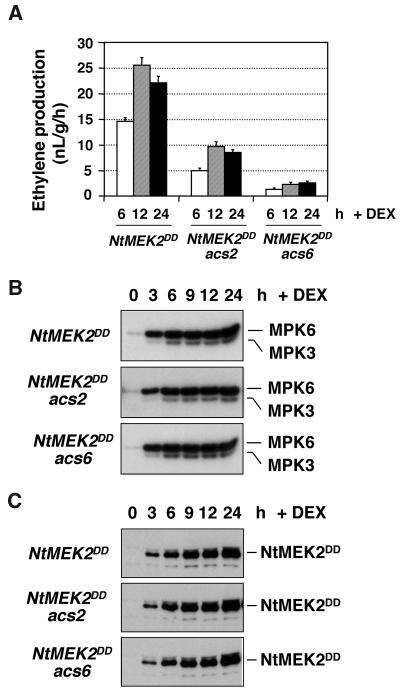
ACS2 and ACS6 Are Required for High-Level Induction of Ethylene Biosynthesis in NtMEK2DD Plants. (A) Ethylene production in NtMEK2DD, NtMEK2DD/acs2, and NtMEK2DD/acs6 seedlings after DEX treatment. Twelve-day-old homozygous F3 seedlings grown in 50-mL GC vials were treated with DEX (2 μM). Ethylene levels in the headspace were determined at various times. (B) MAPK activation in NtMEK2DD, NtMEK2DD/acs2, and NtMEK2DD/acs6 seedlings after DEX treatment as determined by in-gel kinase assay using MBP as a substrate. (C) NtMEK2DD induction in NtMEK2DD, NtMEK2DD/acs2, and NtMEK2DD/acs6 seedlings as determined by immunoblot analysis.
Figure 10.
Figure 10.
Mutation in MPK6 Only Partially Blocks Flg22-Induced Ethylene Production. (A) Two-week-old wild-type (closed circles) and mpk6 (open circles) seedlings grown in 50-mL GC vials were treated with Flg22 (0.2 μM). Ethylene levels in the headspace were determined at various times. (B) MAPK activation in wild-type and mpk6 mutant seedlings treated with Flg22. Two-week-old wild-type and mpk6 seedlings grown in 50-mL GC vials were treated with Flg22 (0.2 μM), and samples were taken at various times. MAPK activity in the total protein extracts was determined by in-gel kinase assay using MBP as a substrate.
Figure 11.
Figure 11.
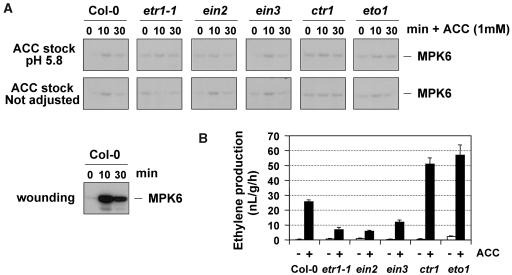
No Significant MPK6 Activation Was Observed in Arabidopsis Seedlings Treated with ACC. (A) Two-week-old wild-type and mutant seedlings grown in 50-mL GC vials were treated with ACC (1 mM final concentration). The pH of ACC stock solutions was either adjusted to 5.8 or unadjusted. Samples were taken before the addition of ACC (0 min) and 10 and 30 min after the addition of ACC. Wounding treated samples were used as positive controls. MAPK activity in the total protein extracts was determined by in-gel kinase assay using MBP as a substrate. (B) Ethylene production in Arabidopsis seedlings in the absence and presence of exogenous ACC. Two-week-old Arabidopsis seedlings grown in 50-mL GC vials were treated with 1 mM ACC (+) or an equal volume of water (−) as controls. The vials were flushed and then capped. Ethylene levels in the headspace were determined after 1 h for vials received ACC or after 24 h for vials received no ACC. Error bars indicate standard deviation (n = 3).
Figure 12.
Figure 12.
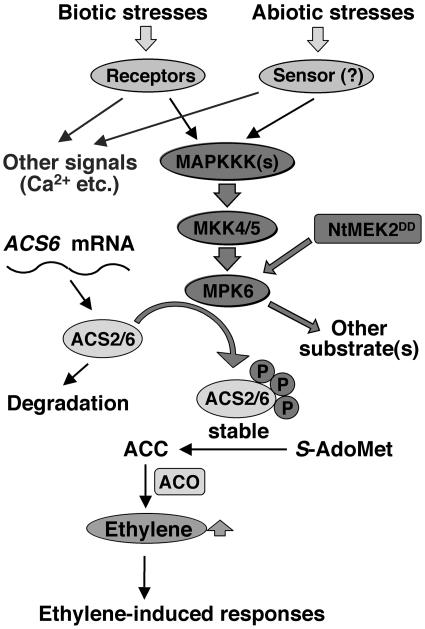
A Model Depicts the Role of MPK6 Cascade in Stress-Induced Ethylene Production.

References

    1. Abeles, F.B., Morgan, P.W., and Saltveit, M.E.J. (1992). Ethylene in Plant Biology. (San Diego: Academic Press).
    1. Alonso, J.M., et al. (2003). Genome-wide insertional mutagenesis of Arabidopsis thaliana. Science 301, 653–657. - PubMed
    1. Aoyama, T., and Chua, N.-H. (1997). A glucocorticoid-mediated mediated transcriptional induction system in transgenic plants. Plant J. 11, 605–612. - PubMed
    1. Asai, T., Tena, G., Plotnikova, J., Willmann, M.R., Chiu, W.-L., Gomez-Gomez, L., Boller, T., Ausubel, F.M., and Sheen, J. (2002). MAP kinase signalling cascade in Arabidopsis innate immunity. Nature 415, 977–983. - PubMed
    1. Bleecker, A.B., and Kende, H. (2000). Ethylene: A gaseous signal molecule in plants. Annu. Rev. Cell Dev. Biol. 16, 1–18. - PubMed

Publication types

MeSH terms