. 2004 Dec;24(23):10381-9.
doi: 10.1128/MCB.24.23.10381-10389.2004.

The mouse genomic instability mutation chaos1 is an allele of Polq that exhibits genetic interaction with Atm

Affiliations

The mouse genomic instability mutation chaos1 is an allele of Polq that exhibits genetic interaction with Atm

Naoko Shima et al. Mol Cell Biol. 2004 Dec.

Abstract

chaos1 (for chromosome aberrations occurring spontaneously 1) is a recessive mutation that was originally identified in a phenotype-based screen for chromosome instability mutants in mice. Mutant animals exhibit significantly higher frequencies of spontaneous and radiation- or mitomycin C-induced micronucleated erythrocytes, indicating a potential defect in homologous recombination or interstrand cross-link repair. The chaos1 allele was genetically associated with a missense mutation in Polq, which encodes DNA polymerase theta;. We demonstrate here that chaos1 is a mutant allele of Polq by using two genetic approaches: chaos1 mutant phenotype correction by a bacterial artificial chromosome carrying wild-type Polq and a failed complementation test between chaos1 and a Polq-disrupted allele generated by gene targeting. To investigate the potential involvement of Polq in DNA double-strand break repair, we introduced chaos1 into an Atm (for ataxia telangiectasia mutated)-deficient background. The majority ( approximately 90%) of double-homozygous mice died during the neonatal period. Surviving double mutants exhibited synergistic phenotypes such as severe growth retardation and enhanced chromosome instability. However, remarkably, double mutants had delayed onset of thymic lymphoma, significantly increasing life span. These data suggest a unique role of Polq in maintaining genomic integrity, which is probably distinctive from the major homologous recombination pathway regulated by ATM.


Figures
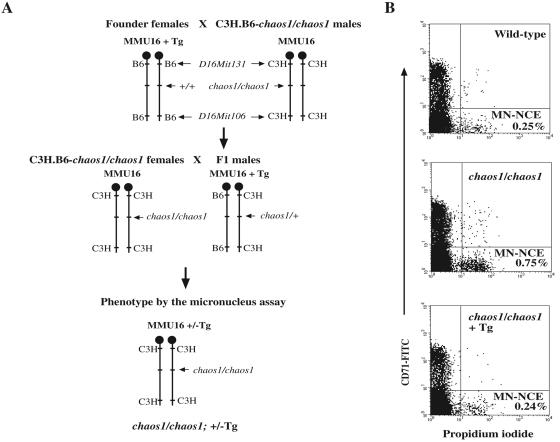
FIG. 1.
FIG. 1.
Phenotype rescue by BAC transgene (Tg). (A) BAC transgenic founder females (generated in B6 background) were outcrossed to C3H.B6-chaos1/chaos1 males (N10F1) in which the chaos1 allele had been introduced into C3H genome by backcrossing nine generations. This was necessary to identify chromosome 16 that carries the chaos1 allele. Resulting F1 males carrying the BAC transgene were mated with C3H.B6-chaos1/chaos1 females. Among their offspring, chaos1/chaos1 mice were identified as those homozygous for the C3H alleles of the two polymorphic microsatellite markers D16Mit131 (proximal) and D16Mit106 (distal). chaos1/chaos1 mice (+/−Tg) were phenotyped by the micronucleus assay. (B) Spontaneous micronucleus frequencies were measured in CD71-negative normochromatic erythrocytes (NCE; lower quadrants of the plots). Micronucleated erythrocytes (MN-NCE) are in the population positive to propidium iodide (lower right quadrant). Anti-CD71 antibody was used to separate reticulocytes (younger erythrocytes) containing significant amounts of RNA, which potentially interferes with accurate enumeration of micronuclei in NCE. The transgene carriers show a normal range of micronucleus frequencies as comparable to those seen in wild-type mice, whereas chaos1/chaos1 mice exhibited significantly higher micronucleus frequencies, indicating complete phenotype correction. At least 10,000 erythrocytes were collected.
FIG. 2.
FIG. 2.
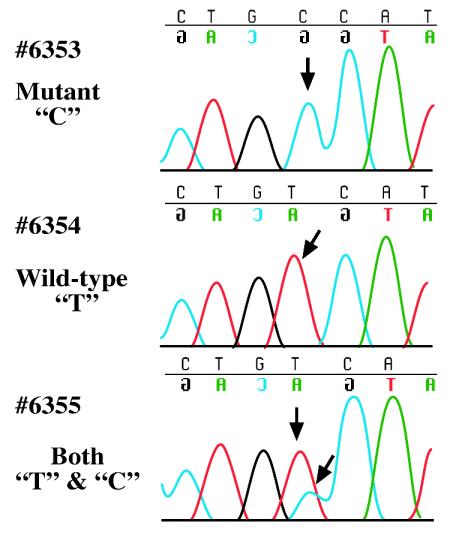
BAC transgene expression is correlated with phenotype rescue. Shown are sequence traces of Polq peripheral blood cDNA from the indicated transgenes in chaos1/chaos1 background. Arrows show the mutated residue in the chaos1 allele. Although cDNA from the rescuing transgene lines 6354 and 6355 contained wild-type “T”; only mutant “C” was observed in the nonrescuing line 6353.
FIG. 3.
FIG. 3.
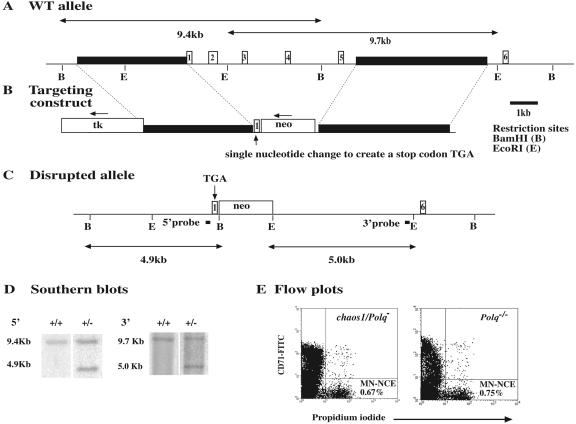
Polq gene targeting strategy. (A) Schematic representation of a part of the genomic Polq locus. The first six exons are indicated as boxes with numbers. Locations of selected restriction sites are shown. (B) The targeting construct was designed to replace exons 2 to 5 with a neomycin resistance gene (neo) by homologous recombination. Solid rectangles represent genomic sequences used for each arm, one of which contains a part of exon 1 modified to contain a premature stop codon (TGA). The position of the negatively selectable marker thymidine kinase (tk) is also shown. Small arrows indicate the direction of transcription. (C) The disrupted allele lacks exons 2 to 5 and contains modified exon1 with a stop codon just after the initiation codon. (D) Southern blot analysis of correctly targeted ES cell clones, in which the expected sizes of BamHI (left) and EcoRI (right) fragments were detected by the probes indicated in panel C. (E) Representative flow plots of micronucleus assays on chaos1/Polq mice and Polq−/− mice. Spontaneous micronuclei in CD71-negative normochromatic erythrocytes were detected by propidium iodide.
FIG. 4.
FIG. 4.
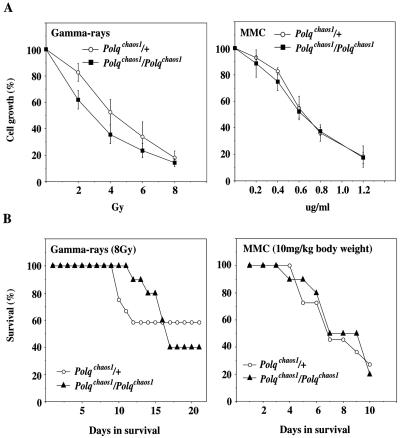
Polqchaos1/Polqchaos1 cells and animals exhibit no hypersensitivities to radiation or MMC. (A) Relative growth of MEFs 5 days after gamma-ray or MMC treatment. Each point is shown with the standard deviation. Experiments were replicated at least twice by using independent MEF lines derived from different animals. (B) Survival curves after whole-body exposure to 8 Gy gamma rays (1.35 Gy/min) or a single intraperitoneal injection of MMC (10 mg/kg [body weight]). Mice were monitored daily after the treatment. If mice showed any signs of being moribund, they were immediately euthanized.
FIG. 5.
FIG. 5.
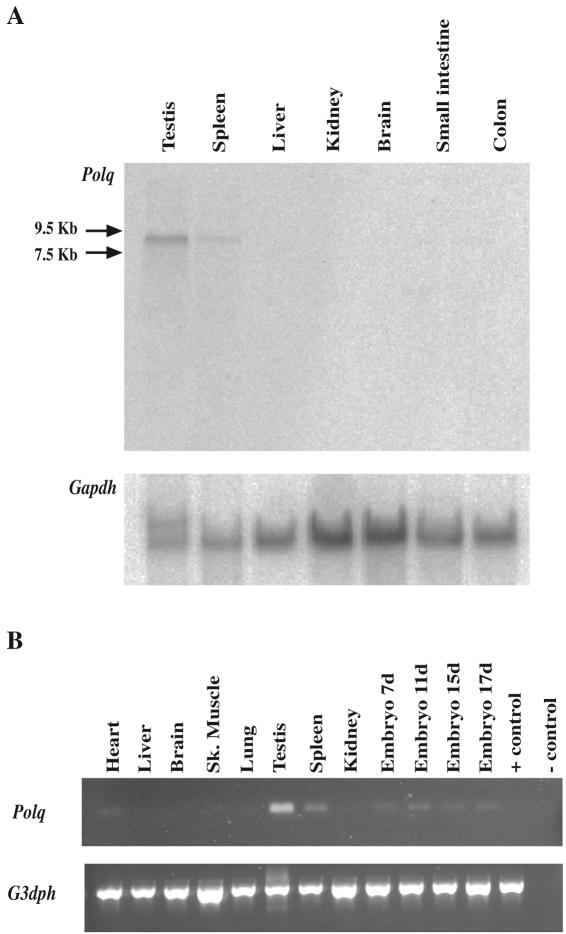
Expression of Polq in mouse tissues. (A) Northern hybridization analysis. Polq expression was detectable only after exposure of a FUJI imaging plate (overnight) to the blot that contains ca. 20 μg of total RNA, whereas the control Gadph expression was clearly detected after only 4 h of exposure. (B) Semiquantitative PCR on normalized cDNA from different tissues. Positive/negative (+/−) controls indicate PCR on control cDNA provided by the manufacturer and on the sample without reverse transcription, respectively. PCR was performed by using Polq or G3dph primers as indicated.
FIG. 6.
FIG. 6.
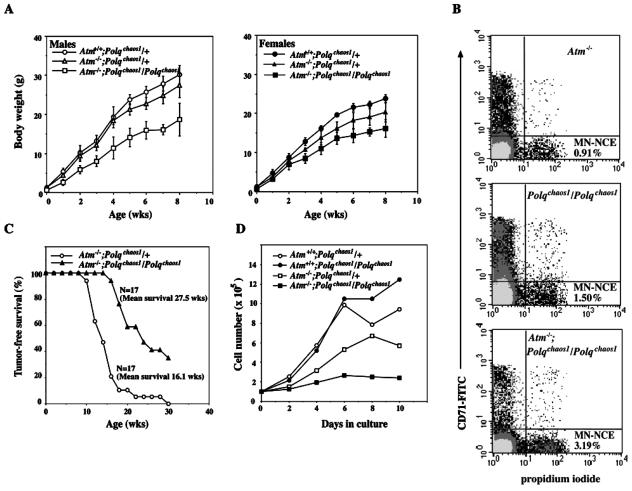
Synergistic phenotypes observed in Atm/Polqchaos1 double homozygotes. (A) Growth curves of males (left) and females (right) with indicated genotypes. Each point represents at least five animals and is shown with the standard deviation. (B) Enhanced spontaneous micronucleus formation in Atm/Polqchaos1 double homozygotes. Micronuclei in CD71-negative erythrocytes were detected by propidium iodide. (C) The Polqchaos1 mutation significantly delays development of thymic lymphoma in Atm-deficient mice (P < 0.0005, t test). (D) Cell growth of MEFs. Atm/Polqchaos1 double homozygous cell show severely impaired proliferation. Each point is shown with the standard deviation. Experiments were replicated at least once by using two independent MEF lines.

References

    1. Abraham, R. T. 2001. Cell cycle checkpoint signaling through the ATM and ATR kinases. Genes Dev. 15:2177-2196. - PubMed
    1. Alizadeh, A. A., M. B. Eisen, R. E. Davis, C. Ma, I. S. Lossos, A. Rosenwald, J. C. Boldrick, H. Sabet, T. Tran, X. Yu, J. I. Powell, L. Yang, G. E. Marti, T. Moore, J. J. Hudson, L. Lu, D. B. Lewis, R. Tibshirani, G. Sherlock, W. C. Chan, T. C. Greiner, D. D. Weisenburger, J. O. Armitage, R. Warnke, R. Levy, W. Wilson, M. R. Grever, J. C. Byrd, D. Botstein, P. O. Brown, and L. M. Staudt. 2000. Distinct types of diffuse large B-cell lymphoma identified by gene expression profiling. Nature 403:503-511. - PubMed
    1. Balling, R. 2001. ENU mutagenesis: analyzing gene function in mice. Annu. Rev. Genomics Hum. Genet. 2:463-492. - PubMed
    1. Barlow, C., S. Hirotsune, R. Paylor, M. Liyanage, M. Eckhaus, F. Collins, Y. Shiloh, J. N. Crawley, T. Ried, D. Tagle, and A. Wynshaw-Boris. 1996. Atm-deficient mice: a paradigm of ataxia telangiectasia. Cell 86:159-171. - PubMed
    1. Boyd, J. B., K. Sakaguchi, and P. V. Harris. 1990. mus308 mutants of Drosophila exhibit hypersensitivity to DNA cross-linking agents and are defective in a deoxyribonuclease. Genetics 125:813-819. - PMC - PubMed

Publication types

MeSH terms