. 2004 Nov 23;101(47):16483-8.
doi: 10.1073/pnas.0407474101. Epub 2004 Nov 15.

The role of the glycocalyx in reorganization of the actin cytoskeleton under fluid shear stress: a "bumper-car" model

Affiliations

The role of the glycocalyx in reorganization of the actin cytoskeleton under fluid shear stress: a "bumper-car" model

Mia M Thi et al. Proc Natl Acad Sci U S A. .

Abstract

We propose a conceptual model for the cytoskeletal organization of endothelial cells (ECs) based on a major dichotomy in structure and function at basal and apical aspects of the cells. Intracellular distributions of filamentous actin (F-actin), vinculin, paxillin, ZO-1, and Cx43 were analyzed from confocal micrographs of rat fat-pad ECs after 5 h of shear stress. With intact glycocalyx, there was severe disruption of the dense peripheral actin bands (DPABs) and migration of vinculin to cell borders under a uniform shear stress (10.5 dyne/cm2; 1 dyne = 10 microN). This behavior was augmented in corner flow regions of the flow chamber where high shear stress gradients were present. In striking contrast, no such reorganization was observed if the glycocalyx was compromised. These results are explained in terms of a "bumper-car" model, in which the actin cortical web and DPAB are only loosely connected to basal attachment sites, allowing for two distinct cellular signaling pathways in response to fluid shear stress, one transmitted by glycocalyx core proteins as a torque that acts on the actin cortical web (ACW) and DPAB, and the other emanating from focal adhesions and stress fibers at the basal and apical membranes of the cell.


Figures

Fig. 1.
Fig. 1.
Confocal analysis of cell surface HSPG in the EG layer. Cells were cultured in DMEM with (A) and without (B) 10% FBS for 5 h, with 15 milliunits/ml heparinase III (Hep III) (C) for 2 h, and postcultured in DMEM + 1% BSA for 5 h (graph). To visualize cell-surface HSPG, cells were stained with primary antibody for HSPG (green) and with CellTracker orange dye. XZ views from the highlighted boxes of various control conditions show different degrees of cell surface HSPG distributions. Expression of HSPG was quantified and plotted by using scion image (Scion, Frederick, MD). Eight images per experiment, for a total of four experiments, were taken for each treatment condition. All data are presented as mean ± SEM, n = 32 (*, P < 0.05). (Bar, 20 μm.)
Fig. 2.
Fig. 2.
Reorganization of EC cytoskeleton and FAs in response to fluid shear stress with various flow media. Cells were exposed to USS of 10.5 dyne/cm2 and HSSG of 0 ≈ 2,500 dyne/cm2 per cm for 5 h. Effects of USS and HSSG on distribution of F-actin (A) and vinculin (B) were analyzed by using confocal microscopy. Overall average protein-density profiles from stacked images of different treatments were plotted by using scion image. Changes in the distributions of F-actin and vinculin were detected by using kurtosis analysis. Four images per experiment, for a total of four experiments, were taken from USS and HSSG regions. All data are presented as mean ± SEM, n = 160 (*, P < 0.05). Flow direction, arrows; transverse SFs, thin arrows; redistribution of F-actin (A) and vinculin (B), arrowheads; HepIII, heparinase III. (Bar, 20 μm.)
Fig. 3.
Fig. 3.
Junctional adaptation of EC in response to fluid shear stress with various flow media. Cells were exposed to USS of 10.5 dyne/cm2 and HSSG of 0 ≈ 2,500 dyne/cm2 per cm for 5 h. Effects of USS and HSSG on the distribution of ZO-1 (A) and Cx43 (B) were analyzed by using confocal microscopy. Overall average protein density profiles from stacked images of different treatments were plotted by using scion image. Disruption and distribution of ZO-1 and Cx43 were detected by using kurtosis analysis. Four images per experiment, for a total of four experiments, were taken from USS and HSSG regions. All data are presented as mean ± SEM, n = 160 (*, P < 0.05). Flow direction, arrow; perinuclear Cx43, thin arrows; disruption of ZO-1 (A) and Cx43 (B) at cell–cell borders, arrowheads. HepIII, heparinase III. (Bar, 20 μm.)
Fig. 4.
Fig. 4.
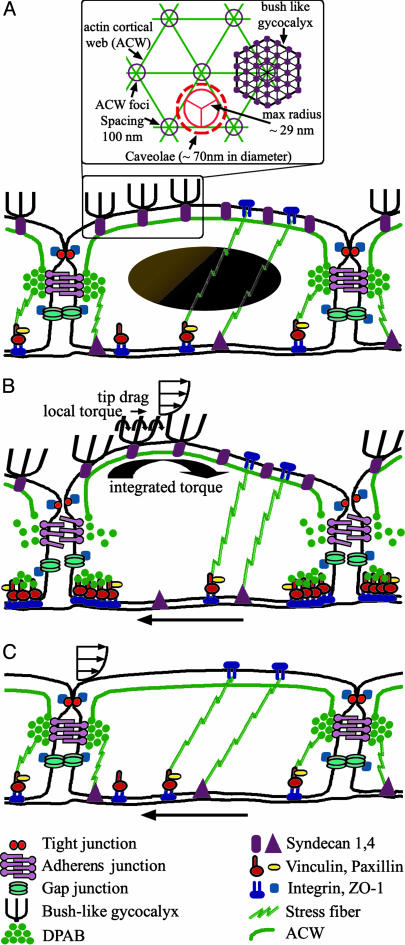
A conceptual bumper-car model for the structural organization of the EC in response to fluid shear stress. In its confluent control state (A), ECs display an intact DPAB that is localized to the adherens junction, where it serves as the base for the ACW that we hypothesize is the underlying cortical scaffold for the entire apical surface. The ACW is invisible in immunofluorescence studies, because it is comprised of a geodesic-like network of individual actin filaments in contrast to SFs and the DPAB, which are bundles of hundreds of α-actinin crosslinked antiparallel microfilaments. The polygonal nature of the ACW was first reported in optical tweezer experiments (30). Recent freeze-fracture EMs by Squire et al. (13) in regions close to the plasmalemma have revealed a highly ordered hexagonal lattice with a characteristic spacing of 100 nm between junctional nodes (Inset). Schematic diagrams show adaptation steps for confluent ECs predicted by the bumper-car model for intact (B) and compromised (C) EG in response to fluid shear stress; see text for detailed discussion.

References

    1. Davies, P. F. (1995) Physiol. Rev. 75, 519–560. - PMC - PubMed
    1. Ogunrinade, O., Kameya, G. T. & Truskey, G. A. (2002) Ann. Biomed. Eng 30, 430–446. - PubMed
    1. Tarbell, J. M. (2003) Annu. Rev. Biomed. Eng. 5, 79–118. - PubMed
    1. Vink, H. & Duling, B. R. (1996) Circ. Res. 79, 581–589. - PubMed
    1. Hu, X. & Weinbaum, S. (1999) Microvasc. Res. 58, 281–304. - PubMed

Publication types

LinkOut - more resources