. 2004 Dec;16(12):3413-25.
doi: 10.1105/tpc.104.023622. Epub 2004 Nov 17.

The role of [Delta]1-pyrroline-5-carboxylate dehydrogenase in proline degradation

Affiliations

The role of [Delta]1-pyrroline-5-carboxylate dehydrogenase in proline degradation

Karen Deuschle et al. Plant Cell. 2004 Dec.

Abstract

In response to stress, plants accumulate Pro, requiring degradation after release from adverse conditions. Delta1-Pyrroline-5-carboxylate dehydrogenase (P5CDH), the second enzyme for Pro degradation, is encoded by a single gene expressed ubiquitously. To study the physiological function of P5CDH, T-DNA insertion mutants in AtP5CDH were isolated and characterized. Although Pro degradation was undetectable in p5cdh mutants, neither increased Pro levels nor an altered growth phenotype were observed under normal conditions. Thus AtP5CDH is essential for Pro degradation but not required for vegetative plant growth. External Pro application caused programmed cell death, with callose deposition, reactive oxygen species production, and DNA laddering, involving a salicylic acid signal transduction pathway. p5cdh mutants were hypersensitive toward Pro and other molecules producing P5C, such as Arg and Orn. Pro levels were the same in the wild type and mutants, but P5C was detectable only in p5cdh mutants, indicating that P5C accumulation may be the cause for Pro hypersensitivity. Accordingly, overexpression of AtP5CDH resulted in decreased sensitivity to externally supplied Pro. Thus, Pro and P5C/Glu semialdehyde may serve as a link between stress responses and cell death.


Figures
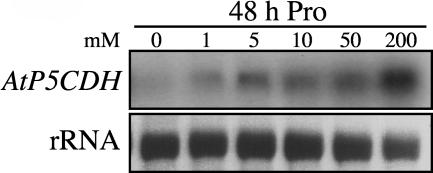
Figure 1.
Figure 1.
Induction of AtP5CDH Expression by Pro. Gel blot analysis of RNA extracted from 3-week-old Arabidopsis plants 48 h after transfer to liquid MS medium with Pro. Equal amounts of total RNA were loaded in each lane (13 μg).
Figure 2.
Figure 2.
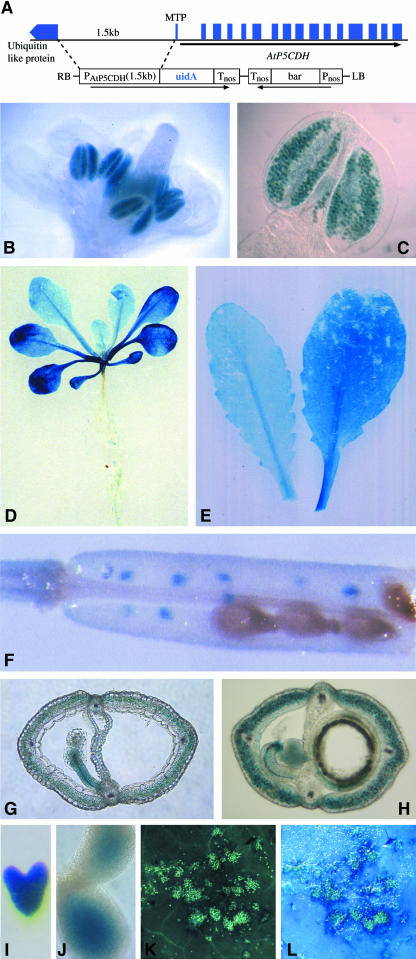
AtP5CDH Is Strongly Expressed in Pollen and Tissue Undergoing Cell Death. (A) Construct used for AtP5CDH promoter analysis. Including the translation initiation codon, 1.5 kb of 5′-upstream sequence was fused to uidA, and GUS expression was monitored in transgenic Arabidopsis plants carrying the fusion construct. LB, left border; RB, right border. (B) and (C) GUS expression in developing and mature pollen grains. (D) Three-week-old seedling showing GUS expression in senescing cotyledons. (E) Rosette leaves of soil-grown plants. (F) Silique with aborted seeds. (G) and (H) Silique cross sections showing staining in funiculi and silique coat. (I) and (J) Stained embryos. (K) and (L) Autofluorescent lesions caused by spraying with Pro. (L) Overlay of (K) with induced GUS expression.
Figure 3.
Figure 3.
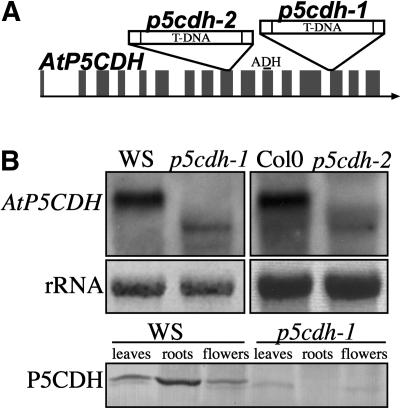
T-DNA Insertions in AtP5CDH. From the Wisconsin and Salk collections, two Arabidopsis lines carrying single T-DNA insertions in the 13th (p5cdh-1) and 9th (p5cdh-2) exons of AtP5CDH, respectively, were identified. The aldehyde dehydrogenase domain (ADH) of AtP5CDH is completely encoded by the 11th exon. (A) Schematic illustration of T-DNA insertion sites in the mutant lines p5cdh-1 and p5cdh-2. (B) RNA gel blot analysis of AtP5CDH transcript in both mutant lines shown on top. Bottom, polyclonal antibodies raised against potato P5CDH cross-reacted with AtP5CDH, but no protein could be detected in extracts of p5cdh-1. A second cross-reacting protein with slightly lower molecular mass was present in both the wild type and mutant, but absent in roots.
Figure 4.
Figure 4.
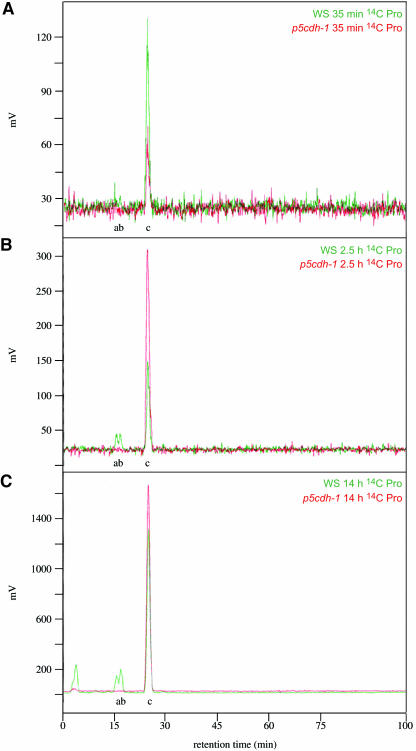
No Labeled Pro Degradation Products Could Be Detected in p5cdh-1 after Feeding with 14C Pro. HPLC analysis of radioactive peaks in p5cdh-1 and the wild type (Wassilewskija) after feeding with 14C-labeled Pro. a, Glu; b, Gln; c, Pro. (A) HPLC chromatograms from leaves after 35 min incubation with 14C Pro. (B) After 2.5 h. (C) After 14 h incubation.
Figure 5.
Figure 5.
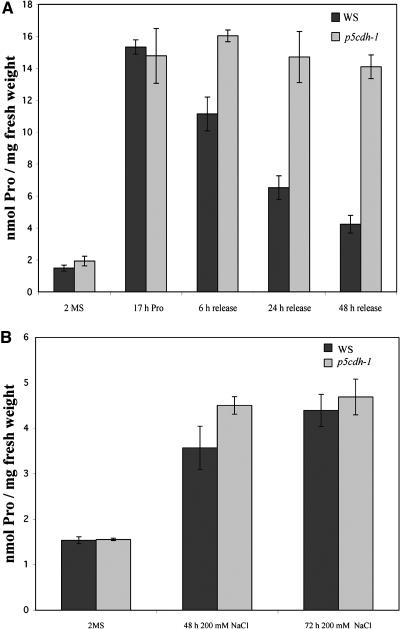
Internal Pro Levels Were Not Increased in p5cdh-1. (A) p5cdh-1 and wild-type plants were grown on solid 2MS (MS supplemented with 60 mM sucrose) medium for 3 weeks, then they were incubated in MS medium supplemented with 100 mM Pro and 60 mM sucrose for 17 h. Pro treatment increased Pro levels in both the mutant and the wild type. Subsequently, plants were rinsed and transferred to MS medium without Pro for the indicated periods of time. Already 6 h after removal of Pro, the Pro levels in wild-type plants decreased, whereas even after 48 h release, Pro levels in the p5cdh-1 mutant were not significantly changed. (B) Plants were precultured as in (A) and transferred to liquid MS supplemented with 200 mM NaCl and 20 mM sucrose. The 72-h NaCl treatment increased Pro levels in the wild type and p5cdh-1 mutant approximately threefold. All values are mean ± sd, n ≥ 3.
Figure 6.
Figure 6.
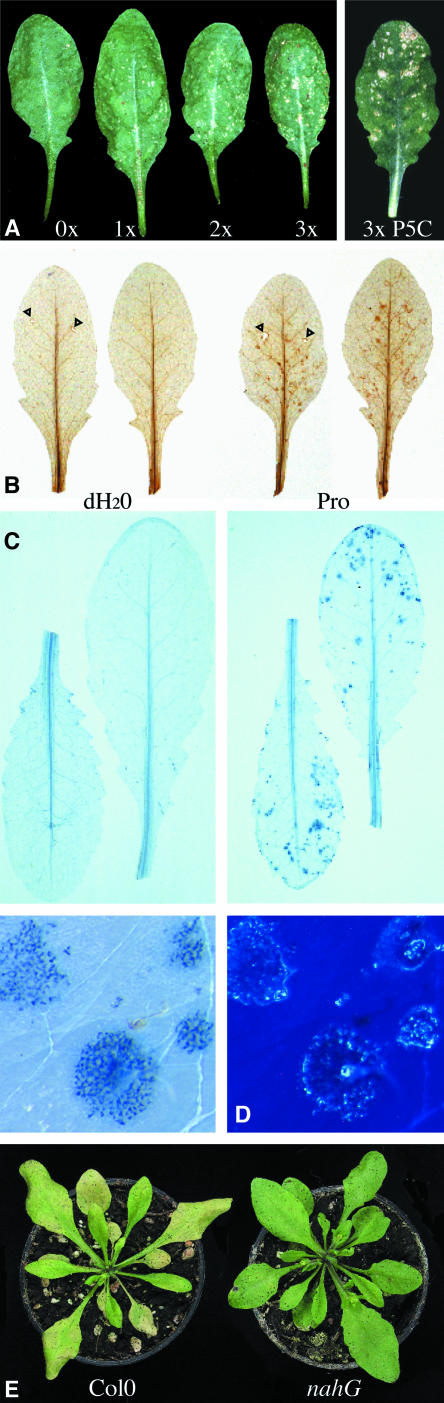
Pro Induces HR-Like Lesions in Arabidopsis. (A) Mature rosette leaves from Arabidopsis were sprayed one to three times with 20 mM Pro or three times with 750 μM P5C. Pictures were taken at the fifth day after the initial spraying. (B) to (E) Leaves were sprayed at three consecutive days with 20 mM Pro. (B) H2O2 detection by DAB staining; arrowheads indicate staining in wounding sites as control. (C) and (D) Staining of dead cells with trypan blue. (D) Formation of callose at sites of Pro-induced cell death is shown as fluorescence after staining with aniline blue. (E) Transgenic plants expressing a bacterial salicylate hydroxylase (NahG) and control plants were sprayed with water (data not shown) or with 20 mM Pro and kept in the dark for 4 d.
Figure 7.
Figure 7.
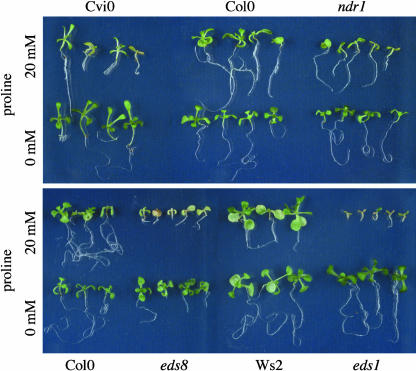
Pro Hypersensitivity of Ecotype Cvi-0 and Pathogen Response Mutants eds1, eds8, and ndr1. Shown are 15-d-old seedlings of Cvi-0, ndr1, eds1, and eds8 and the corresponding wild type grown in the presence or absence of 20 mM Pro.
Figure 8.
Figure 8.
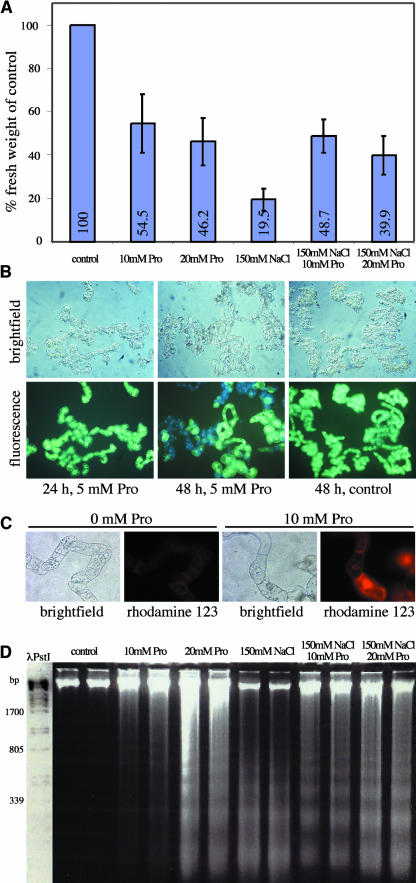
Pro Addition to Tobacco BY-2 Suspension Cultures Causes Symptoms of PCD. (A) Accumulation of biomass in tobacco BY-2 cells 48 h after addition of Pro or NaCl to the growth medium. (B) Viability of BY-2 cells 24 and 48 h after addition of 5 mM Pro. After addition of membrane-permeable fluorescein-diacetate, living cells accumulate green fluorescent fluorescein, and dead cells appear light blue because of autofluorescence. Light microscopy revealed cytoplasmic condensation in BY-2 cells 48 h after addition of Pro. (C) H2O2 production in BY-2 cells treated with 10 mM Pro for 48 h was detected by staining with dihydrorhodamine 123. (D) Nuclear DNA of BY-2 cells showed fragmentation into oligonucleosome fragments after treatment with Pro and/or NaCl for 48 h.
Figure 9.
Figure 9.
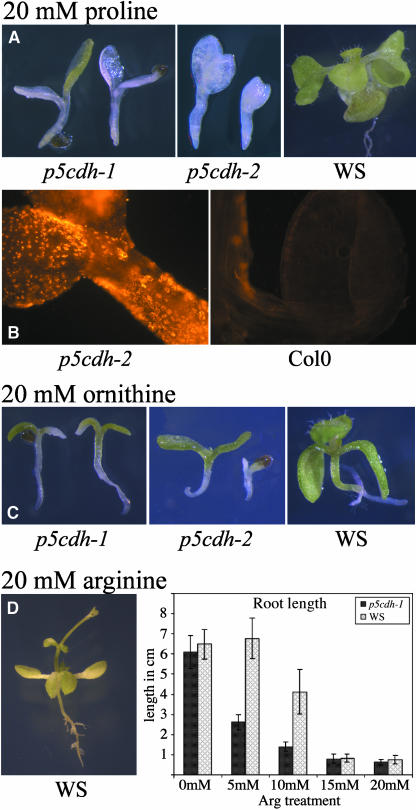
Cell Death Caused by Exogenously Supplied Pro and Other P5C-Producing Substrates in p5cdh Mutants. (A) Both p5cdh mutant lines were arrested in growth in the presence of 20 mM Pro. The mutants did not form roots or true leaves and bleached rapidly, whereas wild-type plants were only mildly affected. (B) Production of ROS in p5cdh-2 seedlings grown on 20 mM Pro, shown by staining with dihydrorhodamine 123. (C) p5cdh mutants are hypersensitive to growth on 20 mM Orn. (D) Growth on 20 mM Arg causes decreased root growth in the wild type and mutants.
Figure 10.
Figure 10.
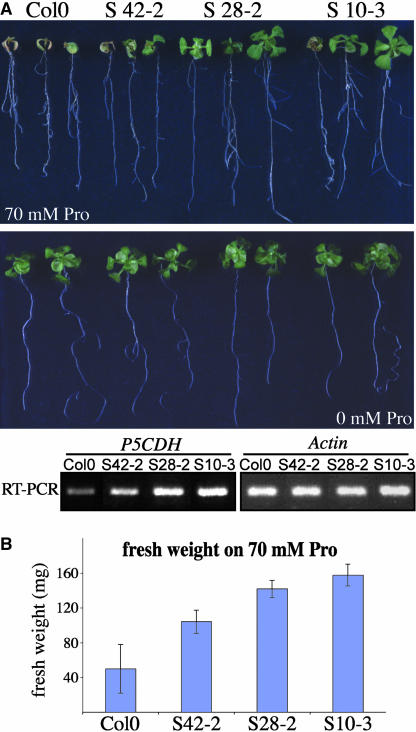
Overexpression of P5CDH Reduces Pro Sensitivity. (A) Arabidopsis lines overexpressing AtP5CDH and corresponding wild-type Col-0 grown on MS medium containing 30 mM sucrose and 0 or 70 mM Pro. (B) Plants were grown on medium containing 30 mM sucrose and 70 mM Pro for 18 d. Fresh weight shown is mean ± SD, n ≥ 3.

References

    1. Alonso, J.M., et al. (2003). Genome-wide insertional mutagenesis of Arabidopsis thaliana. Science 301, 653–657. - PubMed
    1. Ayliffe, M.A., Roberts, J.K., Mitchell, H.J., Zhang, R., Lawrence, G.J., Ellis, J.G., and Pryor, T.J. (2002). A plant gene up-regulated at rust infection sites. Plant Physiol. 129, 169–180. - PMC - PubMed
    1. Bates, L.S., Waldren, R.P., and Teare, I.D. (1973). Rapid determination of free proline for water-stress studies. Plant Soil 39, 205–207.
    1. Bonner, C.A., Williams, D.S., Aldrich, H.C., and Jensen, R.A. (1996). Antagonism by L-glutamine of toxicity and growth inhibition caused by other amino acids in suspension cultures of Nicotiana silvestris. Plant Sci. 113, 43–58.
    1. Bowling, S.A., Guo, A., Cao, H., Gordon, A.S., Klessig, D.F., and Dong, X. (1994). A mutation in Arabidopsis that leads to constitutive expression of systemic acquired resistance. Plant Cell 6, 1845–1857. - PMC - PubMed

Publication types

MeSH terms