


Factors influencing visual acuity after intravitreal triamcinolone acetonide as treatment of exudative age related macular degeneration
- PMID: 15548812
- PMCID: PMC1772424
- DOI: 10.1136/bjo.2003.039552
Factors influencing visual acuity after intravitreal triamcinolone acetonide as treatment of exudative age related macular degeneration
Abstract
Aim: To evaluate factors influencing change in visual acuity (VA) after intravitreal injection of triamcinolone acetonide as treatment of exudative age related macular degeneration (AMD).
Methods: This prospective, interventional, comparative non-randomised clinical case series study included 94 patients (99 eyes) showing progressive exudative AMD with occult (n = 61 eyes), minimally classic (n = 18), predominantly classic (n = 1), or totally classic (n = 8) subfoveal neovascularisation. Mean follow up was 8.5 (SD 4.7) months (median, 7.3 months; range 3.1-24.5 months). All patients received an intravitreal injection of 20-25 mg of triamcinolone acetonide.
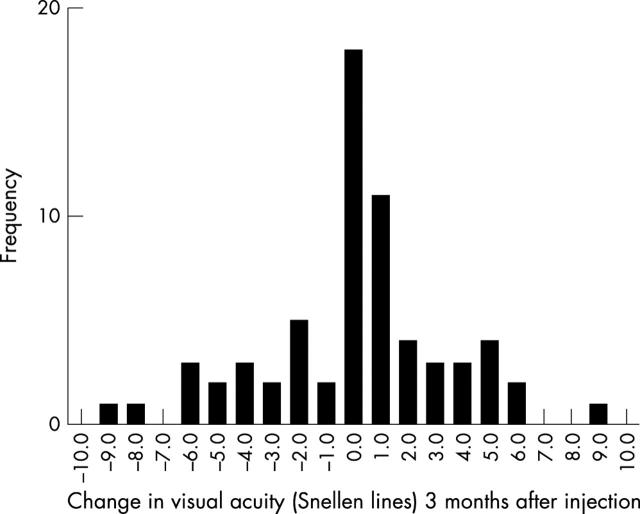
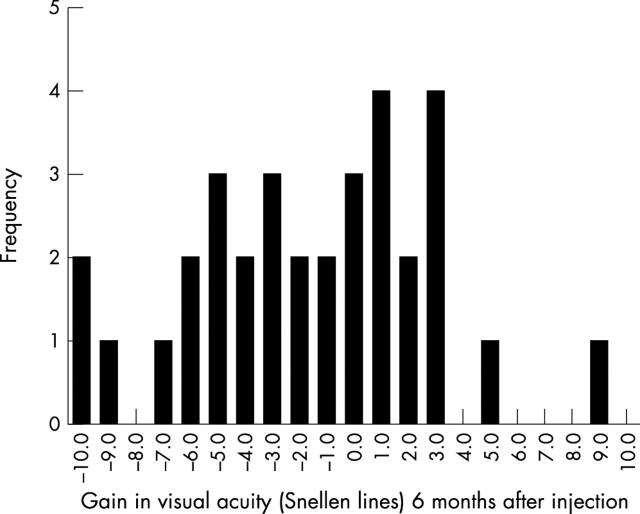
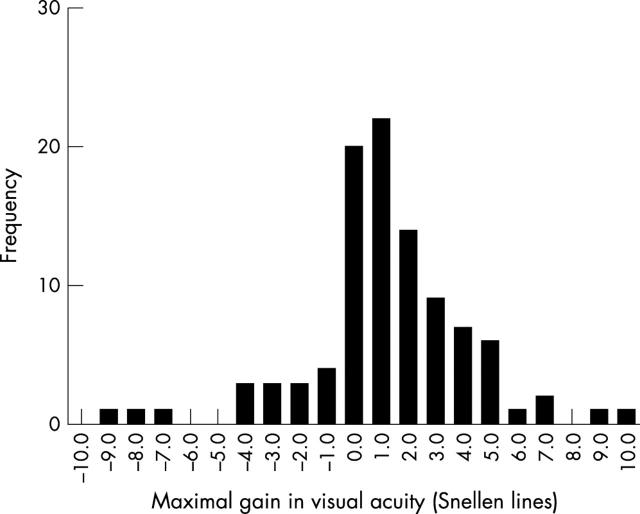
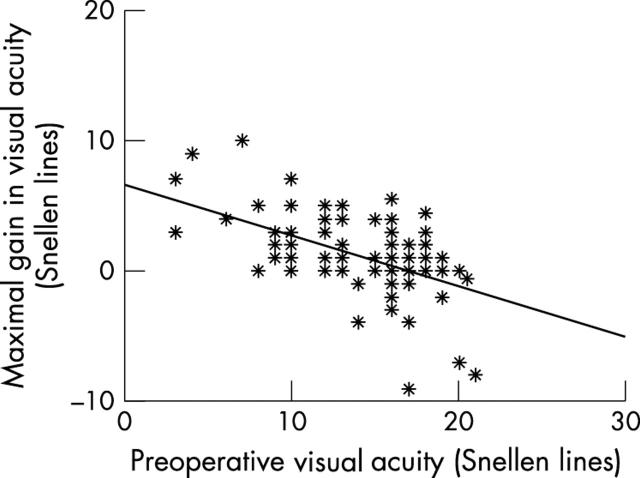
Results: An increase in best VA of at least one line on the Snellen charts was found in 63 (63.1%) eyes. Correspondingly, mean VA increased significantly (p<0.001) from 0.17 (SD 0.13) to 0.22 (SD 0.17) after the injection. Postoperative increase in VA was significantly (p<0.001) and negatively correlated with preoperative VA (correlation coefficient, -0.49). Gain in visual acuity was significantly (p = 0.009) higher if preoperative visual acuity was less than 0.08 (gain: 3.2 (SD 2.9) Snellen lines) than if preoperative VA ranged between 0.08 and 0.20 (gain: 1.2 (SD 2.2) Snellen lines). Change in VA was significantly (p = 0.016) less if preoperative VA was higher than 0.20 (change: -0.8 (SD 3.4) Snellen lines). Maximal gain in VA was significantly (p = 0.035) larger in eyes with retinal pigment epithelium detachment than in eyes with minimally classic subfoveal neovascularisation. This was statistically independent of age (p = 0.99), refractive error (p = 0.88), sex (p = 0.92), and duration of follow up (p = 0.46).
Conclusions: Gain in VA after intravitreal injection of 20-25 mg of triamcinolone acetonide is significantly and negatively correlated with preoperative VA. It is significantly larger in eyes with retinal pigment epithelium detachment than in eyes with minimally classic subfoveal neovascularisation.
Figures
References
-
- Jonas JB, Söfker A. Intraocular injection of crystalline cortisone as adjunctive treatment of diabetic macular oedema. Am J Ophthalmol 2001;132:425–7. - PubMed
-
- Martidis A , Duker JS, Greenberg PB, et al. Intravitreal triamcinolone for refractory diabetic macular edema. Ophthalmology 2002;109:920–7. - PubMed
-
- Jonas JB, Kreissig I, Söfker A, et al. Intravitreal injection of triamcinolone acetonide for diabetic macular edema. Arch Ophthalmol 2003;121:57–61. - PubMed
-
- Jonas JB, Hayler JK, Söfker A, et al. Intravitreal injection of crystalline cortisone as adjunctive treatment of proliferative diabetic retinopathy. Am J Ophthalmol 2001;131:468–71. - PubMed
-
- Jonas JB, Hayler JK, Söfker A, et al. Regression of neovascular iris vessels by intravitreal injection of crystalline cortisone. J Glaucoma 2001;10:284–7. - PubMed
MeSH terms
Substances
LinkOut - more resources
Full Text Sources
Medical
