


Neutrophils contribute to muscle injury and impair its resolution after lengthening contractions in mice
- PMID: 15550464
- PMCID: PMC1665528
- DOI: 10.1113/jphysiol.2004.073965
Neutrophils contribute to muscle injury and impair its resolution after lengthening contractions in mice
Abstract
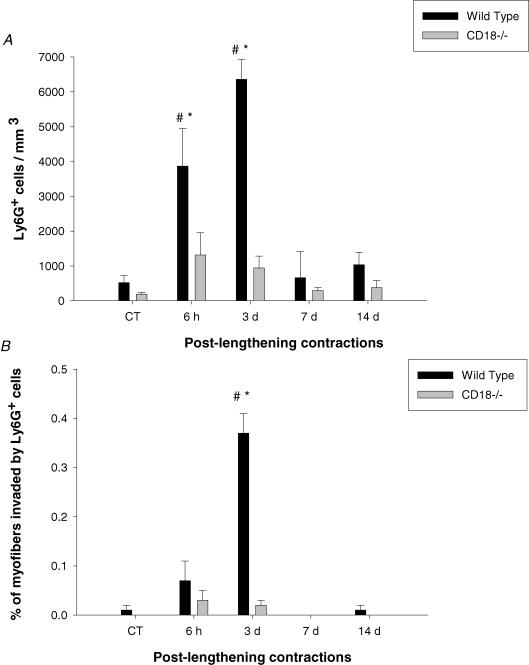
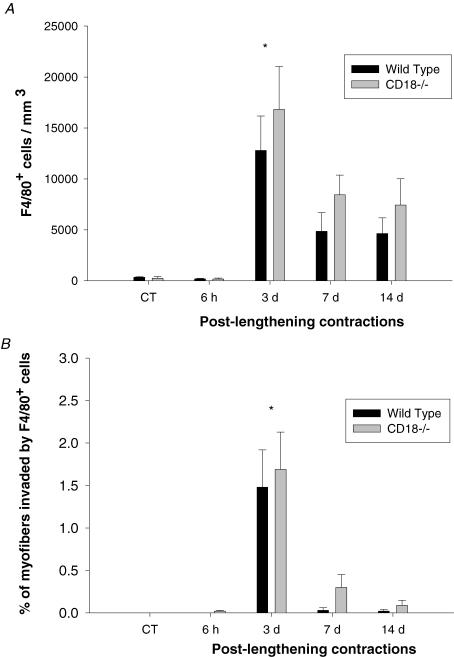
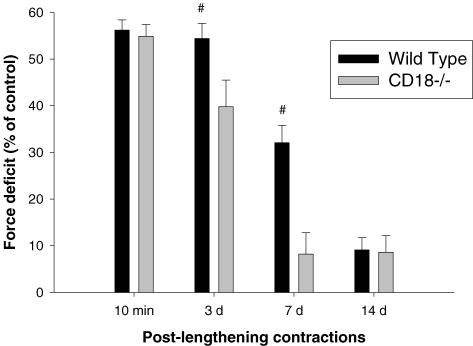
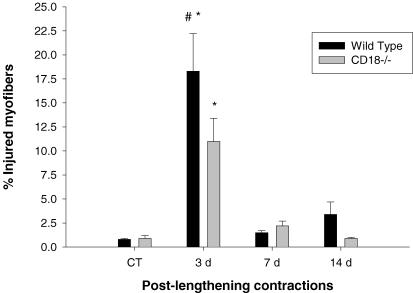
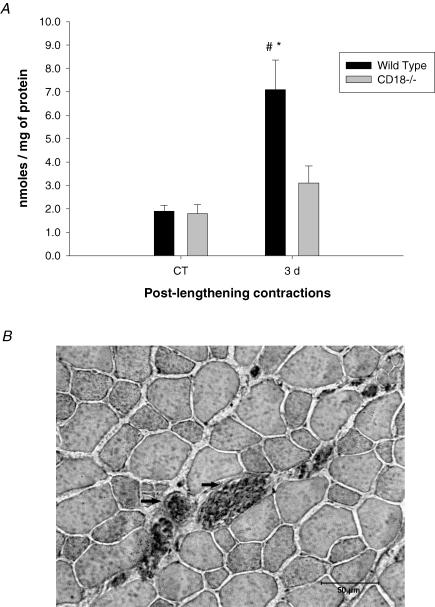
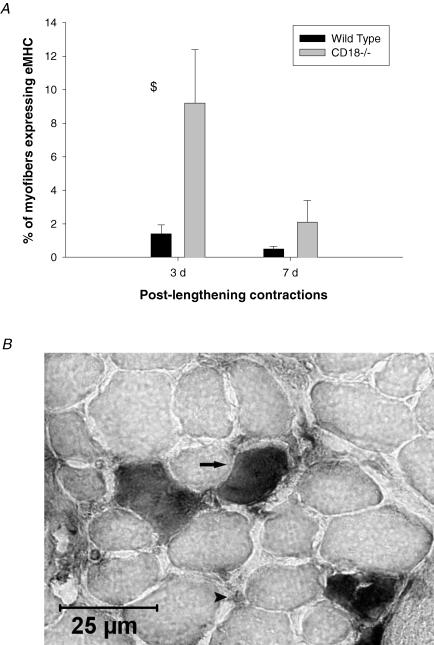
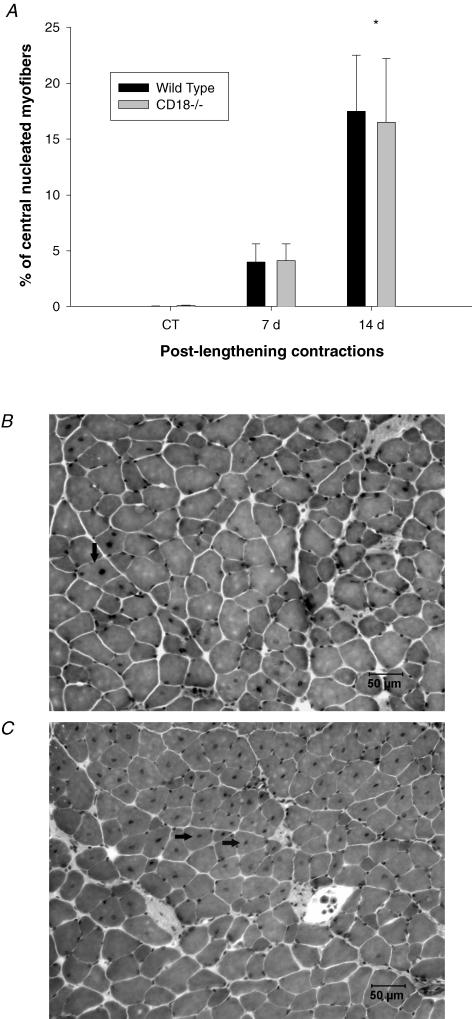
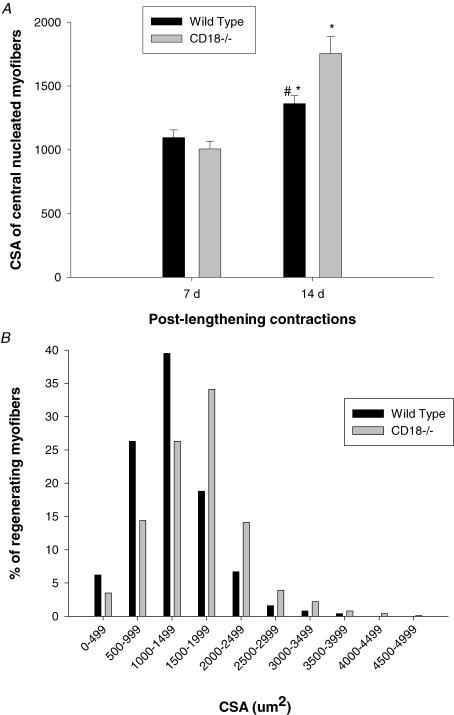
We tested the hypotheses that: (1) neutrophil accumulation after contraction-induced muscle injury is dependent on the beta(2) integrin CD18, (2) neutrophils contribute to muscle injury and oxidative damage after contraction-induced muscle injury, and (3) neutrophils aid the resolution of contraction-induced muscle injury. These hypotheses were tested by exposing extensor digitorum longus (EDL) muscles of mice deficient in CD18 (CD18(-/-); Itgb2(tm1Bay)) and of wild type mice (C57BL/6) to in situ lengthening contractions and by quantifying markers of muscle inflammation, injury, oxidative damage and regeneration/repair. Neutrophil concentrations were significantly elevated in wild type mice at 6 h and 3 days post-lengthening contractions; however, neutrophils remained at control levels at these time points in CD18-/- mice. These data indicate that CD18 is required for neutrophil accumulation after contraction-induced muscle injury. Histological and functional (isometric force deficit) signs of muscle injury and total carbonyl content, a marker of oxidative damage, were significantly higher in wild type relative to CD18-/- mice 3 days after lengthening contractions. These data show that neutrophils exacerbate contraction-induced muscle injury. After statistically controlling for differences in the force deficit at 3 days, wild type mice also demonstrated a higher force deficit at 7 days, a lower percentage of myofibres expressing embryonic myosin heavy chain at 3 and 7 days, and a smaller cross sectional area of central nucleated myofibres at 14 days relative to CD18-/- mice. These observations suggest that neutrophils impair the restoration of muscle structure and function after injury. In conclusion, neutrophil accumulation after contraction-induced muscle injury is dependent on CD18. Furthermore, neutrophils appear to contribute to muscle injury and impair some of the events associated with the resolution of contraction-induced muscle injury.
Figures
References
-
- Allen RE, Boxhorn LK. Regulation of skeletal muscle satellite cell proliferation and differentiation by transforming growth factor-beta, insulin-like growth factor I, and fibroblast growth factor. J Cell Physiol. 1989;138:311–315. - PubMed
-
- Allen RE, Sheehan SM, Taylor RG, Kendall TL, Rice GM. Hepatocyte growth factor activates quiescent skeletal muscle satellite cells in vitro. J Cell Physiol. 1995;165:307–312. - PubMed
-
- Best TM, Fiebig R, Corr DT, Brickson S, Ji L. Free radical activity, antioxidant enzyme, and glutathione changes with muscle stretch injury in rabbits. J Appl Physiol. 1999;87:74–82. - PubMed
Publication types
MeSH terms
Substances
Grants and funding
LinkOut - more resources
Full Text Sources
Other Literature Sources
Miscellaneous
