


Functional role of G9a-induced histone methylation in small heterodimer partner-mediated transcriptional repression
- PMID: 15550569
- PMCID: PMC534628
- DOI: 10.1093/nar/gkh947
Functional role of G9a-induced histone methylation in small heterodimer partner-mediated transcriptional repression
Abstract
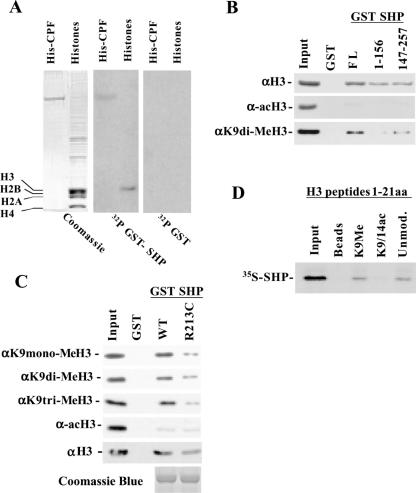
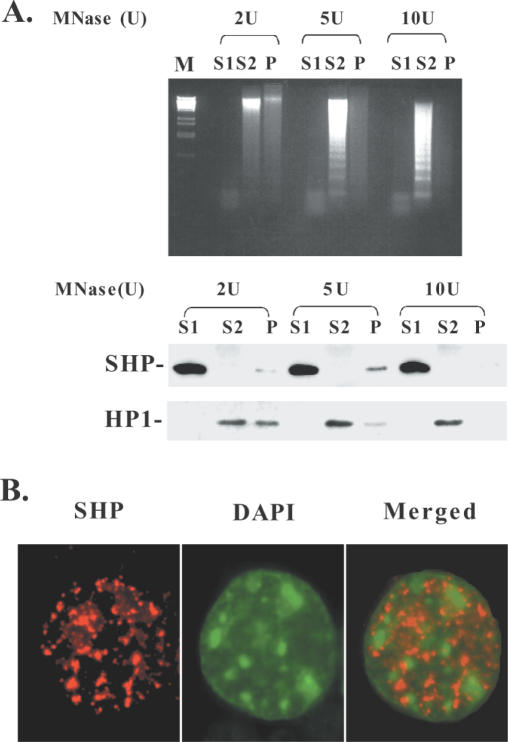
Site-specific modification of nucleosomal histones plays a central role in the formation of transcriptionally active and inactive chromatin structures. These modifications may serve as specific recognition motifs for chromatin proteins, which act as a signal for the adoption of the appropriate regulatory responses. Here, we show that the orphan nuclear receptor SHP (small heterodimer partner), a coregulator that inhibits the activity of several nuclear receptors, can associate with unmodified and lysine 9-methylated histone-3, but not with the acetylated protein. The naturally occurring SHP mutant (R213C), which exhibits decreased transrepression potential, interacts less avidly with K9-methylated histone 3. We demonstrate that SHP can functionally interact with histone deacetylase-1 and the G9a methyltransferase and that it is localized exclusively in nuclease-sensitive euchromatin. The results point to the involvement of a multistep mechanism in SHP-dependent transcriptional repression, which includes histone deacetylation, followed by H3-K9 methylation and stable association of SHP itself with chromatin.
Figures
References
-
- Turner B.M. (2000) Histone acetylation and an epigenetic code. BioEssays, 2, 836–845. - PubMed
-
- Jenuwein T. and Allis,C.D. (2001) Translating the histone code. Science, 93, 1074–1080. - PubMed
-
- Turner B.M. (2002) Cellular memory and the histone code. Cell, 111, 285–291. - PubMed
-
- Rea S., Eisenhaber,F., O'Carroll,D., Strahl,B.D., Sun,Z.W., Schmid,M., Opravil,S., Mechtler,K., Ponting,C.P., Allis,C.D. and Jenuwein,T. (2000) Regulation of chromatin structure by site-specific histone H3 methyltransferases. Nature, 406, 593–599. - PubMed
Publication types
MeSH terms
Substances
LinkOut - more resources
Full Text Sources
Molecular Biology Databases
