. 2004 Dec;72(12):7063-72.
doi: 10.1128/IAI.72.12.7063-7072.2004.

Polymorphisms in the Chlamydia trachomatis cytotoxin locus associated with ocular and genital isolates

Affiliations

Polymorphisms in the Chlamydia trachomatis cytotoxin locus associated with ocular and genital isolates

John H Carlson et al. Infect Immun. 2004 Dec.

Abstract

Chlamydia trachomatis is a strict human pathogen producing infections that cause medically important chronic inflammatory diseases, such as blinding trachoma and tubal factor infertility. Isolates exist as serotypes that fall into distinct biologic and pathological groups corresponding to differences in infection tissue tropism and invasion properties. Paradoxically, genome sequencing of several diverse strains has revealed a remarkable level of genomic synteny, suggesting that minor genetic differences determine the pathogen host- and tissue-specific infection characteristics. To better understand the genetic basis of chlamydial pathobiologic diversity, we performed comparative DNA-DNA microarray genomic hybridizations with all 15 C. trachomatis serovariants. We found there are few major genetic differences among the 15 serovars. An exception was the cytotoxin locus located in the plasticity zone, a region that exhibited significant polymorphisms among serovars. We therefore sequenced this region from all 15 serovars. The cytotoxin gene was interrupted by extensive mutations and deletions among the different serovars; however, three basic open reading frame motifs were discovered that correlated with noninvasive oculotropic, urogenitotropic, and invasive serovars. Of interest, only noninvasive genitotropic serovars possessed an intact N-terminal portion of the putative toxin gene. This region contains the UDP-glucose binding domain and the glycosyltransferase domain required for enzymatic activity of the clostridial toxin homologs, suggesting a role in urogenital infection or pathogenesis.


Figures

FIG. 1.
FIG. 1.
Comparative genomic hybridization of C. trachomatis reference strains. Chromosomal and plasmid genes (894 and 8 genes, respectively) from C. trachomatis serovar D are shown for the 15 C. trachomatis serovars (A to K and L1 to L3). Each test strain DNA was cohybridized with the control strain DNA (C. trachomatis serovar D), and the fluorescence levels were used in a trinary analysis to determine whether genes were present in the test strain (white), slightly divergent in the test strain (grey), or highly divergent (or absent) in the test strain (black), as defined in Materials and Methods. The expanded section of the figure shows the PZ of all serovars to highlight the region of the genome in which deletions were found. All deletions were found to be centered about the genes encoding the portions of the cytotoxin in serovar D, i.e., CT164 to CT167.
FIG. 2.
FIG. 2.
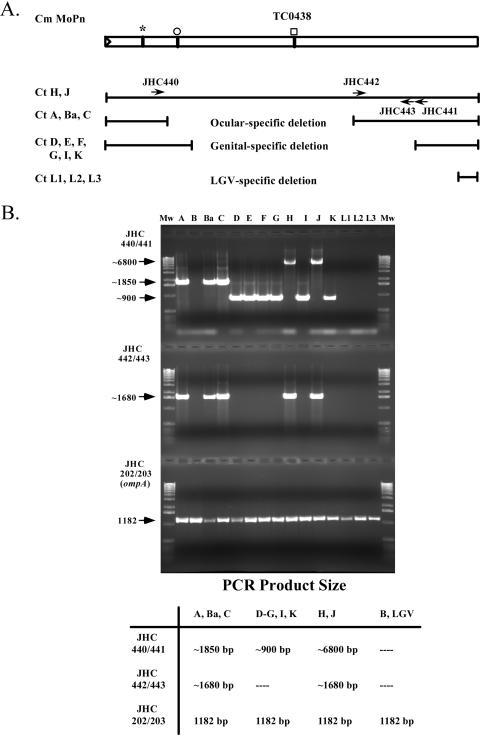
PCR amplification patterns of the cytotoxin gene in C. trachomatis serovars. Selected oligonucleotides used to amplify the cytotoxin region gave serovar-specific patterns that clustered according to the disease type and biovar. (A) Schematic representation; (B) agarose gel and summary table. An ocular-specific deletion was found for serovars A, Ba, and C by using PCR primer pairs JHC440 and JHC441 (∼1,850 bp) and JHC442 and JHC443 (∼1,680 bp). Two deletion patterns were found for genital serovars. The first group contained serovars D, E, F, G, I, and K and amplified products of ∼900 bp with the primer pair JHC440 and JHC441 and no product with JHC442 and JHC443. The second group consisted of serovars H and J, which produced products of ∼1,680 bp with JHC442 and JHC443 and ∼6,800 bp with JHC440 and JHC441. No products were found for either reaction with the LGV serovars L1, L2, and L3. The symbols above the TC0438 cytotoxin gene from C. muridarum (Cm MoPn) indicate the encoding region for the UDP-glucose binding domain (asterisk), the glycosyltransferase domain (open circle), and the cysteine-protease domain (open square).
FIG. 3.
FIG. 3.
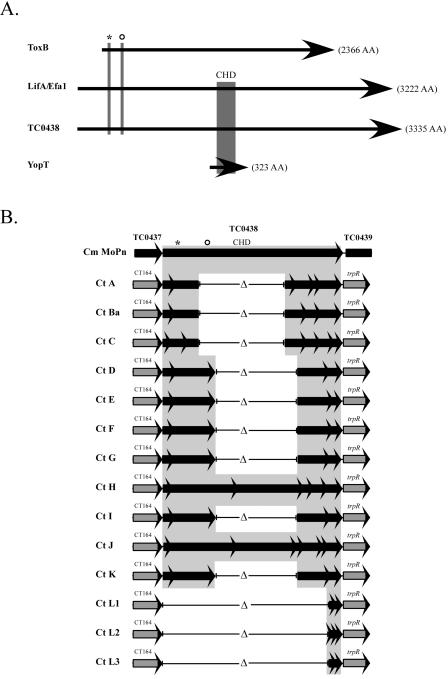
Putative GTPase-inactivating domains present in the cytotoxin gene(s) of C. muridarum (MoPn) and the 15 human C. trachomatis reference serovars. (A) Schematic diagram of the C. muridarum toxin (TC0438) aligned with E. coli LifA/Efa1, C. difficile toxin B, and YopT. The illustration highlights domains that function in the inactivation of GTPases by either covalent or proteolytic modification. Toxin B is 2,366 amino acids (aa) (269.7 kDa), with UDP-glucose binding (UDP-Glc) and glycosyltranseferase (GT) domains located at the protein's N terminus, residues 94 to 137 and 263 to 298, respectively (6, 7). The UDP-Glc domain is shown with an asterisk, and the GT domain is shown with an open circle. YopT is 323 aa (36.3 kDa) and possesses a cysteine protease domain (CPD) within residues 102 to 317. The invariant Cys/His/Asp (CHD, depicted in the diagram by the shaded box) active site is critical for the proteolytic cleavage of Rho GTPases and is contained within this region (27). LifA/Efa1 is 3,222 aa (366 kDa). The protein contains the UDP-Glc (residues 312 to 355) and GT (534 to 569) domains, in addition to the CPD (1445 to 1644). C. muridarum TC0438 encodes a protein of 3,335 aa (376.5 kDa). Similar to LifA/Efa1, TC0438 has both GTPase-inactivating domains, UDP-Glc (residues 314 to 357) and GT (542 to 577), and the CPD (1530 to 1727) (2, 27). (B) Schematic showing the toxin loci for all 15 C. trachomatis reference serovars aligned to the amino acid sequence of the C. muridarium toxin (TC0438). The shaded regions identify ORFs encoding putative proteins that share strong identity with TC0438. The sequences are depicted as partial gene fragments, with arrows representing prematurely truncated ORFs. The noninvasive mucosotropic serovars constitute two genotypes and ocular serovars possess only the UDP-Glu domain, while genital serovars possess both the UDP-Glu domain and the GT domain. All lack the YopT CPD, due either to deletion or to frameshift mutation. Invasive disseminating LGV strains lack sequences corresponding to any of the domains.
FIG. 4.
FIG. 4.
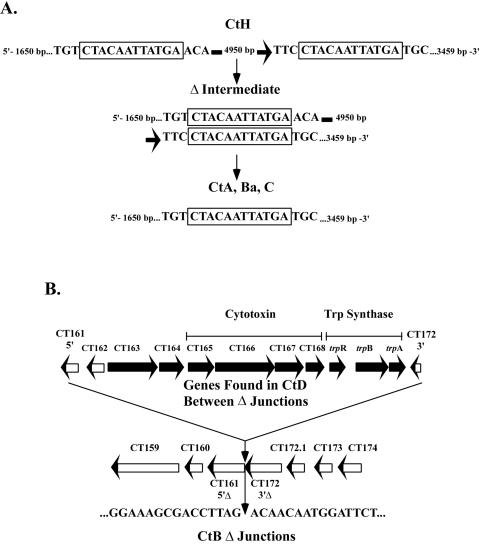
Characterization of the deletion junctions of the cytotoxin genes of the ocular serovars. (A) The cytotoxin gene of C. trachomatis serovar H (CtH) has two direct 12-bp repeats separated by 4,956 bp. Recombination between these repeats would result in the sequence of the cytotoxin loci found in serovars A (CtA), Ba (CtBa), and C (CtC), with loss of one of the 12-bp repeats. (B) A large deletion in the cytotoxin region of the genome of serovar B results in the loss of 9,662 bp (in comparison to the D/UW-3/Cx genome sequence), including 10 complete ORFs, the 5′ portion of CT161, and the 3′ portion of CT172. This deletion encompasses the entire cytotoxin locus and the tryptophan synthase regulon.

References

    1. Albertini, A. M., M. Hofer, M. P. Calos, and J. H. Miller. 1982. On the formation of spontaneous deletions: the importance of short sequence homologies in the generation of large deletions. Cell 29:319-328. - PubMed
    1. Belland, R. J., M. A. Scidmore, D. D. Crane, D. M. Hogan, W. Whitmire, G. McClarty, and H. D. Caldwell. 2001. Chlamydia trachomatis cytotoxicity associated with complete and partial cytotoxin genes. Proc. Natl. Acad. Sci. USA 98:13984-13989. - PMC - PubMed
    1. Belland, R. J., G. Zhong, D. D. Crane, D. Hogan, D. Sturdevant, J. Sharma, W. L. Beatty, and H. D. Caldwell. 2003. Genomic transcriptional profiling of the developmental cycle of Chlamydia trachomatis. Proc. Natl. Acad. Sci. USA 100:8478-8483. - PMC - PubMed
    1. Boquet, P., and E. Lemichez. 2003. Bacterial virulence factors targeting Rho GTPases: parasitism or symbiosis? Trends Cell Biol. 13:238-246. - PubMed
    1. Brunelle, B. W., T. L. Nicholson, and R. S. Stephens. 2004. Microarray-based genomic surveying of gene polymorphisms in Chlamydia trachomatis. Genome Biol. 5:R42. - PMC - PubMed

LinkOut - more resources