


Stability and change in attachment security across adolescence
- PMID: 15566380
- PMCID: PMC1761126
- DOI: 10.1111/j.1467-8624.2004.00817.x
Stability and change in attachment security across adolescence
Abstract
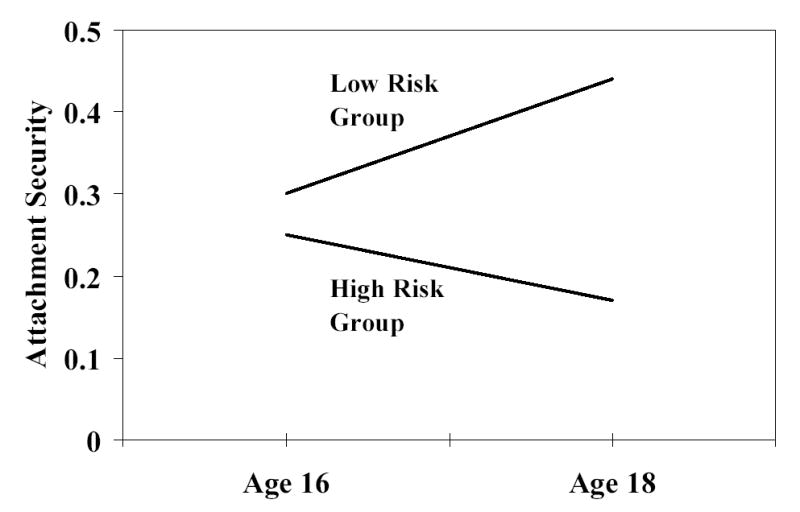
This study examined both continuity and familial, intrapsychic, and environmental predictors of change in adolescent attachment security across a 2-year period from middle to late adolescence. Assessments included the Adult Attachment Interview, observed mother-adolescent interactions, test-based data, and adolescent self-reports obtained from an ethnically and socioeconomically diverse sample of moderately at-risk adolescents interviewed at ages 16 and 18. Substantial stability in security was identified. Beyond this stability, however, relative declines in attachment security were predicted by adolescents' enmeshed, overpersonalizing behavior with their mothers; depressive symptoms; and poverty status. Results suggest that although security may trend upward for nonstressed adolescents, stressors that overwhelm the capacity for affect regulation and that are not easily assuaged by parents predict relative declines in security over time.
Figures
References
-
- Allen JP, Hauser ST. Autonomy and relatedness in adolescent-family interactions as predictors of young adults' states of mind regarding attachment. Development & Psychopathology. 1996;8(4):793–809.
-
- Allen JP, Hauser ST, Bell KL, McElhaney KB, Tate DC. University of Virginia; Charlottesville, VA: 1998. The autonomy and relatedness coding system. Unpublished manuscript.
-
- Allen JP, Land D. Attachment in adolescence. In: Cassidy J, Shaver PR, editors. Handbook of attachment: Theory, research, and clinical applications. New York, NY, USA: The Guilford Press; 1999. pp. 319–335.
Publication types
MeSH terms
Grants and funding
LinkOut - more resources
Full Text Sources
Medical
