


Review
doi: 10.1186/gb-2004-5-12-250.
Epub 2004 Nov 25.
Tetraodon genome confirms Takifugu findings: most fish are ancient polyploids
Affiliations
- PMID: 15575976
- PMCID: PMC545788
- DOI: 10.1186/gb-2004-5-12-250
Item in Clipboard
Review
Tetraodon genome confirms Takifugu findings: most fish are ancient polyploids
Genome Biol.
2004.
Abstract
An evolutionary hypothesis suggested by studies of the genome of the tiger pufferfish Takifugu rubripes has now been confirmed by comparison with the genome of a close relative, the spotted green pufferfish Tetraodon nigroviridis. Ray-finned fish underwent a whole-genome duplication some 350 million years ago that might explain their evolutionary success.
Figures
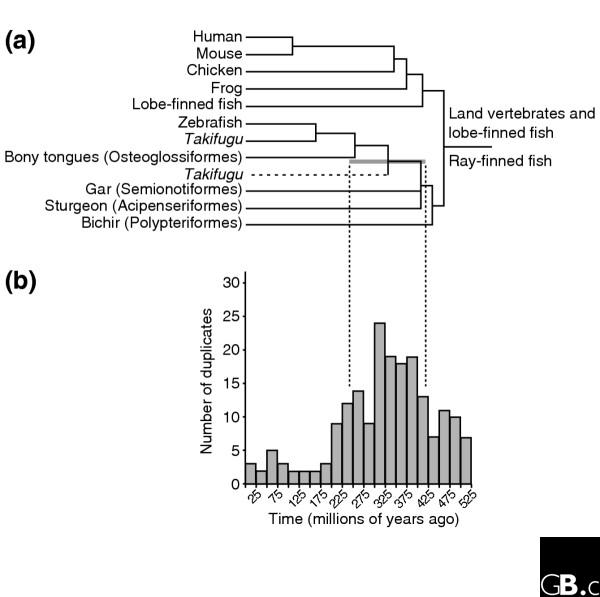
A phylogenetic tree showing the vertebrate phylogenetic relationships and superimposed pufferfish gene-duplication events. (a) A generally accepted tree illustrating the relationships between several vertebrate species. The gray horizontal bar denotes the fish-specific genome-duplication event inferred from absolute dating of Takifugu paralogs. The broken line indicates the position of the duplicated copy of the Takifugu genome that originated between the divergence of gar and the bony tongues. (b) The bar chart shows the number of paralogous genes that could be dated through the construction of linearized trees. Modified from [8,9].

Uncovering genome duplications through comparative analysis with related sequences. The hypothetical genomes of two related organisms are shown, each containing the same set of genes. Both genomes are initially identical, but the genome of Organism 1 is duplicated, resulting in a second identical set of chromosomes and genes. After some time, homologous chromosomes lose a different set of genes, keeping two copies for only a minority of the duplicated genes. For the sake of simplicity, the genome of Organism 2 is assumed to remain unchanged. Within Organism 1, the only evidence for a duplication event comes from the conserved order of the anchor points formed by genes 1 and 11 (indicated by boxed regions). Comparison with the genome of Organism 2, however, shows a pattern of so-called 'double conserved synteny' where the duplicated nature of Organism 1 is revealed.
References
-
- Jaillon O, Aury J-M, Brinet F, Petit J-L, Stange-Thomann N, Mauceli E, Bouneau L, Fischer C, Ozoef-Costaz C, Bernot A, et al. Genome duplication in the teleost fish Tetraodon nigroviridis reveals the early vertebrate proto-karyotype. Nature. 2004;431:946–957. doi: 10.1038/nature03025. - DOI - PubMed
Publication types
MeSH terms
LinkOut - more resources
Full Text Sources
