Review
. 2004 Dec;5(12):1130-6.
doi: 10.1038/sj.embor.7400293.

Always look on the bright site of Rho: structural implications for a conserved intermolecular interface

Affiliations
Review

Always look on the bright site of Rho: structural implications for a conserved intermolecular interface

Radovan Dvorsky et al. EMBO Rep. 2004 Dec.

Abstract

The signalling functions of Rho-family GTPases are based on the formation of distinctive protein-protein complexes. Invaluable insights into the structure-function relationships of the Rho GTPases have been obtained through the resolution of several of their structures in complex with regulators and downstream effectors. In this review, we use these complexes to compare the binding and specificity-determining sites of the Rho GTPases. Although the properties that characterize these sites are diverse, some fundamental conserved principles that govern their intermolecular interactions have emerged. Notably, all of the interacting partners of the Rho GTPases, irrespective of their function, bind to a common set of conserved amino acids that are clustered on the surface of the switch regions. This conserved region and its specific structural characteristics exemplify the convergence of the Rho GTPases on a consensus binding site.


Figures
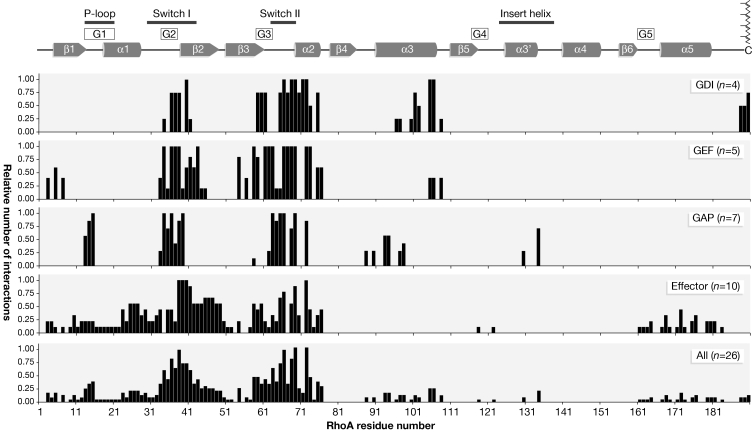
Figure 1
Figure 1
Structural motifs and intermolecular contact sites of Rho GTPases. Structural elements (α-helices are represented as cylinders and β-strands as arrows), the guanine nucleotide-binding peptide loops (G1–G5), the conserved sequence motifs and the isoprenylation site at the C-terminus of RhoA are highlighted on the top according to Ihara et al (1998). The frequencies of intermolecular contacts of interacting partners with Rho GTPases are shown as histograms. The relative numbers of GTPase interactions with the individual guanine nucleotide-dissociation inhibitors (GDIs), guanine nucleotide-exchange factors (GEFs), GTPase-activating proteins (GAPs) and effectors, and all interacting partners are plotted as a function of the residue numbers of RhoA. The relative numbers of interactions for the corresponding residues of Rho GTPases are calculated as the numbers of contacts (defined as ≤4 Å) divided by the maximal number of contacts. 'n' indicates the number of analysed complexes.
Figure 2
Figure 2
Frequency alignment of residues of Rho GTPases that are involved in intermolecular interactions. Aligned sequences of the switch I, β3, switch II and α2 regions of RhoA, Rac1 and Cdc42 are shown together with the frequency of involvement of the residues in the interaction with regulators and effectors using 26 complexes (Table 1). The residues that are most frequently involved in the interfaces are colour coded. The symbol '+' indicates an interaction with the binding partners, whereas the symbol '−' represents no intermolecular contact. GAPRA refers to a GTPase-activating protein (GAP) in which the arginine finger (Arg85) is replaced by an alanine. It is important to note that protein kinase Nα (PKNα) binds RhoA at two sites: contact site 1 (1cs; outside of the switch regions) and contact site 2 (2cs; inside the switch regions). Moreover, the former, along with p67phox, does not make contact with any of the colour-coded residues. ACK, activated Cdc42-associated tyrosine kinase; Dbs, Dbl's big sister; GDI, guanine nucleotide-dissociation inhibitor; ITSN, intersectin; PAK, p21-activated kinase; ROCK, Rho kinase; WASP, Wiskott–Aldrich syndrome protein.
Figure 3
Figure 3
Switch regions as the focal points of bimolecular interactions. Residues of RhoA that mediate the interactions with guanine nucleotide-dissociation inhibitors (GDIs), guanine nucleotide-exchange factors (GEFs), GTPase-activating proteins (GAPs) and effectors are coloured from yellow (corresponding to one contact) to red (corresponding to a maximal number of 24 contacts from the 26 analysed complexes). Grey indicates the residues that are not involved in any interactions. The GDP-bound state and the GTP-γS-bound state of the RhoA structures are shown on the upper and lower panels, respectively, in ribbon (A, D) and surface (B, E) representation in the same orientation. (B) and (E) are also rotated 180° around the indicated axis with respect to one another (C,F). The labelled residues that interact most frequently with their partner proteins are shown in a ball-and-stick configuration in (A) and (D). The position of some structural elements (helices α2 and α3 or β2/β3 strands) and sequence motifs (switch I and II or the insert helix) are shown in (A) and (D).
Figure 4
Figure 4
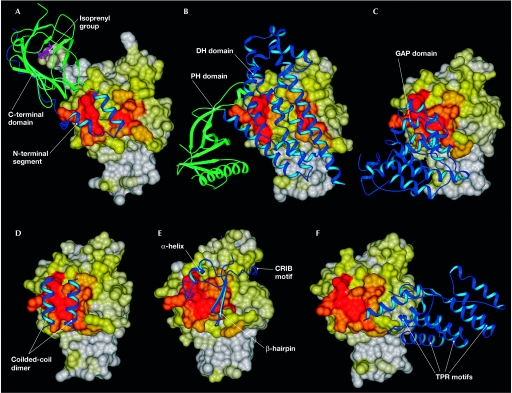
Complexes of regulators and effectors with their respective GTPases. (A) Cdc42·GDP·GDI. (B) RhoA·Dbs. (C) RhoA·GDP·AlF4·GAP. (D) RhoA·GppNHp·ROCK. (E) Cdc42·GppCH2p·WASP. (F) Rac1(Q61L)·GTP·p67phox. The surfaces of the GTPases are coloured as in Fig 3. The guanine nucleotide-dissociation inhibitor (GDI), guanine nucleotide-exchange factor (GEF), GTPase-activating protein (GAP) and effector domains are shown as ribbons. CRIB, Cdc42/Rac-interacting binding; Dbs, Dbl's big sister; DH, Dbl homology; PH, pleckstrin homology; ROCK, Rho kinase; TPR, tetraricopeptide repeat; WASP, Wiskott–Aldrich syndrome protein.
None
None

References

    1. Abdul-Manan N et al. (1999) Structure of Cdc42 in complex with the GTPase-binding domain of the 'Wiskott–Aldrich syndrome' protein. Nature 399: 379–383 - PubMed
    1. Ahmadian MR, Stege P, Scheffzek K, Wittinghofer A (1997) Confirmation of the arginine-finger hypothesis for the GAPstimulated GTP-hydrolysis reaction of Ras. Nat Struct Biol 4: 686–689 - PubMed
    1. Bishop AL, Hall A (2000) Rho GTPases and their effector proteins. Biochem J 348: 241–255 - PMC - PubMed
    1. Blumenstein L, Ahmadian MR (2004) Models of the cooperative mechanism for Rho-effector recognition: implications for RhoA-mediated effector activation. J Biol Chem Oct 8 [epub ahead of print] - PubMed
    1. Boquet P, Lemichez E (2003) Bacterial virulence factors targeting Rho GTPases: parasitism or symbiosis? Trends Cell Biol 13: 238–246 - PubMed

Publication types

Substances