Review
doi: 10.1038/sj.embor.7400299.
Survival of protozoan intracellular parasites in host cells
Affiliations
- PMID: 15577928
- PMCID: PMC1299194
- DOI: 10.1038/sj.embor.7400299
Item in Clipboard
Review
Survival of protozoan intracellular parasites in host cells
EMBO Rep.
2004 Dec.
Abstract
The most common human diseases are caused by pathogens. Several of these microorganisms have developed efficient ways in which to exploit host molecules, along with molecular pathways to ensure their survival, differentiation and replication in host cells. Although the contribution of the host cell to the development of many intracellular pathogens (particularly viruses and bacteria) has been unequivocally established, the study of host-cell requirements during the life cycle of protozoan parasites is still in its infancy. In this review, we aim to provide some insight into the manipulation of the host cell by parasites through discussing the hurdles that are faced by the latter during infection.
Figures
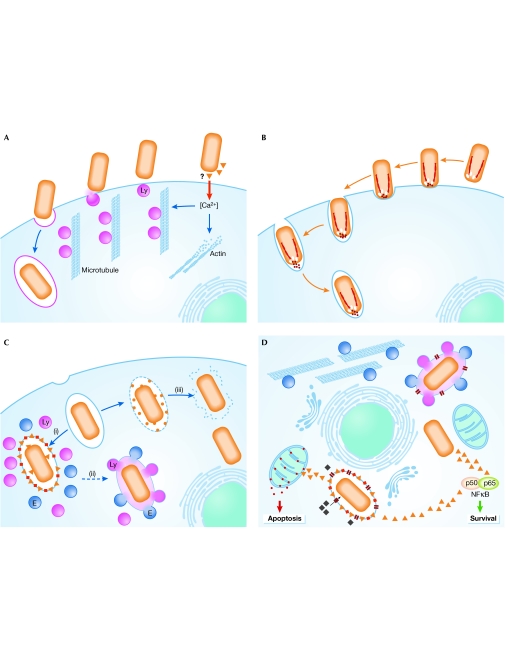
Recognition, entrance and survival: a schematic representation of some of the strategies adopted by pathogens. (A) Induced recruitment of lysosomes to fuse with the host-cell plasma membrane to form the required vacuole for Trypanosoma cruzi. (B) A parasite, such as Toxoplasma, uses its own form of motility to propel itself into the host cell. (C) Once inside, intracellular pathogens follow different routes: they either reside inside the vacuole (i), which sometimes fuses with the exocytic/endocytic pathways (ii), or they reside in the host cytosol (iii). The same pathogen might use different strategies at different stages of development. (D) Independent of the route taken, all pathogens face similar problems, which include how to ensure that the cell is alive or dead at the appropriate times, how to acquire nutrients, how to avoid host-recognition systems and how to increase in size. Parasites and their proteins are shown in orange. E, endosomes; Ly, lysosomes.

Clockwise from top left: Sónia S. Albuquerque, Maria M. Mota, Patricia Leirião & Cristina D. Rodrigues
References
-
- Andrews NW, Whitlow MB (1989) Secretion by Trypanosoma cruzi of a hemolysin active at low pH. Mol Biochem Parasitol 33: 249–256 - PubMed
-
- Andrews NW, Abrams CK, Slatin SL, Griffiths G (1990) A T. cruzisecreted protein immunologically related to the complement component C9: evidence for membrane pore-forming activity at low pH. Cell 61: 1277–1287 - PubMed
-
- Arrizabalaga G, Boothroyd JC (2004) Role of calcium during Toxoplasma gondii invasion and egress. Int J Parasitol 34: 361–368 - PubMed
Publication types
MeSH terms
LinkOut - more resources
Full Text Sources
Other Literature Sources