


Comment
doi: 10.1172/JCI23701.
Marfan syndrome and mitral valve prolapse
Affiliations
- PMID: 15578086
- PMCID: PMC529288
- DOI: 10.1172/JCI23701
Item in Clipboard
Comment
Marfan syndrome and mitral valve prolapse
J Clin Invest.
2004 Dec.
Abstract
Mitral valve prolapse (MVP), an abnormal displacement into the left atrium of a thickened and redundant mitral valve during systole, is a relatively frequent abnormality in humans and may be associated with serious complications. A recent study implicates fibrillin-1, a component of extracellular matrix microfibrils, in the pathogenesis of a murine model of MVP. This investigation represents an initial step toward understanding the mechanisms involved in human MVP disease and the development of potential treatments.
Figures
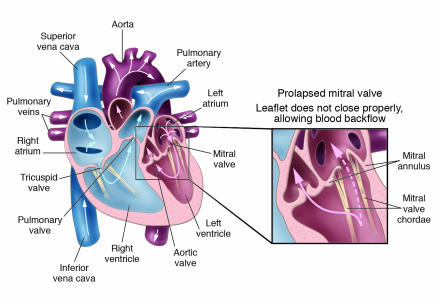
MVP. Mitral valve leaflets, shaped like parachutes, are attached to the inner wall of the left ventricle by a series of strings called chordae. When the ventricles contract, the mitral valve leaflets close snugly to prevent backflow of blood from the left ventricle into the left atrium. Upon ventricle relaxation, the valves open to allow oxygenated blood from the lungs to fill the left ventricle. In patients with MVP, myxomatous degeneration of the leaflets and chordae results in leaflet thickening and redundancy, causing the leaflets to prolapse, or flop backwards, into the left atrium (detail). This sometimes allows leakage of blood through the mitral valve (mitral regurgitation). Severe mitral regurgitation can lead to heart failure and abnormal heart rhythms.
Comment on
-
TGF-beta-dependent pathogenesis of mitral valve prolapse in a mouse model of Marfan syndrome.J Clin Invest. 2004 Dec;114(11):1586-92. doi: 10.1172/JCI22715. J Clin Invest. 2004. PMID: 15546004 Free PMC article.
References
-
- Devereux RB, et al. Diagnosis and classification of severity of mitral valve prolapse: methodologic, biologic, and prognostic considerations. Am. Heart J. 1987;113:1265–1280. - PubMed
-
- Chavez AM, Cosgrove DM. Surgery for mitral prolapse. Herz. 1988;13:400–404. - PubMed
-
- Shah PM, Gramiak R. Echocardiographic recognition of mitral valve prolapse [abstract] Circulation. 1970;42(Suppl. III):III–45. - PubMed
-
- Dillon JC, Haine CL, Chang S, Feigenbaum H. Use of echocardiography in patients with prolapsed mitral valve. Circulation. 1971;43:503–507. - PubMed
-
- Kerber RE, Isaeff DM, Hancock EW. Echocardiographic patterns in patients with the syndrome of systolic click and late systolic murmur. N. Engl. J. Med. 1971;284:691–693. - PubMed
Publication types
MeSH terms
Substances
LinkOut - more resources
Full Text Sources
Medical
Miscellaneous
