


Analysis of group differences in processing speed: where are the models of processing?
- PMID: 15581129
- PMCID: PMC1479450
- DOI: 10.3758/bf03196631
Analysis of group differences in processing speed: where are the models of processing?
Abstract
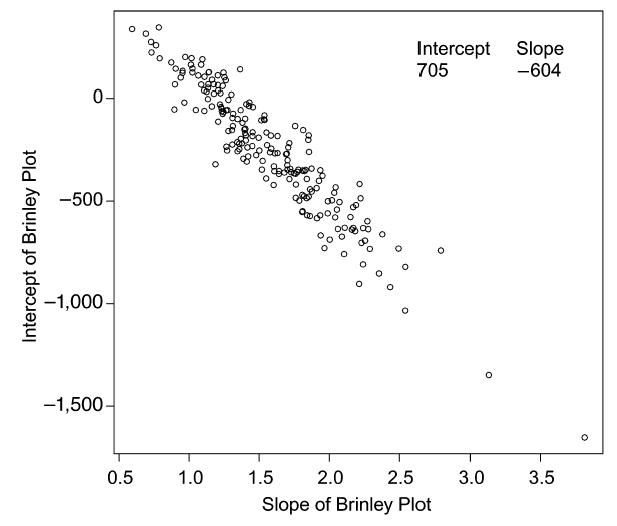
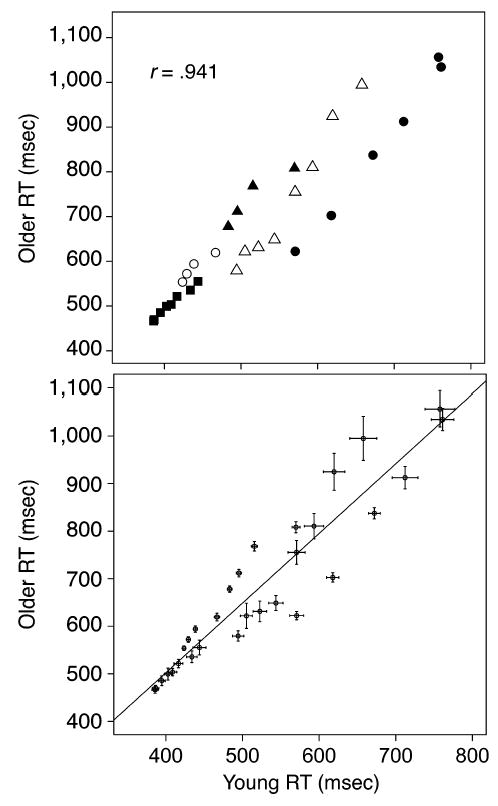
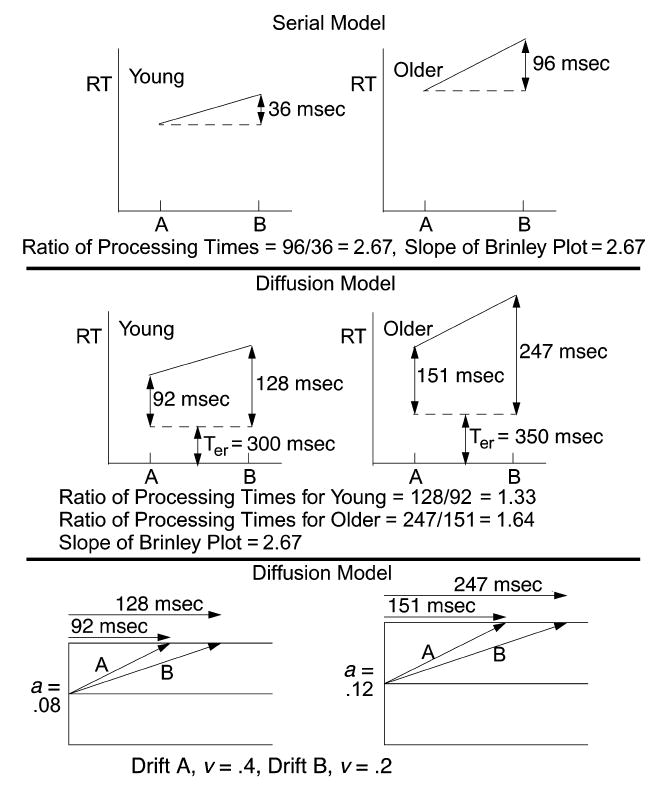
Recently, Myerson, Adams, Hale, and Jenkins (2003) replied to arguments advanced by Ratcliff, Spieler, and McKoon (2000) about interpretations of Brinley functions. Myerson et al. (2003) focused on methodological and terminological issues, arguing that (1) Brinley functions are not quantile-quantile (QQ) plots of distributions of mean reaction times (RTs) across conditions; that the fact that the slope of a Brinley function is the ratio of the standard deviations of the two distributions of means has no implications for the use of slope as a measure of processing speed; that the ratio of slopes of RT functions for older and young subjects plotted against independent variables equals the Brinley function slope; and that speed-accuracy criterion effects do not account for slowing with age. We reply by showing that Brinley functions are plots of quantiles against quantiles; that the slope is best estimated by the ratio of standard deviations because there is variability in the distributions of mean RTs for both older and young subjects; that the interpretation of equality of the slopes Brinley functions and plots of RTs against independent variables in terms of processing speed is model dependent; and that speed-accuracy effects in some, but not all, experiments are solely responsible for Brinley slopes greater than 1. We conclude by reiterating the point that was not addressed in Myerson et al. (2003), that the goal of research should be model-based accounts of processing that deal with correct and error RT distributions and accuracy.
Figures
Comment on
-
Analysis of group differences in processing speed: Brinley plots, Q-Q plots, and other conspiracies.Psychon Bull Rev. 2003 Mar;10(1):224-37. doi: 10.3758/bf03196489. Psychon Bull Rev. 2003. PMID: 12747512
References
-
- nderson, J. R., & Lebiere, C. (1998). The atomic components of thought Mahwah, NJ: Erlbaum.
-
- Briggs GE. On the predictor variable for choice reaction time. Memory & Cognition. 1974;2:575–580. - PubMed
-
- rinley, J. F. (1965). Cognitive sets, speed and accuracy of performance in the elderly. In A. T. Welford & J. E. Birren (Eds.), Behavior, aging and the nervous system (pp. 114–149). Springfield, IL: Thomas.
-
- Bundesen C. A theory of visual attention. Psychological Review. 1990;97:523–547. - PubMed
-
- Busemeyer JR, Townsend JT. Decision field theory: A dynamic-cognitive approach to decision making in an uncertain environment. Psychological Review. 1993;100:432–459. - PubMed
Publication types
MeSH terms
Grants and funding
LinkOut - more resources
Full Text Sources