


Detection of four Plasmodium species in blood from humans by 18S rRNA gene subunit-based and species-specific real-time PCR assays
- PMID: 15583293
- PMCID: PMC535226
- DOI: 10.1128/JCM.42.12.5636-5643.2004
Detection of four Plasmodium species in blood from humans by 18S rRNA gene subunit-based and species-specific real-time PCR assays
Abstract
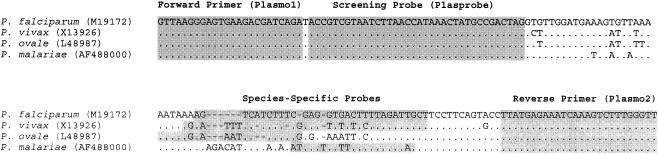
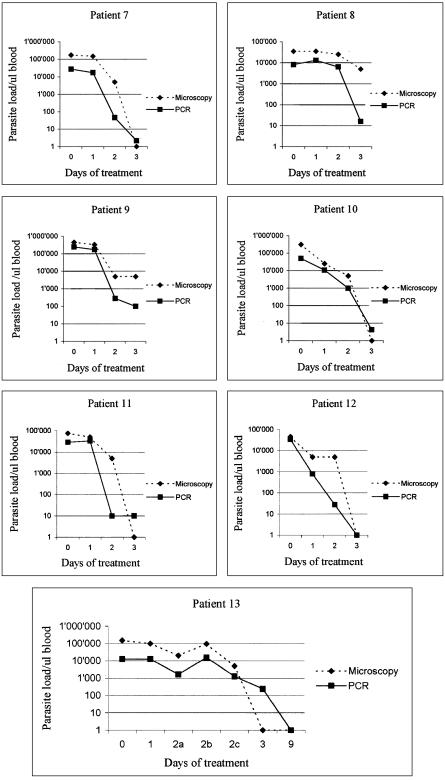
There have been reports of increasing numbers of cases of malaria among migrants and travelers. Although microscopic examination of blood smears remains the "gold standard" in diagnosis, this method suffers from insufficient sensitivity and requires considerable expertise. To improve diagnosis, a multiplex real-time PCR was developed. One set of generic primers targeting a highly conserved region of the 18S rRNA gene of the genus Plasmodium was designed; the primer set was polymorphic enough internally to design four species-specific probes for P. falciparum, P. vivax, P. malarie, and P. ovale. Real-time PCR with species-specific probes detected one plasmid copy of P. falciparum, P. vivax, P. malariae, and P. ovale specifically. The same sensitivity was achieved for all species with real-time PCR with the 18S screening probe. Ninety-seven blood samples were investigated. For 66 of them (60 patients), microscopy and real-time PCR results were compared and had a crude agreement of 86% for the detection of plasmodia. Discordant results were reevaluated with clinical, molecular, and sequencing data to resolve them. All nine discordances between 18S screening PCR and microscopy were resolved in favor of the molecular method, as were eight of nine discordances at the species level for the species-specific PCR among the 31 samples positive by both methods. The other 31 blood samples were tested to monitor the antimalaria treatment in seven patients. The number of parasites measured by real-time PCR fell rapidly for six out of seven patients in parallel to parasitemia determined microscopically. This suggests a role of quantitative PCR for the monitoring of patients receiving antimalaria therapy.
Figures
References
-
- Bretagne, S. 2003. Molecular diagnostics in clinical parasitology and mycology: limits of the current polymerase chain reaction (PCR) assays and interest of the real-time PCR assays. Clin. Microbiol. Infect. 9:505-511. - PubMed
-
- Brown, A. E., K. C. Kain, J. Pipithkul, and H. K. Webster. 1992. Demonstration by the polymerase chain reaction of mixed Plasmodium falciparum and P. vivax infections undetected by conventional microscopy. Trans. Soc. Trop. Hyg. 86:609-612. - PubMed
-
- Delley, V., P. Bouvier, N. Breslow, O. Doumbo, I. Sagara, M. Diakite, A. Mauris, A. Dolo, and A. Rougemont. 2000. What does a single determination of malaria parasite density mean? A longitudinal survey in Mali. Trop. Med. Int. Health 5:404-412. - PubMed
Publication types
MeSH terms
Substances
LinkOut - more resources
Full Text Sources
Other Literature Sources
Medical
