. 2004 Dec;42(12):5767-73.
doi: 10.1128/JCM.42.12.5767-5773.2004.

Emergence of extended-spectrum-beta-lactamase (CTX-M-9)-producing multiresistant strains of Salmonella enterica serotype Virchow in poultry and humans in France

Affiliations

Emergence of extended-spectrum-beta-lactamase (CTX-M-9)-producing multiresistant strains of Salmonella enterica serotype Virchow in poultry and humans in France

François-Xavier Weill et al. J Clin Microbiol. 2004 Dec.

Abstract

During 2002 to 2003, eight Salmonella enterica serotype Virchow poultry and poultry product isolates from various sources (chicken farms, poultry slaughterhouse, or retail store) and one S. enterica rough strain isolated from human feces were found to produce extended-spectrum beta-lactamase CTX-M-9. Poultry and poultry product isolates were recovered from different locations in the southwest of France. The human rough isolate had sequences of flagellin genes (fliC and fljB) typical of serotype Virchow and ribotyping and pulsed-field gel electrophoresis (PFGE) patterns closely similar to those of serotype Virchow strains. PFGE confirmed the clonal relationship between the poultry isolates, while the human isolate displayed a pattern with 94% homology. The bla(CTX-M-9) gene was located on a conjugative plasmid and was shown to be linked to orf513. Plasmid profiling found a very similar EcoRI restriction pattern in six transconjugants studied, including transconjugants obtained from the human isolate. A single hatchery, supplying chicks to the six farms, was identified. Emergence of extended-spectrum beta-lactamase-producing S. enterica strains in food animals is a major concern, as such strains could disseminate on a large scale and lead to antibiotic therapy difficulties.


Figures
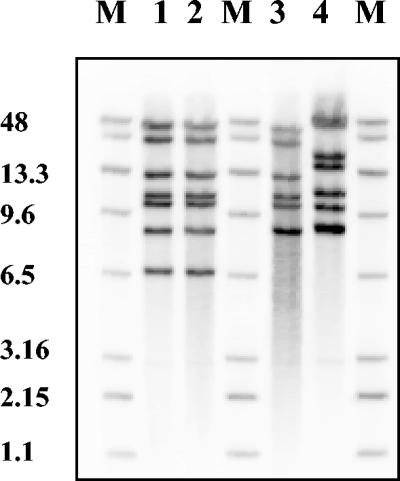
FIG. 1.
FIG. 1.
Automated ribotyping of PstI-digested genomic DNA from isolate ROU, isolate 2731, and reference strains of serotypes Virchow and Grandhaven. Lane M, RiboPrinter molecular size markers (band sizes in kilobase pairs); lane 1, isolate ROU (human rough isolate); lane 2, isolate 2731 (poultry Virchow isolate); lane 3, serotype Virchow reference strain 41K; lane 4, serotype Grandhaven reference strain 3363/81.
FIG. 2.
FIG. 2.
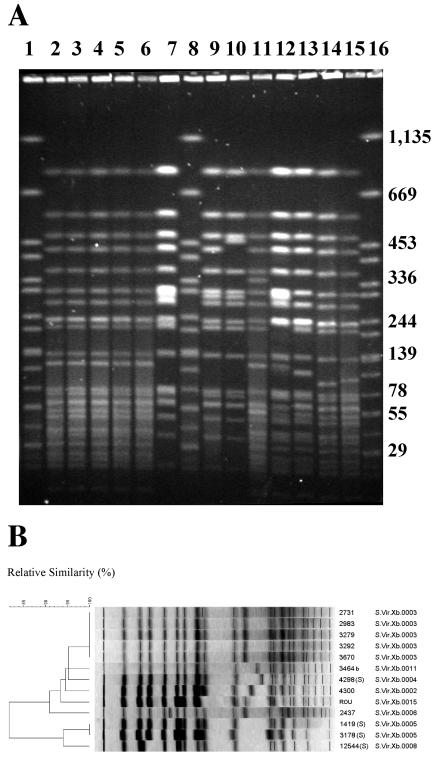
(A) PFGE of XbaI-digested genomic DNA from the nine CTX-M-9-producing S. enterica isolates under study and four non-extended-spectrum β-lactamase-producing S. enterica serotype Virchow poultry isolates (S). Lanes 1, 8, and 16, S. enterica serotype Braenderup H9812 used as molecular size markers (band sizes in kilobase pairs); lane 2, isolate 3292; lane 3, isolate 3670; lane 4, isolate 3279; lane 5, isolate 2983; lane 6, isolate 2731; lane 7, isolate 3178 (S); lane 9, isolate 1419 (S); lane 10, isolate 12544 (S); lane 11, isolate 2437; lane 12, isolate ROU; lane 13, isolate 4300; lane 14, isolate 4298 (S); lane 15, isolate 3464. (B) Dendrogram generated by BioNumerics showing the results of cluster analysis on the basis of PFGE fingerprinting. Similarity analysis was performed with the Dice coefficient, and clustering was by unweighted pair group method with arithmetic averages.
FIG. 3.
FIG. 3.
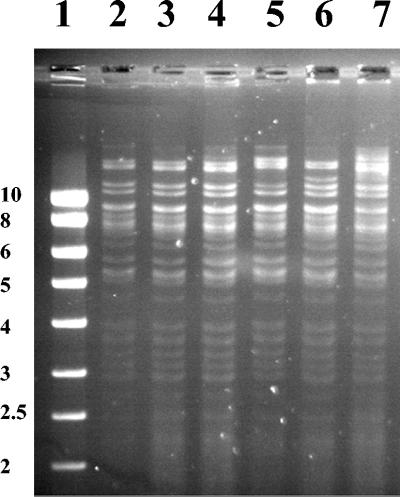
Restriction analysis (EcoRI) of plasmids isolated from E. coli transconjugants. Lane 1, markers (SmartLadder, Eurogentec, Seraing, Belgium) (band sizes in kilobase pairs); lane 2, E. coli transconjugant p2437-1; lane 3, E. coli transconjugant p2731-1; lane 4, E. coli transconjugant p3279-1; lane 5, E. coli transconjugant p3464b-1; lane 6, E. coli transconjugant p4300-1; lane 7, E. coli transconjugant pROU-1.

References

    1. AitMhand, R., A. Soukri, N. Moustaoui, H. Amarouch, N. ElMaghri, D. Sirot, and M. Benbachir. 2002. Plasmid-mediated TEM-3 extended-spectrum β-lactamase production in Salmonella typhimurium in Casablanca. J. Antimicrob. Chemother. 49:169-172. - PubMed
    1. Baucheron, S., H. Imberechts, E. Chaslus-Dancla, and A. Cloeckaert. 2002. The AcrB multidrug transporter plays a major role in High-level fluoroquinolone resistance in Salmonella enterica serovar Typhimurium phage type 204. Microb. Drug Resist. 8:281-289. - PubMed
    1. Bauernfeind, A., I. Stemplinger, R. Jungwirth, P. Mangold, S. Amann, E. Akalin, O. Ang, C. Bal, and J. M. Casellas. 1996. Characterization of β-lactamase gene blaPER-2, which encodes an extended-spectrum class A β-lactamase. Antimicrob. Agents Chemother. 40:616-620. - PMC - PubMed
    1. Bonnet, R. 2004. Growing group of extended-spectrum β-lactamases: the CTX-M enzymes. Antimicrob. Agents Chemother. 48:1-14. - PMC - PubMed
    1. Bonnet, R., C. Dutour, J. L. M. Sampaio, C. Chanal, D. Sirot, R. Labia, C. De Champs, and J. Sirot. 2001. Novel cefotaximase (CTX-M-16) with increased catalytic efficiency due to substitution Asp240Gly. Antimicrob. Agents Chemother. 45:2269-2275. - PMC - PubMed

MeSH terms