


Building a model to understand youth service access: the gateway provider model
- PMID: 15588030
- PMCID: PMC3745273
- DOI: 10.1023/b:mhsr.0000044745.09952.33
Building a model to understand youth service access: the gateway provider model
Abstract
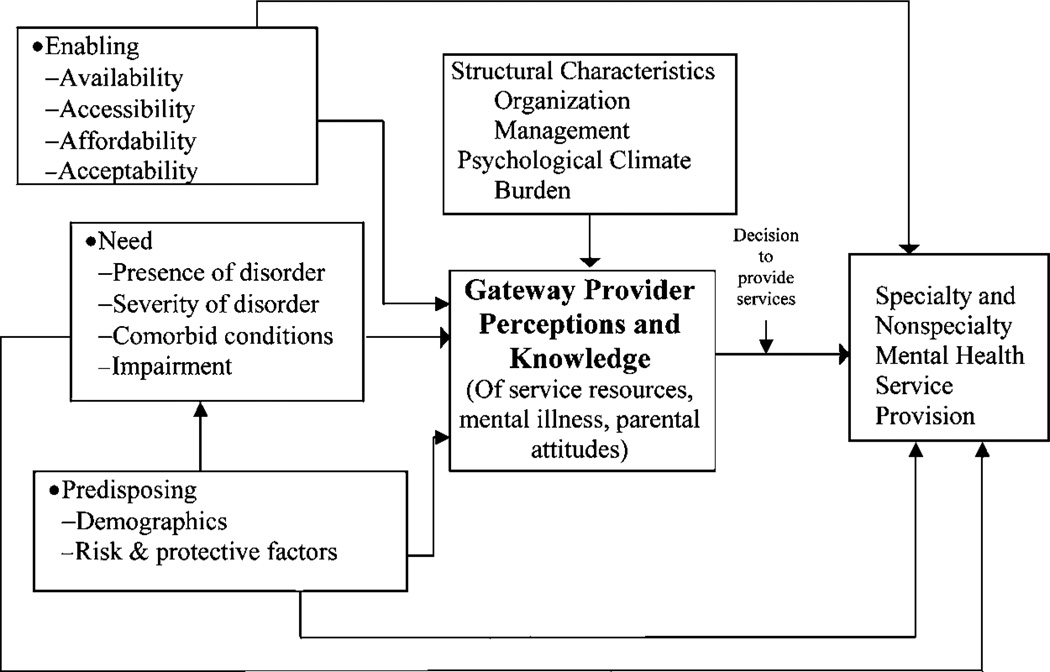
Enhancing the functioning of parents, teachers, juvenile justice authorities, and other health and mental heal professionals who direct children and adolescents to services is a major mental health services concern. The Gateway Provider Model is an elaborated testable subset of the Network-Episode Model (NEM; B. A. Pescosolido & C. A. Boyer, 1999) that synthesizes it with Decision (D. H. Gustafson, et al., 1999) and organizational theory (C. Glisson, 2002; C. Glisson & L. James, 1992, 2002). The Gateway Provider Model focuses on central influences that affect youth's access to treatment, i.e., the individual who first identifies a problem and sends a youth to treatment (the "gateway provider"); and the need those individuals have for information on youth problems and relevant potential resources. Preliminary studies by the authors and other applicable studies (D. Carise & O. Gurel, 2003) show that providers' perception of need, and their knowledge of resources, and their environment are related to the decision to offer or refer to services, supporting key aspects of the Model.
References
-
- Albert DA. Decision theory in medicine: A review and critique. Health and Society. 1978;56(3):362–401. - PubMed
-
- Alegria M, Canino G, Rios R, Vera M, Calderon J, Rusch D, et al. Mental health care for Latinos: Inequalities in use of specialty mental health services among Latinos, African Americans, and non-Latino Whites. Psychiatric Services. 2002;53(12):1547–1555. - PubMed
-
- Andersen RM. Behavioral model of family’s use of health services: Research series, 25. Chicago, IL: University of Chicago, Center for Health Administration Studies; 1968.
-
- Andersen RM. Revisiting the behavioral model and access to medical care: Does it matter? Journal of Health and Social Behavior. 1995;36:1–10. - PubMed