. 2004 Dec 28;101(52):18058-63.
doi: 10.1073/pnas.0408118101. Epub 2004 Dec 13.

Molecular origins of rapid and continuous morphological evolution

Affiliations

Molecular origins of rapid and continuous morphological evolution

John W Fondon 3rd et al. Proc Natl Acad Sci U S A. .

Abstract

Mutations in cis-regulatory sequences have been implicated as being the predominant source of variation in morphological evolution. We offer a hypothesis that gene-associated tandem repeat expansions and contractions are a major source of phenotypic variation in evolution. Here, we describe a comparative genomic study of repetitive elements in developmental genes of 92 breeds of dogs. We find evidence for selection for divergence at coding repeat loci in the form of both elevated purity and extensive length polymorphism among different breeds. Variations in the number of repeats in the coding regions of the Alx-4 (aristaless-like 4) and Runx-2 (runt-related transcription factor 2) genes were quantitatively associated with significant differences in limb and skull morphology. We identified similar repeat length variation in the coding repeats of Runx-2, Twist, and Dlx-2 in several other species. The high frequency and incremental effects of repeat length mutations provide molecular explanations for swift, yet topologically conservative morphological evolution.


Figures
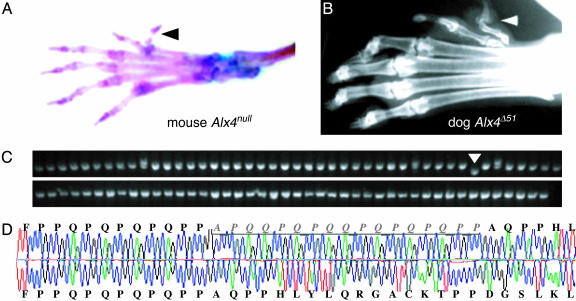
Fig. 1.
Fig. 1.
Large magnitude repeat length mutations can result in gross morphological change. (A) Alx-4–/– mice exhibit a duplication of the first digit (arrowhead). [Adapted with permission from ref. (Copyright 1998, The Company of Biologists).] (B) A radiograph of the rear paw of a Great Pyrenees shows the typical double dewclaw phenotype specified in the breed standard (arrowhead). (C) Polydactylous Great Pyrenees are homozygous for a 51-nucleotide repeat contraction in the Alx-4 gene. PCR amplification of the repeat-containing regions of Alx-4 from 89 dog breeds reveals that this deletion is unique to the Great Pyrenees breed (arrow). Phenotypically normal basset hounds, flat-coated retrievers, and harriers were heterozygous for distinct two amino acid insertions (doublets). (D) DNA sequencing reveals that the deletion is caused by a contraction of the PQn repeat that results in the removal of 17 aa within the repeat.
Fig. 2.
Fig. 2.
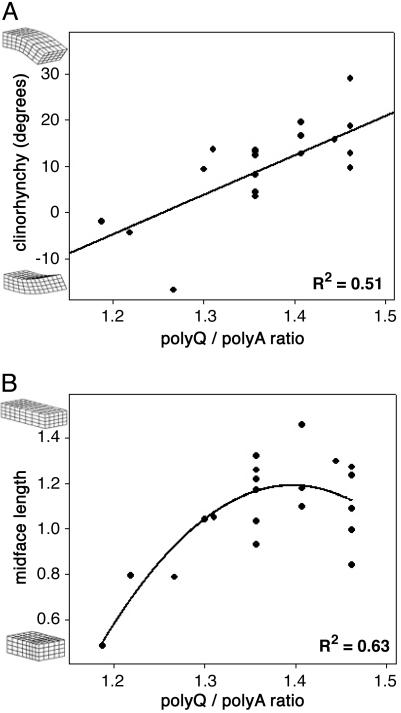
Tandem repeat length in a developmental gene is quantitatively correlated with continuous morphological features. (A and B) Reported (9, 11) effects on transcription of polyglutamine and polyalanine repeats suggested that these two domains may be involved in competitive activities and that the relative lengths of these domains may be more instructive than their aggregate length. A Pearson correlation test of this hypothesis revealed a significant correlation between Runx-2 polyglutamine to polyalanine ratio and clinorhynchy (D/V nose bend, P = 0.0001, Pearson one-sided significance, n = 27, A) and midface length (P = 0.0002, n = 27, B) (24). The nature and direction of these correlations is indicative of longer relative Runx-2 glutamine repeats resulting in increased midface growth, consistent with observations from human cleidocranial dysplasia patients (25). Published studies (–16) indicate that amino acid repeat length-function relationships are typically nonlinear; however, fitting a quadratic or exponential to the clinorhynchy data (A) does not provide sufficient improvement in residuals to support the use of a nonlinear function over a simple line.
Fig. 3.
Fig. 3.
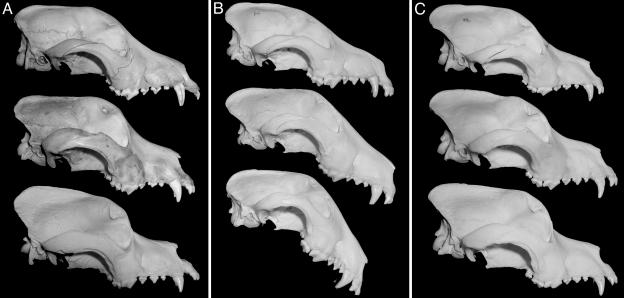
Rapid and sustained evolution of breeds. (A) Purebred St. Bernard skulls from ≈1850 (Top), 1921 (Middle), and 1967 (Bottom). (B) Purebred bull terrier skulls from 1931 (Top), 1950 (Middle), and 1976 (Bottom) (24). (C) Purebred Newfoundland skulls from 1926 (Top), 1964 (Middle), and 1971 (Bottom). Despite the lack of genetic diversity caused by population structure and history, these breeds are able to continually create new and more extreme morphological variations at a rapid and sustained pace. Analysis of the Runx-2 repeats in the 1931 bull terrier reveals a more intermediate allele (Q19A14) than is present in the modern bull terrier (Q19A13).

References

    1. Darwin, C. (1859) On the Origin of Species by Means of Natural Selection, or the Preservation of Favoured Races in the Struggle for Life (Murray, London), 4th Ed., pp. 359–360. - PMC - PubMed
    1. Mayr, E. (1954) in Evolution as a Process, ed. Huxley, J. (Allen and Unwin, London), pp. 157–180.
    1. Eldredge, N. & Gould, S. J. (1972) in Models in Paleobiology, ed. Schopf, T. J. M. (Freeman & Cooper, San Francisco), pp. 305–332.
    1. Thompson, D'A. W. (1917) On Growth and Form (Dover, New York).
    1. Carroll, S. B. (2000) Cell 101, 577–580. - PubMed

Publication types

MeSH terms