. 2005 Jan;79(1):28-38.
doi: 10.1128/JVI.79.1.28-38.2005.

Identification of an adeno-associated virus Rep protein binding site in the adenovirus E2a promoter

Affiliations

Identification of an adeno-associated virus Rep protein binding site in the adenovirus E2a promoter

John M Casper et al. J Virol. 2005 Jan.

Abstract

Adeno-associated virus (AAV) and other parvoviruses inhibit proliferation of nonpermissive cells. The mechanism of this inhibition is not thoroughly understood. To learn how AAV interacts with host cells, we investigated AAV's interaction with adenovirus (Ad), AAV's most efficient helper virus. Coinfection with Ad and AAV results in an AAV-mediated inhibition of Ad5 gene expression and replication. The AAV replication proteins (Rep) activate and repress gene expression from AAV and heterologous transcription promoters. To investigate the role of Rep proteins in the suppression of Ad propagation, we performed chromatin immunoprecipitation analyses that demonstrated in vivo AAV Rep protein interaction with the Ad E2a gene promoter. In vitro binding of purified AAV Rep68 protein to the Ad E2a promoter was characterized by electrophoretic mobility shift assays (Kd= 200 +/- 25 nM). A 38 bp, Rep68-protected region (5'-TAAGAGTCAGCGCGCAGTATTTACTGAAGAGAGCCT-3') was identified by DNase I footprint analysis. The 38-bp protected region contains the weak E2a TATA box, sequence elements that resemble the Rep binding sites identified by random sequence oligonucleotide selection, and the transcription start site. These results suggest that Rep binding to the E2a promoter contributes to the inhibition of E2a gene expression from the Ad E2a promoter and may affect Ad replication.


Figures
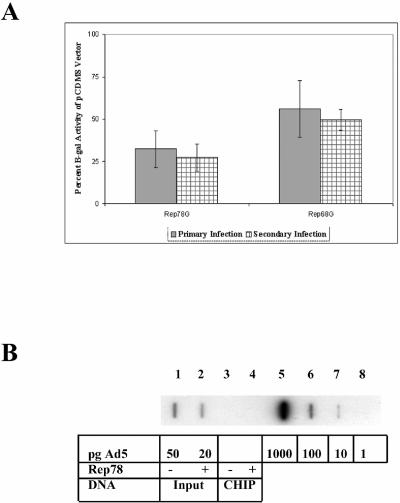
FIG. 1.
FIG. 1.
AAV2 Rep proteins inhibit Ad5 replication. (A) β-Gal activity was measured from HeLa cell extracts obtained after transfection with pCDM8 plasmids expressing Rep proteins and infected with Ad5lacZ5. β-Gal activity was normalized to the pCDM8 vector control (not shown). Error bars represent the standard deviations from four experiments performed in triplicate (n = 12). (B) Slot blot hybridization analysis on nuclear extracts from HeLa cells with radiolabeled Ad5 probe. HeLa cells were transfected with either pCDM8 (slots 1 and 3) or pCDMRep78 (slots 2 and 4). Input slots contain equal amounts of chromatin, as determined by the absorbance at 260 nm. CHIP slots contain chromatin-immunoprecipitated DNA. Slots 5 to 8 contain decreasing amounts of the Ad5 genome excised from plasmid pJM17. The radioactive signal in slots 5 to 8 was measured with a phosphorimager, and the amount of DNA in slots 1 to 4 was determined by comparison to the known amounts of DNA in slots 5 to 8.
FIG. 2.
FIG. 2.
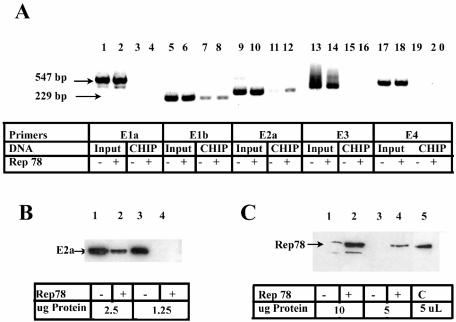
Rep78 protein is preferentially cross-linked at the Ad5 E2a promoter region. (A) CHIP assay from nuclear lysates of Ad5-infected cells transfected with pCDMRep78. Input DNA (before immunoprecipitation, diluted 1:1,000) and CHIP DNA (after immunoprecipitation, 1 μl) were amplified by using Ad5 promoter region primers. PCR products were separated by agarose gel electrophoresis and stained with ethidium bromide. Lanes labeled “+” were from cells transfected with pCDMRep78; lanes labeled “−” were from cells transfected with pCDM8. The sizes of the largest and smallest products are indicated at the left side of the gel. Equal amounts of protein were compared from nuclear lysates for the expression of E2a (B) and Rep78 (C). Lysates were from Ad-infected HeLa cells transfected with pCDM8 (lanes 1 and 3) or pCDMRep78 (lanes 3 and 4). Lane 5 in panel C contains a positive control for the Rep78 protein.
FIG. 3.
FIG. 3.
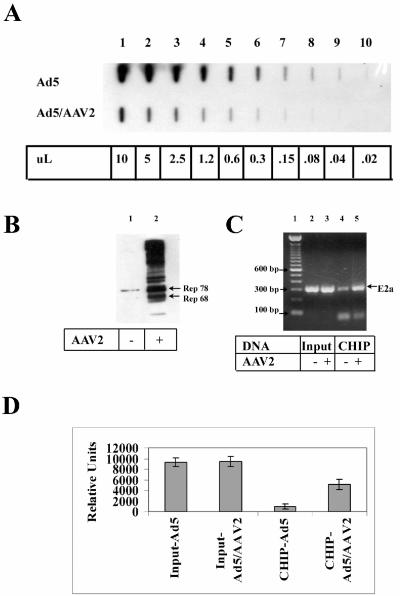
Rep proteins are cross-linked to the Ad5 E2a promoter region during AAV2 coinfection. (A) Equal amounts of DNA from formaldehyde-cross-linked nuclei from Ad5-infected or Ad5- and AAV-coinfected HeLa cells were analyzed by slot blot hybridization with an Ad5 probe. The numbers at the bottom of the panel refer to the amount of purified DNA from the original 50 μl obtained after chromatin isolation. (B) The presence of the Rep proteins was verified by SDS-PAGE and immunoblot analysis after CHIP analyses. Lane 1 is from Ad-infected cells, and lane 2 is from Ad-AAV-coinfected cells. (C) CHIP analysis was performed with primers that amplify the Ad5 E2a region. Equivalent amounts of input (lanes 2 and 3) and CHIP (lanes 4 and 5) Ad DNA (as determined in panel A) were amplified and separated by agarose gel electrophoresis. Lane 1 contains 1.0 μg of 100-bp DNA ladder separated. (D) The ethidium-bromide stained bands from panel C were quantitated by using a Kodak Image Station 440 from PCRs performed in triplicate. Error bars represent standard deviations.
FIG. 4.
FIG. 4.
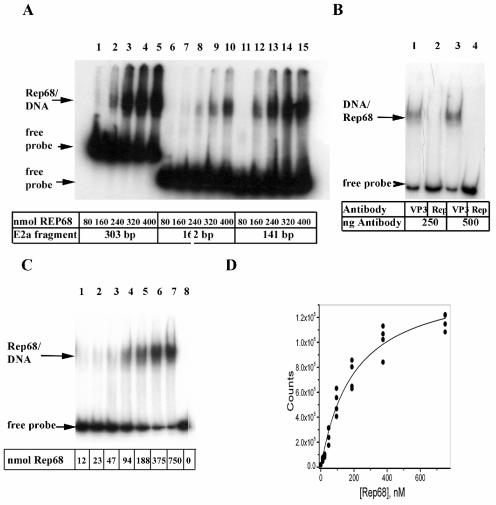
Characterization of Rep68 binding to the E2a promoter region by EMSA. (A) The 303-bp promoter element from pE2aLUC was obtained by digestion with HindIII and XhoI and end labeled. The 162- and 141-bp promoter fragments were obtained by digestion of the 303-bp element with NciI. EMSA was performed by using ∼10 fmol of each DNA fragment with increasing amounts of Rep68 protein. (B) The 303-bp fragment was used as a template to amplify a 150-bp fragment containing sequences essentially identical to the 141-bp element in panel A. Primers corresponding to the ends of the 141-bp fragment (with an additional 9 nt) were used to amplify the 150-bp fragment in a reaction containing [α-32P]dATP. EMSA was performed by using both affinity purified VP3 and Rep antibody. Totals of 250 and 500 ng of antibody were used. Antibodies contained ∼50 μg of IgG/ml. (C) Increasing amounts of Rep68 were added to 7.5 fmol of the 150-bp fragment. (D) The dissociation constant was determined after performing the titration in panel C in quadruplicate. The dried gel was exposed to a phosphorimager cassette, and densitometry was performed with ImageQuant software.
FIG. 5.
FIG. 5.
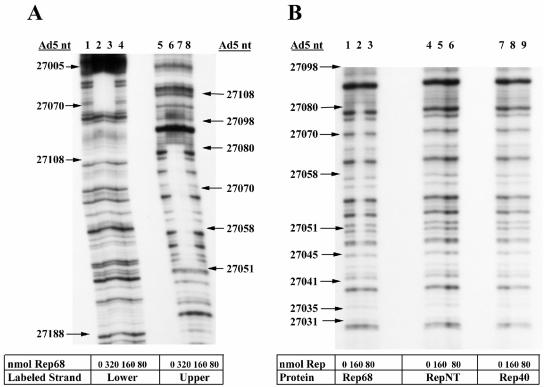
Rep68 protects a region of the Ad5 E2a promoter from DNase I digestion. (A) DNase I protection assays were performed on the 303-bp fragment (∼600 pmol) containing labeled lower strand (lanes 1 to 4) or labeled upper strand (lanes 5 to 8) with decreasing concentrations of Rep68. (B) DNase I protection assays were performed on labeled upper strand in the presence of Rep68, RepNT, and Rep40. Radiolabeled DNA size markers (not shown) were used to determine the corresponding nucleotide position in the Ad5 genome.
FIG. 6.
FIG. 6.
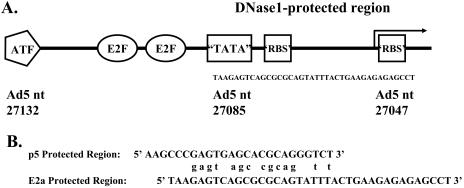
Ad5 E2a and AAV p5 promoter regions protected by Rep68. (A) Schematic diagram of the Ad5 E2a promoter showing principal transcription factor binding sites and the transcription start site (arrow). The DNase I-protected region is bracketed. (B) Sequences between the TATA box (underlined) and transcription start sites (arrows) for the AAV p5 and Ad E2a transcription promoters. A total of 14 identical nucleotides that are found in the DNase I-protected regions are indicated.

References

    1. Antoni, B. A., A. B. Rabson, I. L. Miller, J. P. Trempe, N. Chejanovsky, and B. J. Carter. 1991. Adeno-associated virus Rep protein inhibits human immunodeficiency virus type 1 production in human cells. J. Virol. 65:396-404. - PMC - PubMed
    1. Bantel-Schaal, U., and H. zur Hausen. 1988. Adeno-associated viruses inhibit SV40 DNA amplification and replication of herpes simplex virus in SV40-transformed hamster cells. Virology 164:64-74. - PubMed
    1. Batchu, R. B., and P. L. Hermonat. 1995. The trans-inhibitory Rep78 protein of adeno-associated virus binds to TAR region DNA of the human immunodeficiency virus type 1 long terminal repeat. FEBS Lett. 367:267-271. - PubMed
    1. Batchu, R. B., M. A. Shammas, J. Y. Wang, and N. C. Munshi. 2001. Dual level inhibition of E2F-1 activity by adeno-associated virus Rep78. J. Biol. Chem. 276:24315-24322. - PubMed
    1. Buller, R. M., J. E. Janik, E. D. Sebring, and J. A. Rose. 1981. Herpes simplex virus types 1 and 2 completely help adenovirus-associated virus replication. J. Virol. 40:241-247. - PMC - PubMed

Publication types

MeSH terms

LinkOut - more resources