


Regulation of uptake and processing of the quorum-sensing autoinducer AI-2 in Escherichia coli
- PMID: 15601708
- PMCID: PMC538819
- DOI: 10.1128/JB.187.1.238-248.2005
Regulation of uptake and processing of the quorum-sensing autoinducer AI-2 in Escherichia coli
Abstract
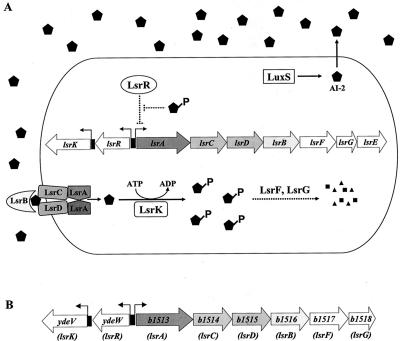
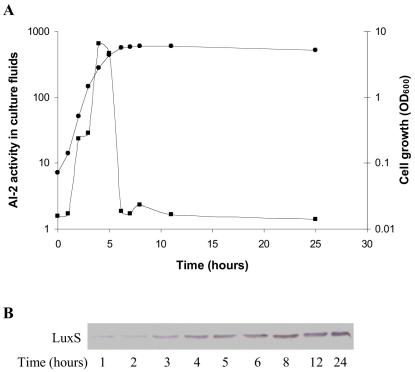
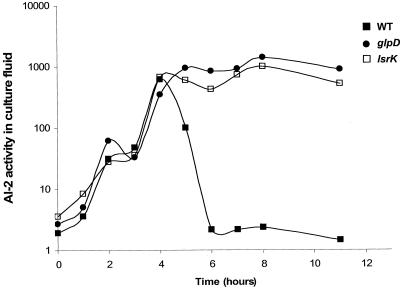
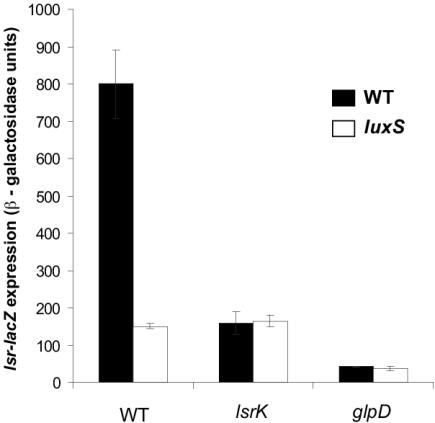
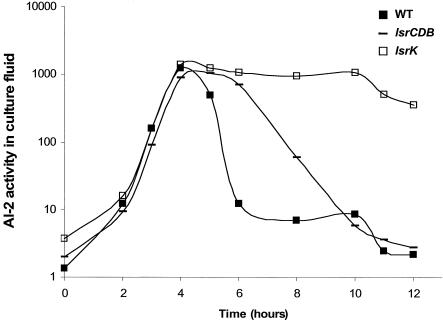
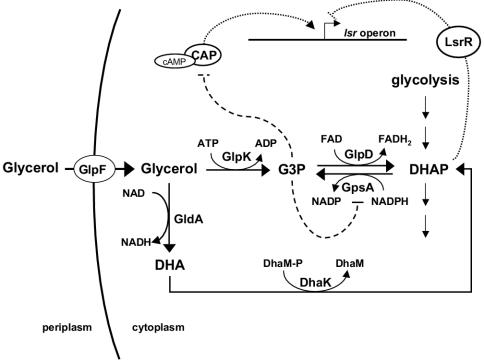
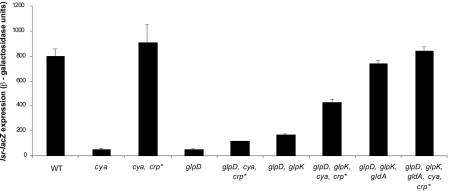
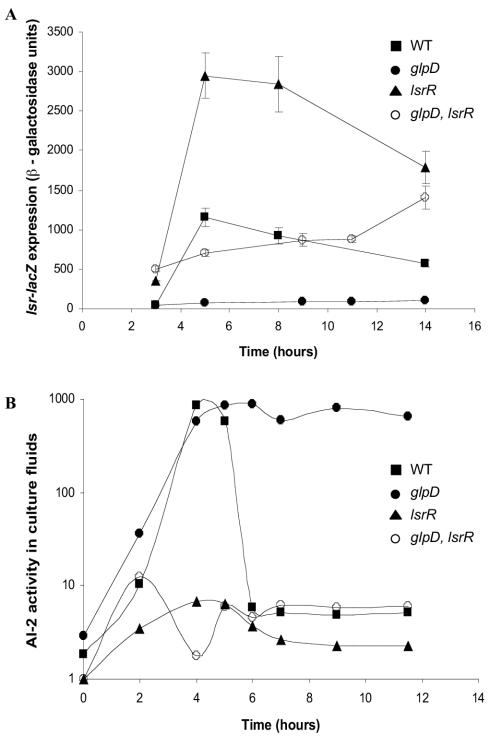
AI-2 is a quorum-sensing signaling molecule proposed to be involved in interspecies communication. In Escherichia coli and Salmonella enterica serovar Typhimurium, extracellular AI-2 accumulates in exponential phase, but the amount decreases drastically upon entry into stationary phase. In S. enterica serovar Typhimurium, the reduction in activity is due to import and processing of AI-2 by the Lsr transporter. We show that the Lsr transporter is functional in E. coli, and screening for mutants defective in AI-2 internalization revealed lsrK and glpD. Unlike the wild type, lsrK and glpD mutants do not activate transcription of the lsr operon in response to AI-2. lsrK encodes the AI-2 kinase, and the lsrK mutant fails to activate lsr expression because it cannot produce phospho-AI-2, which is the lsr operon inducer. glpD encodes the glycerol-3-phosphate (G3P) dehydrogenase, which is involved in glycerol and G3P metabolism. G3P accumulates in the glpD mutant and represses lsr transcription by preventing cyclic AMP (cAMP)-catabolite activator protein (CAP)-dependent activation. Dihydroxyacetone phosphate (DHAP) also accumulates in the glpD mutant, and DHAP represses lsr transcription by a cAMP-CAP-independent mechanism involving LsrR, the lsr operon repressor. The requirement for cAMP-CAP in lsr activation explains why AI-2 persists in culture fluids of bacteria grown in media containing sugars that cause catabolite repression. These findings show that, depending on the prevailing growth conditions, the amount of time that the AI-2 signal is present and, in turn, the time that a given community of bacteria remains exposed to this signal can vary greatly.
Figures
References
-
- Bassler, B. L., M. Wright, R. E. Showalter, and M. R. Silverman. 1993. Intercellular signalling in Vibrio harveyi: sequence and function of genes regulating expression of luminescence. Mol. Microbiol. 9:773-786. - PubMed
-
- Bassler, B. L., M. Wright, and M. R. Silverman. 1994. Multiple signalling systems controlling expression of luminescence in Vibrio harveyi: sequence and function of genes encoding a second sensory pathway. Mol. Microbiol. 13:273-286. - PubMed
-
- Bell, R. M., and J. E. Cronan, Jr. 1975. Mutants of Escherichia coli defective in membrane phospholipid synthesis. Phenotypic suppression of sn-glycerol-3-phosphate acyltransferase Km mutants by loss of feedback inhibition of the biosynthetic sn-glycerol-3-phosphate dehydrogenase. J. Biol. Chem. 250:7153-7158. - PubMed
-
- Blattner, F. R., G. Plunkett III, C. A. Bloch, N. T. Perna, V. Burland, M. Riley, J. Collado-Vides, J. D. Glasner, C. K. Rode, G. F. Mayhew, J. Gregor, N. W. Davis, H. A. Kirkpatrick, M. A. Goeden, D. J. Rose, B. Mau, and Y. Shao. 1997. The complete genome sequence of Escherichia coli K-12. Science 277:1453-1474. - PubMed
Publication types
MeSH terms
Substances
Grants and funding
LinkOut - more resources
Full Text Sources
Other Literature Sources
Molecular Biology Databases
Miscellaneous
