. 2005 Jan;25(1):233-40.
doi: 10.1128/MCB.25.1.233-240.2005.

Characterization of a U2AF-independent commitment complex (E') in the mammalian spliceosome assembly pathway

Affiliations

Characterization of a U2AF-independent commitment complex (E') in the mammalian spliceosome assembly pathway

Oliver A Kent et al. Mol Cell Biol. 2005 Jan.

Abstract

Early recognition of pre-mRNA during spliceosome assembly in mammals proceeds through the association of U1 small nuclear ribonucleoprotein particle (snRNP) with the 5' splice site as well as the interactions of the branch binding protein SF1 with the branch region and the U2 snRNP auxiliary factor U2AF with the polypyrimidine tract and 3' splice site. These factors, along with members of the SR protein family, direct the ATP-independent formation of the early (E) complex that commits the pre-mRNA to splicing. We report here the observation in U2AF-depleted HeLa nuclear extract of a distinct, ATP-independent complex designated E' which can be chased into E complex and itself commits a pre-mRNA to the splicing pathway. The E' complex is characterized by a U1 snRNA-5' splice site base pairing, which follows the actual commitment step, an interaction of SF1 with the branch region, and a close association of the 5' splice site with the branch region. These results demonstrate that both commitment to splicing and the early proximity of conserved sequences within pre-mRNA substrates can occur in a minimal complex lacking U2AF, which may function as a precursor to E complex in spliceosome assembly.


Figures
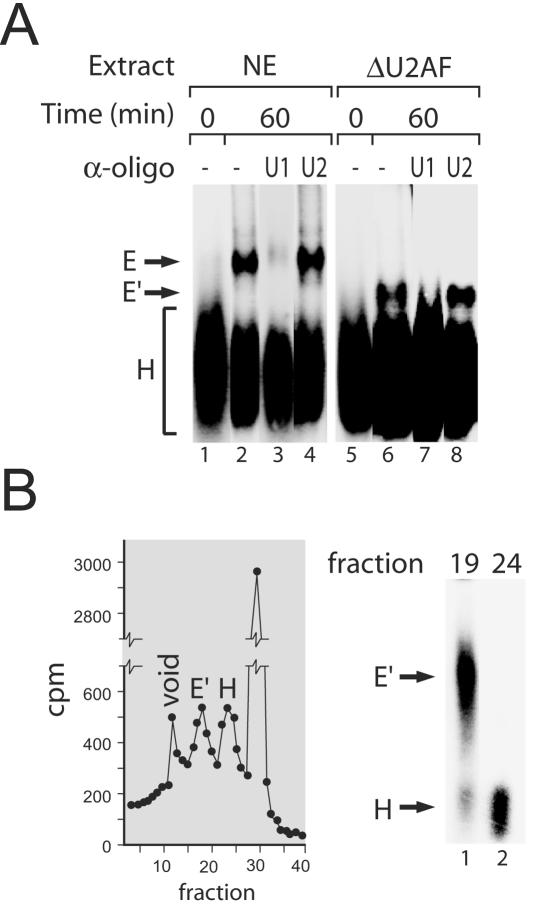
FIG. 1.
FIG. 1.
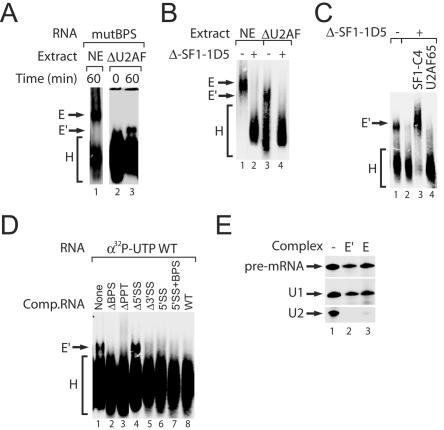
Identification of a novel prespliceosome complex (E′). (A) Native agarose gel shift analysis of complexes formed in nuclear extract (NE) and U2AF-depleted nuclear extract (ΔU2AF). Complex formation was analyzed in the presence and absence of anti-U1 and anti-U2 oligonucleotides. (B) Gel filtration column purification of the E′ complex from U2AF-depleted extract. (Left panel) Pre-mRNA elution profile of column-purified prespliceosome reaction. The void volume and E′ and H complexes are indicated. (Right panel) Native agarose gel analysis of an aliquot of fraction 19 (E′, lane 1) and fraction 24 (H, lane 2).
FIG. 2.
FIG. 2.
Formation of the E′ complex requires SF1, and the complex contains U1 snRNP. (A) E′ complex formation in the absence of a functional BPS within the pre-mRNA. Complexes were formed on pre-mRNAs containing a scrambled BPS (mutBPS) in wild-type nuclear extract (NE) or U2AF-depleted nuclear extract (ΔU2AF). (B) E′ complex formation requires the branch binding protein SF1. Native agarose gel shift of complexes formed in wild-type (NE) or U2AF-depleted (ΔU2AF) nuclear extract which had been SF1 immunodepleted (+). (C) SF1 reconstitutes formation of E′ in depleted extracts. Native agarose gel shift of complexes formed in U2AF-depleted nuclear extract which had been SF1 immunodepleted (+) and reconstituted with recombinant SF1-C4 mutant (lane 3) or U2AF65 (lane 4). (D) E′ complex formation is dependent on the presence of a 5′ splice site within the pre-mRNA. Complexes were formed on a body-labeled ([α-32P]UTP) wild-type (WT) pre-mRNA in extract saturated with unlabeled mutant competitor RNA. (E) E′ complex contains U1 snRNP. Shown are results from RT primer extension of RNAs purified from isolated complexes (lanes 2 and 3) and RNA isolated from an aliquot of precipitated nuclear extract (lane 1). The pre-mRNA, U1 snRNA, and U2 snRNA are indicated.
FIG. 3.
FIG. 3.
Commitment of pre-mRNA to splicing in the absence of U2AF. (A) The E′ complex contains commitment ability. RNAs were preincubated in nuclear extract (NE) or U2AF-depleted nuclear extract (ΔU2AF) and chased with wild-type nuclear extract saturated with increasing competitor RNA (0.8, 1.4, or 5 pmol). Splicing substrates, products, and intermediates are indicated. (B) Quantification of splicing products (from panel A) generated after the formation of commitment complexes at 30°C under E complex-forming conditions in wild-type extract [NE(30)] or E′ complex-forming conditions in U2AF-depleted extract [ΔU2AF(30)] alongside a control reaction in wild-type extract incubated on ice [NE(0)]. (C) The E′ complex is a precursor to the E complex. Preformed E′ complex chased with nuclear extract (NE; lanes 1 and 2), U2AF65 (lanes 3 and 4) or U2AF65/35 heterodimer (lanes 5 and 6) shifts E′ complex to E complex.
FIG. 4.
FIG. 4.
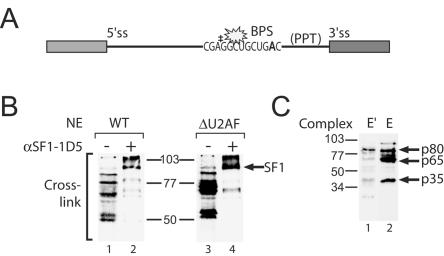
E′ complex contains SF1 at the branch point. (A) Pre-mRNA containing a unique 32P label (‡) was site-specifically modified with benzophenone (star) at the BPS. (B) Cross-linking SF1 to the branch region under E′ complex conditions. Modified pre-mRNAs were incubated in wild-type (WT) or U2AF-depleted (ΔU2AF) nuclear extracts under E (lanes 1 and 2) and E′ (lanes 3 and 4) complex-forming conditions, irradiated with UV light, treated with RNase A, and analyzed by SDS-PAGE before (lanes 1 and 3) and after (lanes 2 and 4) immunoprecipitation with anti-SF1 antibody (anti-SF1-1D5). The position of SF1 is indicated. (C) E′ complex contains SF1. Proteins cross-linked to the BPS were purified from agarose gel-isolated E′ complex (lane1) and E complex (lane 2). Indicated are molecular weight markers and cross-links to p80, p65, and p35 proteins.
FIG. 5.
FIG. 5.
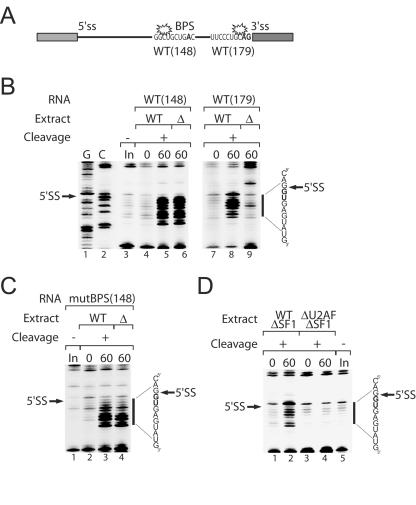
Directed hydroxyl radical cleavage of pre-mRNA within the ATP-independent prespliceosome complexes. (A) Pre-mRNA substrate derivatized with Fe-BABE (star) at the branch region [WT(148)] or 3′ splice site [WT(179)]. (B) Analysis of pre-mRNA cleavage at the 5′ splice site in E and E′ complexes. Reactions were performed in nuclear extract (WT) and U2AF-depleted (Δ) nuclear extract probed with WT148 (lanes 4 to 6) or WT179 (lanes 7 to 9) pre-mRNAs. Fe-BABE cleavage reactions were initiated after incubation at 30°C for 0 or 60 min. Reverse transcription of cleavage reactions were compared to input RNA (In; lane 3) for location of reverse transcription stops. G and C sequencing is shown (lanes 1 and 2). (C) Analysis of pre-mRNA cleavage at the 5′ splice site with mutant BPS pre-mRNAs. Pre-mRNAs derivatized at position 148 containing a scrambled branch region were probed in wild-type (WT) and U2AF-depleted (Δ) nuclear extracts. Fe-BABE cleavage reactions were initiated after incubation at 30°C for 0 or 60 min. Cleavage reactions (lanes 2 to 4) were compared to input RNA (In; lane 1) for location of reverse transcription stops. (D) Analysis of pre-mRNA cleavage at the 5′ splice site in SF1-depleted extracts. Reactions were performed in SF1-depleted nuclear extract (WT ΔSF1) or ΔU2AF SF1-depleted extract (ΔU2AF ΔSF1) and probed with WT148 pre-mRNA. Fe-BABE cleavage reactions were initiated after incubation at 30°C for 0 or 60 min. Reverse transcription lanes of cleavage reactions were compared to input RNA (In; lane 5) for location of reverse transcription stops. The location of and sequence around the 5′ splice site are indicated. Regions of significant cleavage are represented by the vertical bar.
FIG. 6.
FIG. 6.
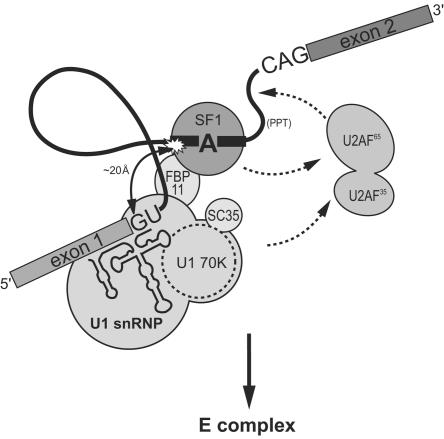
Assembly of the E complex proceeds through early recognition of the 5′ splice site-branch region followed by recruitment of U2AF to the polypyrimidine tract. Pre-mRNAs are committed to prespliceosome assembly by the association of U1 snRNP with the 5′ splice site. SF1 interacts with the branch point sequence and may contact FBP11, providing a bridging interaction between SF1 and U1 snRNP. This interaction results in the proximity of the BPS and the 5′ splice site (curved arrow). U1 snRNP and/or SF1 recruit U2AF to the polypyrimidine tract (dotted arrows) resulting in structural reorganization of the 3′ splice site and E complex formation.

References

    1. Abovich, N., and M. Rosbash. 1997. Cross-intron bridging interactions in the yeast commitment complex are conserved in mammals. Cell 89:403-412. - PubMed
    1. Abovich, N., X. C. Liao, and M. Rosbash. 1994. The yeast MUD2 protein: an interaction with PRP11 defines a bridge between commitment complexes and U2 snRNP addition. Genes Dev. 8:843-854. - PubMed
    1. Barabino, S. M. L., B. J. Blencowe, U. Ryder, B. S. Sproat, and A. I. Lamond. 1990. Targeted snRNP depletion reveals an additional role for mammalian U1 snRNP in spliceosome assembly. Cell 63:293-302. - PubMed
    1. Berglund, J. A., N. Abovich, and M. Rosbash. 1998. A cooperative interaction between U2AF65 and mBBP/SF1 facilitates branchpoint region recognition. Genes Dev. 12:858-867. - PMC - PubMed
    1. Blencowe, B. J., and A. I. Lamond. 1999. Purification and depletion of RNP particles by antisense affinity chromatography. Methods Mol. Biol. 118:275-287. - PubMed

Publication types

MeSH terms