. 2004 Dec 15;32(22):6605-16.
doi: 10.1093/nar/gkh1004. Print 2004.

Genome-wide prediction of stop codon readthrough during translation in the yeast Saccharomyces cerevisiae

Affiliations

Genome-wide prediction of stop codon readthrough during translation in the yeast Saccharomyces cerevisiae

I Williams et al. Nucleic Acids Res. .

Abstract

In-frame stop codons normally signal termination during mRNA translation, but they can be read as 'sense' (readthrough) depending on their context, comprising the 6 nt preceding and following the stop codon. To identify novel contexts directing readthrough, under-represented 5' and 3' stop codon contexts from Saccharomyces cerevisiae were identified by genome-wide survey in silico. In contrast with the nucleotide bias 3' of the stop codon, codon bias in the two codon positions 5' of the termination codon showed no correlation with known effects on stop codon readthrough. However, individually, poor 5' and 3' context elements were equally as effective in promoting stop codon readthrough in vivo, readthrough which in both cases responded identically to changes in release factor concentration. A novel method analysing specific nucleotide combinations in the 3' context region revealed positions +1,2,3,5 and +1,2,3,6 after the stop codon were most predictive of termination efficiency. Downstream of yeast open reading frames (ORFs), further in-frame stop codons were significantly over-represented at the +1, +2 and +3 codon positions after the ORF, acting to limit readthrough. Thus selection against stop codon readthrough is a dominant force acting on 3', but not on 5', nucleotides, with detectable selection on nucleotides as far downstream as +6 nucleotides. The approaches described can be employed to define potential readthrough contexts for any genome.


Figures
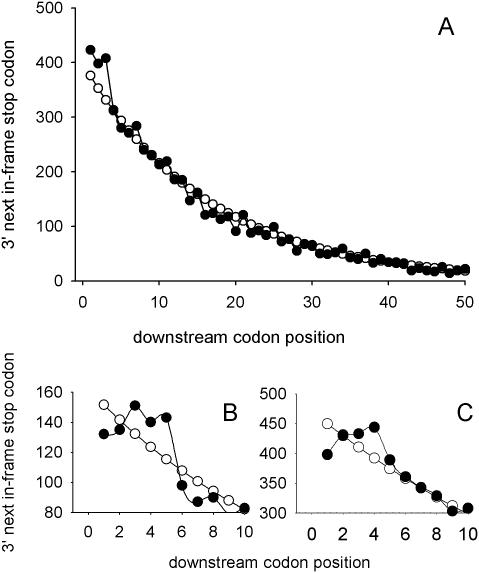
Figure 1
Figure 1
Three fungal species have a significantly increased abundance of second, in-frame stop codons downstream of ORFs. (A) The lengths of the downstream ORF 3′ of all yeast ORFs was recorded, identifying the position of the next-in-frame stop codon for all genes in S.cerevisiae. The data were separated into bins corresponding to the first 50 codon positions after the ORF stop codon, giving the frequency of ‘next in-frame’ stops for each codon position. These observed frequencies (closed circles) were plotted along with an expected frequency (open circles) derived using a geometric probability distribution and knowledge of the probability of encountering a stop codon in the 3′-UTR (Materials and Methods). The analysis was repeated for all ORFs on chromosome I of S.pombe (B), and the complete Neurospora crassa genome (C).
Figure 2
Figure 2
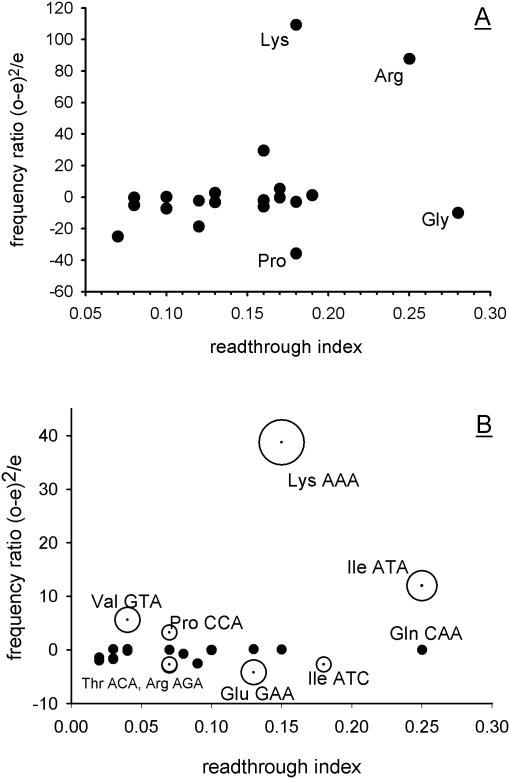
Codon bias at the −1 and −2 codon positions preceding the stop codon is not predictive of effects on stop codon readthrough. Codon usage at the −1 and −2 codon positions preceding the stop codon was recorded for all S.cerevisiae ORFs. These observed frequencies (o) were compared with expected frequencies (e) derived from a codon usage table for all yeast ORFs. A frequency ratio [(oe)2/e] was calculated for each of the codons at the −1 position. For the −2 position, the encoded amino acid frequency was recorded (the primary readthrough determinant at this position (15). The frequency ratio was assigned a polarity depending on whether the codon or encoded amino acid was either over-represented (positive polarity) or under-represented (negative polarity) relative to the expected frequency. (A) The −2 position codons were surveyed for all yeast genes, and the polar chi-squared values for each amino acid were plotted against the known effect of amino acid at this position on stop codon readthrough (15). (B) The process was repeated for −1 position codons, surveyed in a sub-set of genes containing other poor −2 position and stop codon context elements (see text for details). The significance level of under- or over-abundance of −1 position codons is indicated by the three sizes of bubbles used [0.001% (largest), 0.01% and 0.1% (smallest)].
Figure 3
Figure 3
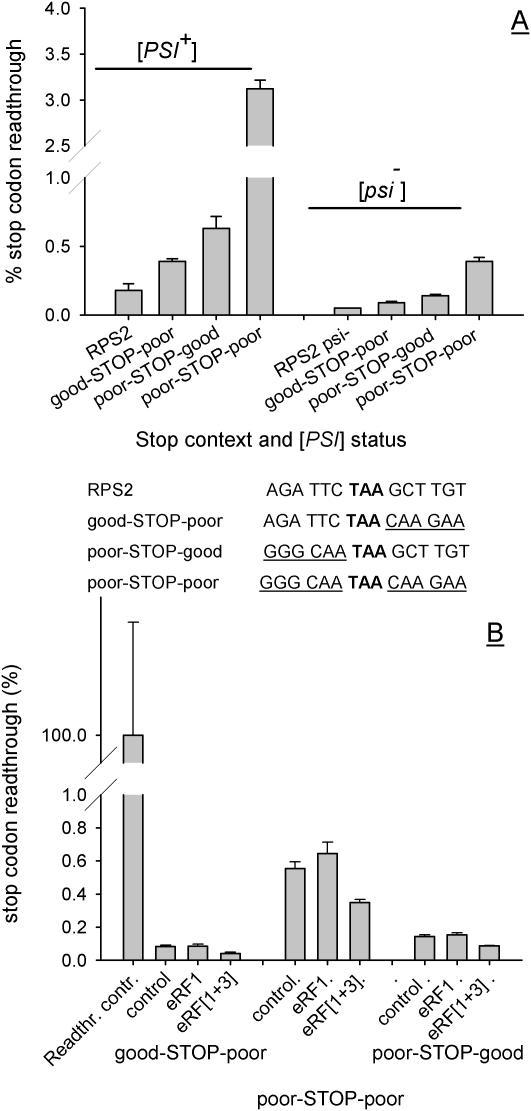
Stop codon readthrough directed by either poor 5′ or 3′ context is identically responsive to release factor levels. Sequences of 6 nt representing poor 5′ or 3′ stop codon contexts were used singly or in combination to replace the stop codon context elements of the RPS2 gene [hybrid sequences listed in (A)], and cloned into a dicistronic stop codon readthrough vector system (Materials and Methods). (A) Plasmids pAC98-RPS2, pAC98-GP, pAC98-PP and pAC98-PG were transformed into the [PSI+] and [psi] derivatives of yeast strain 76D694, and levels of stop codon readthrough determined. (B) Levels of stop codon readthrough were measured in the same strains additionally transformed with either the pRS426 and YEp24 vectors (labelled control), pRS426 with the multicopy eRF1 vector pUKC802 (labelled eRF1), or pJR16 and pUKC802 which together direct over-expression of both release factors (labelled eRF[1+3]). For (A and B), the mean of three readthrough determinations is shown (bars represent the SD, n = 3).
Figure 4
Figure 4
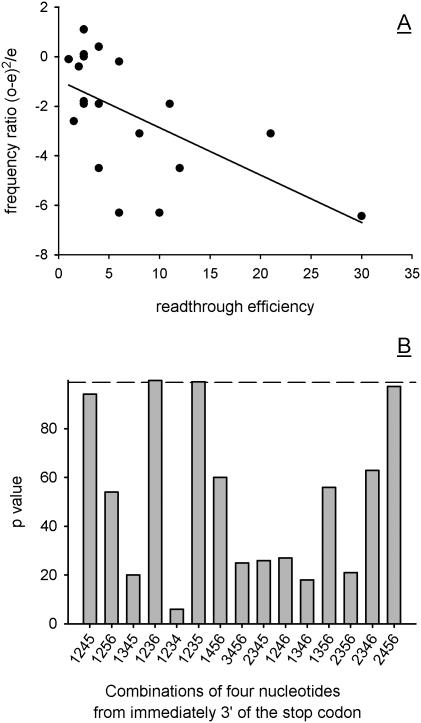
Identifying key nucleotide components of the 3′ stop codon context. Fifteen different tetramer combinations of nucleotide positions (sub-contexts) from within the six nucleotide positions downstream of the stop codon were tested for an inverse correlation between tetramer sequence usage and known effects on stop codon readthrough. A set of 19 known 3′ contexts known to confer leakiness on the upstream stop codon was used to calibrate the predictive quality of each of the 15 sub-contexts. The frequency of these reference tetrameric sequences in control (3′-UTR) and stop codon flanking populations was compared, producing expected and observed frequencies, respectively. These were used to calculate frequency ratios [(oe)2/e], which were plotted against known readthrough levels for the 22 reference 3′ contexts. The +1235 subcontext correlation between abundance in the genome and stop codon readthrough efficiency is shown (A). Linear regression analysis was carried out on this type of correlation plot for all 15 sub-context types. The regression p value obtained in each case was plotted in histogram form (B). For reference, the dotted line shows the 99% significance cut-off used.
Figure 5
Figure 5
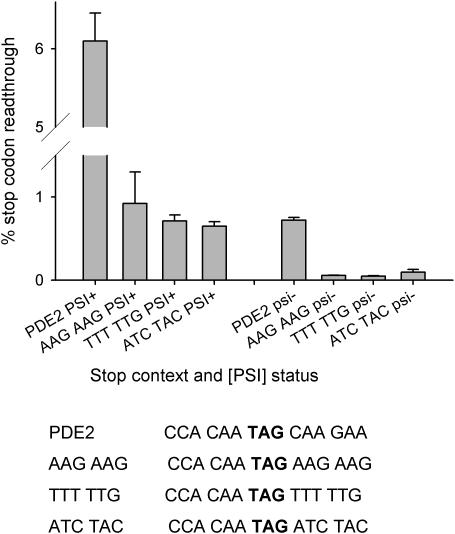
Testing potential readthrough contexts identified through analysis of genome-wide 3′ contexts. Sequences of 6 nt identified in the 3′ context genome screen which represent potential poor 3′ stop codon contexts were tested for their ability to direct stop codon readthrough. The nucleotide hexamers AAGAAG and TTTTTG were used to replace the corresponding 3′ context element of the PDE2 stop codon environment placed in the pAC98 readthrough test system (Materials and Methods). The PDE2 3′ context was used as a positive control, and an over-represented 3′ sequence (ATCTAC) as a negative control. Levels of stop codon readthrough were determined in both [PSI+] and [psi] derivatives of yeast strain 76D694. The mean of three readthrough determinations is shown (bars represent the SD, n = 3).

References

    1. Frolova L., Le Goff,X., Rasmussen,H.H., Cheperegin,S., Drugeon,G., Kress,M., Arman,I., Haenni,A.L., Celis,J.E., Philippe,M. et al. (1994) A highly conserved eukaryotic protein family possessing properties of polypeptide-chain release factor. Nature, 372, 701–703. - PubMed
    1. Zhouravleva G., Frolova,L., Le Goff,X., Leguellec,R., Ingevechtomov,S., Kisselev,L. and Philippe,M. (1995) Termination of translation in eukaryotes is governed by 2 interacting polypeptide-chain release factors, eRF1 and eRF3. EMBO J., 14, 4065–4072. - PMC - PubMed
    1. Stansfield I., Jones,K.M., Kushnirov,V.V., Dagkesamanskaya,A.R., Poznyakovski,A.I., Paushkin,S.V., Nierras,C.R., Cox,B.S., Teravanesyan,M.D. and Tuite,M.F. (1995) The products of the sup45 (erf1) and sup35 genes interact to mediate translation termination in Saccharomyces cerevisiae. EMBO J., 14, 4365–4373. - PMC - PubMed
    1. Bertram G., Innes,S., Minella,O., Richardson,J. and Stansfield,I. (2001) Endless possibilities: translation termination and stop codon recognition. Microbiology, 147, 255–269. - PubMed
    1. Edelman I. and Culbertson,M.R. (1991) Exceptional codon recognition by the glutamine transfer-RNAs in Saccharomyces cerevisiae. EMBO J., 10, 1481–1491. - PMC - PubMed

Publication types

MeSH terms