


doi: 10.1073/pnas.0405919102.
Epub 2004 Dec 16.
Detecting genetic drift versus selection in human evolution
Affiliations
- PMID: 15604148
- PMCID: PMC539739
- DOI: 10.1073/pnas.0405919102
Item in Clipboard
Detecting genetic drift versus selection in human evolution
Proc Natl Acad Sci U S A.
.
Abstract
Recent paleoanthropological discoveries reveal a diverse, potentially speciose human fossil record. Such extensive morphological diversity results from the action of divergent evolutionary forces on an evolving lineage. Here, we apply quantitative evolutionary theory to test whether random evolutionary processes alone can explain the morphological diversity seen among fossil australopith and early Homo crania from the Plio-Pleistocene. We show that although selection may have played an important role in diversifying hominin facial morphology in the late Pliocene, this is not the case during the early evolution of the genus Homo, where genetic drift was probably the primary force responsible for facial diversification.
Figures
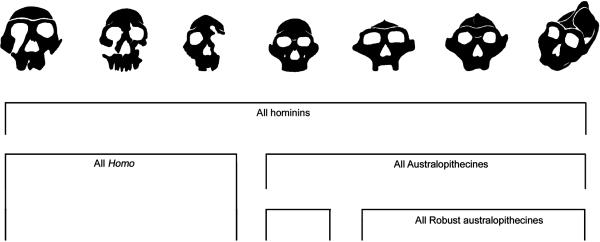
Analyzed hierarchical groups shown are all hominins, all Homo, all australopiths, and all robust australopiths. Fossil specimens depicted from left to right are African H. erectus (KNM-ER 3733), H. habilis (or H. rudolfensis: KNM-ER 1470), H. habilis (KNM-ER 1813), A. africanus (Sts 5), A (P.) robustus (SK 48), A. (P.) boisei (KNM-ER 406), and A. (P.) aethiopicus (KNM-WT 17000).
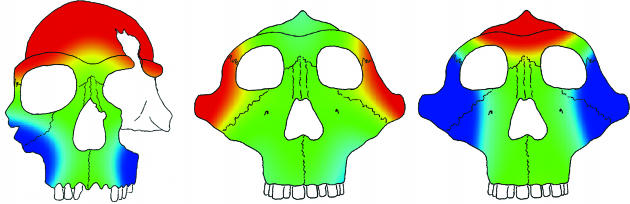
A visual representation of the selection vectors necessary to produce observed differences in facial morphology is shown. (Left) Selection required to produce a Homo from a gracile australopith. (Center) Selection required to produce a robust australopith from a gracile one. (Right) Selection required to produce a later robust australopith from an earlier one. Images shown are based on a chimp V/CV model. Selection is relative, with red indicating strongly positive selection, green no selection, and blue strongly negative selection.
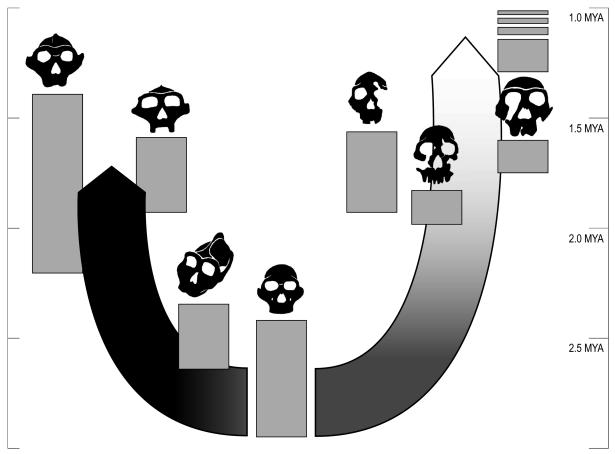
Evolutionary forces and diversity in early human evolution are shown in a temporal context. The arrows represent the action of selection and genetic drift, shown in black and white, respectively.
References
-
- Asfaw, B., White, T., Lovejoy, O., Latimer, B., Simpson, S. & Suwa, G. (1999) Science 284, 629–635. - PubMed
-
- White, T. D., Asfaw, B., DeGusta, D., Gilbert, H., Richards, G. D., Suwa, G. & Howell, F. C. (2003) Nature 423, 742–747. - PubMed
-
- Haile-Selassie, Y. (2001) Nature 412, 178–181. - PubMed
-
- Vekua, A., Lordkipanidze, D., Rightmire, G. P., Agusti, J., Ferring, R., Maisuradze, G., Mouskhelishvili, A., Nioradze, M., Ponce de Leon, M., Tappen, M., et al. (2002) Science 297, 85–89. - PubMed
-
- Leakey, M. G., Spoor, F., Brown, F. H., Gathogo, P. N., Kiarie, C., Leakey, L. N. & McDougall, I. (2001) Nature 410, 433–440. - PubMed
Publication types
MeSH terms
LinkOut - more resources
Full Text Sources
