. 2005 Feb 25;280(8):6648-54.
doi: 10.1074/jbc.M413082200. Epub 2004 Dec 20.

AtNAP1 represents an atypical SufB protein in Arabidopsis plastids

Affiliations

AtNAP1 represents an atypical SufB protein in Arabidopsis plastids

Xiang Ming Xu et al. J Biol Chem. .

Abstract

The assembly of iron-sulfur (Fe-S) clusters involves several pathways and in prokaryotes the mobilization of the sulfur (SUF) system is paramount for Fe-S biogenesis and repair during oxidative stress. The prokaryotic SUF system consists of six proteins: SufC is an ABC/ATPase that forms a complex with SufB and SufD, SufA acts as a scaffold protein, and SufE and SufS are involved in sulfur mobilization from cysteine. Despite the importance of Fe-S proteins in higher plant plastids, little is known regarding plastidic Fe-S cluster assembly. We have recently shown that Arabidopsis harbors an evolutionary conserved plastidic SufC protein (AtNAP7) capable of hydrolyzing ATP and interacting with the SufD homolog AtNAP6. Based on this and the prokaryotic SUF system we speculated that a SufB-like protein may exist in plastids. Here we demonstrate that the Arabidopsis plastid-localized SufB homolog AtNAP1 can complement SufB deficiency in Escherichia coli during oxidative stress. Furthermore, we demonstrate that AtNAP1 can interact with AtNAP7 inside living chloroplasts suggesting the presence of a plastidic AtNAP1.AtNAP6.AtNAP7 complex and remarkable evolutionary conservation of the SUF system. However, in contrast to prokaryotic SufB proteins with no associated ATPase activity we show that AtNAP1 is an iron-stimulated ATPase and that AtNAP1 is capable of forming homodimers. Our results suggest that AtNAP1 represents an atypical plastidic SufB-like protein important for Fe-S cluster assembly and for regulating iron homeostasis in Arabidopsis.


Figures
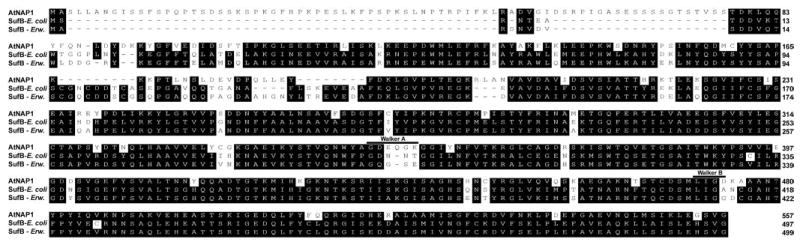
Fig. 1
Fig. 1. Amino acid sequence alignment between AtNAP1 and SufB proteins from E. chrysanthemi (SufB Erw. CAC17125) and E. coli (SufB E. coli P77522)
The degenerate Walker A and Walker B motifs are indicated.
Fig. 2
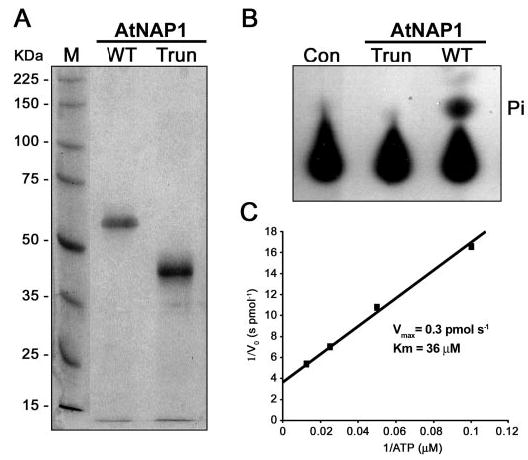
Fig. 2. Purified AtNAP1 and ATPase assays
A, SDS-PAGE of purified full-length wild-type AtNAP1 (WT) and truncated AtNAP1 (Trun) stained with Coomassie Blue. B, autoradiography of ATP hydrolysis by purified wild-type AtNAP1 protein. Released radioactively labeled phosphate (Pi) is indicated. No Pi release is observed when using the purified truncated version (Trun) of AtNAP1. A no enzyme reaction is included as a control (Con). C, kinetic parameters of ATP hydrolysis by AtNAP1. A double-reciprocal plot of the rate of Pi formation (1/initial rate (Vo) s pmol−1) versus substrate concentration (1/[ATP] μm) is shown.
Fig. 3
Fig. 3. Kinetic and expression analysis of AtNAP1
A, effect of pH on ATP hydrolysis by AtNAP1. Activity peaked at pH 7.5. B, the effect of cations on AtNAP1 ATPase activity. FeSO4 had a marked effect on AtNAP1-mediated ATP hydrolysis, whereas MnCl2, MnSO4, and KCl had a modest effect on activity. A no enzyme control (Con) is included. C, the effect of different FeSO4concentrations on AtNAP1 ATPase activity. The 0 FeSO4 reaction only contains 50 mM NaCl. D, semiquantitative RT-PCR analysis of AtNAP1 transcripts in seedlings grown in the presence (+Fe) and absence (−Fe) of iron. AtNAP1 was significantly down-regulated in seedlings subjected to iron starvation. Actin was used as a control.
Fig. 4
Fig. 4. Yeast two-hybrid and in planta analysis of protein-protein interactions
A, HF7c yeast cells co-transformed with different vector combinations were plated on SD medium lacking Leu and Trp and positive interactions were scored on plates containing SD medium lacking Leu, Trp, and His. All plates were grown for 5 days at 30 °C. Controls and classification of yeast growth are described under “Experimental Procedures.” B, bimolecular fluorescence complementation in living chloroplasts showing that AtNAP1 not only forms homodimers but also interacts with AtNAP7.
Fig. 5
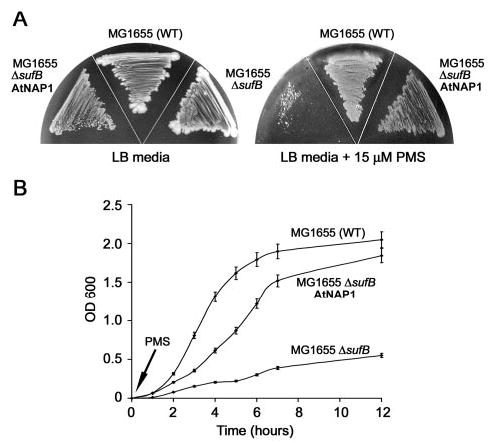
Fig. 5. AtNAP1 can complement SufB deficiency in E. coli under oxidative stress
A, WT E. coli (MG1655), an E. coli SufB mutant (MG1655ΔsufB), and E. coli MG1655ΔsufB expressing AtNAP1 (MG1655ΔsufBAtNAP1) were grown on LB media and LB media supplemented with the oxidative agent PMS. All strains grew equally well on LB but in the presence of PMS strain MG1655ΔsufB exhibited limited growth. By contrast, MG1655ΔsufBAtNAP1 grew similar to WT. B, MG1655, MG1655ΔsufB, and MG1655ΔsufBAtNAP1 were grown in liquid culture. PMS was added and the growth of each strain measured (A600) over a 12-h time course. MG1655ΔsufB showed minimal growth after the addition of PMS. In contrast, after an initial lag period MG1655ΔsufBAtNAP1 showed similar growth characteristics to MG1655. Experiments were performed in triplicate and standard deviations are shown.

References

    1. Beinert H, Holm RH, Munck E. Science. 1997;277:653–659. - PubMed
    1. Beinert H, Kiley PJ. Curr Opin Chem Biol. 1999;3:152–157. - PubMed
    1. Lill R, Kispal G. Trends Biochem Sci. 2000;25:352–356. - PubMed
    1. Frazzon J, Dean DR. Curr Opin Chem Biol. 2003;7:166–173. - PubMed
    1. Takahashi Y, Tokumoto U. J Biol Chem. 2002;277:28380–28383. - PubMed

Publication types

MeSH terms