


Disability forecasts and future Medicare costs
- PMID: 15612336
- PMCID: PMC6298747
- DOI: 10.2202/1558-9544.1052
Disability forecasts and future Medicare costs
Abstract
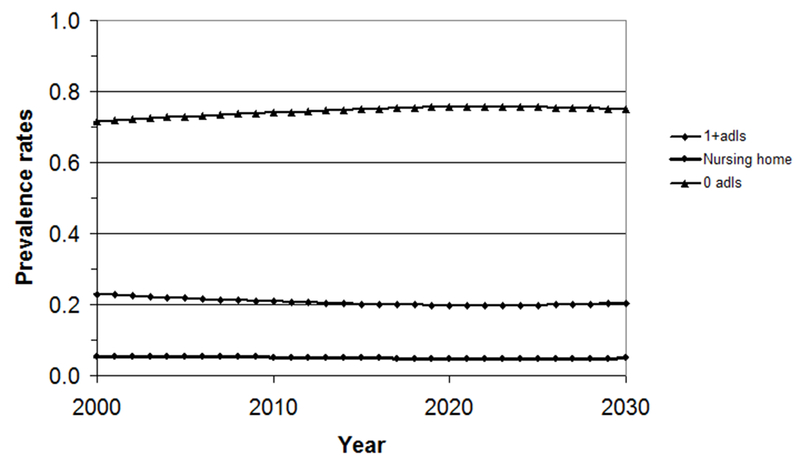
The traditional focus of disability research has been on the elderly, with good reason. Chronic disability is much more prevalent among the elderly, and it has a more direct impact on the demand for medical care. It is also important to understand trends in disability among the young, however, particularly if these trends diverge from those among the elderly. These trends could have serious implications for future health care spending because more disability at younger ages almost certainly translates into more disability among tomorrow's elderly, and disability is a key predictor of health care spending. Using data from the Medicare Current Beneficiary Survey (MCBS) and the National Health Interview Study (NHIS), we forecast that per-capita Medicare costs will decline for the next fifteen to twenty years, in accordance with recent projections of declining disability among the elderly. By 2020, however, the trend reverses. Per-capita costs begin to rise due to growth in disability among the younger elderly. Total costs may well remain relatively flat until 2010 and then begin to rise because per-capita costs will cease to decline rapidly enough to offset the influx of new elderly people. Overall, cost forecasts for the elderly that incorporate information about disability among today's younger generations yield more pessimistic scenarios than those based solely on elderly data sets, and this information should be incorporated into official Medicare forecasts.
Figures


References
-
- Bhattacharya Jay, Garber Alan, and Thomas MaCurdy (1996). “Cause-Specific Mortality Among Medicare Enrollees” Working Paper No. 5409, National Bureau of Economic Research. Cambridge, MA: National Bureau of Economic Research.
-
- Michael Chernew, Hirth Richard, Cutler David (2003). “Increased Spending on Health Care: How Much Can We Afford?” Health Affairs 22(4):15–25. - PubMed
-
- Goldman Dana, Hurd Michael, Shekelle Paul, Newberry Sydne et al. (2003). “Health Status and Medical Treatment of the Future Elderly: Final Report.” RAND Monograph MR-1783-CMS.
-
- MaCurdy Thomas, Green David, and Paarsch Harry J. (1990). “Assessing Empirical Approaches for Analyzing Taxes and Labor Supply.” Journal of Human Resources 25(3): 415–90.
Publication types
MeSH terms
Grants and funding
LinkOut - more resources
Full Text Sources
Medical