


Development of a micro-array to detect human and mouse microRNAs and characterization of expression in human organs
- PMID: 15616155
- PMCID: PMC545483
- DOI: 10.1093/nar/gnh186
Development of a micro-array to detect human and mouse microRNAs and characterization of expression in human organs
Abstract
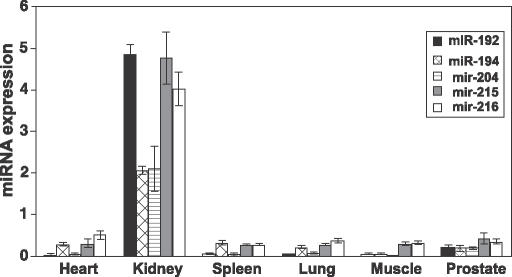
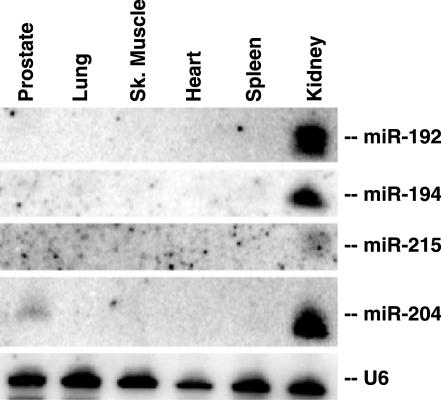
MicroRNAs (miRNAs) are believed to play important roles in developmental and other cellular processes by hybridizing to complementary target mRNA transcripts. This results in either cleavage of the hybridized transcript or negative regulation of translation. Little is known about the regulation or pattern of miRNA expression. The predicted presence of numerous miRNA sequences in higher eukaryotes makes it highly likely that the expression levels of individual miRNA molecules themselves should play an important role in regulating multiple cellular processes. Therefore, determining the pattern of global miRNA expression levels in mammals and other higher eukaryotes is essential to help understand both the mechanism of miRNA transcriptional regulation as well as to help identify miRNA regulated gene expression. Here, we describe a novel method to detect global processed miRNA expression levels in higher eukaryotes, including human, mouse and rats, by using a high-density oligonucleotide array. Array results have been validated by subsequent confirmation of mir expression using northern-blot analysis. Major differences in mir expression have been detected in samples from diverse sources, suggesting highly regulated mir expression, and specific gene regulatory functions for individual miRNA transcripts. For example, five different miRNAs were found to be preferentially expressed in human kidney compared with other human tissues. Comparative analysis of surrounding genomic sequences of the kidney-specific miRNA clusters revealed the occurrence of specific transcription factor binding sites located in conserved phylogenetic foot prints, suggesting that these may be involved in regulating mir expression in kidney.
Figures


References
-
- Ambros V. (2003) MicroRNA pathways in flies and worms: growth, death, fat, stress, and timing. Cell, 113, 673–676. - PubMed
-
- Palatnik J.F., Allen,E., Wu,X., Schommer,C., Schwab,R., Carrington,J.C. and Weigel,D. (2003) Control of leaf morphogenesis by microRNAs. Nature, 425, 257–263. - PubMed
-
- Bartel D.P. (2004) MicroRNAs: genomics, biogenesis, mechanism, and function. Cell, 116, 281–297. - PubMed
-
- Pasquinelli A.E., Reinhart,B.J., Slack,F., Martindale,M.Q., Kuroda,M.I., Maller,B., Hayward,D.C., Ball,E.E., Degnan,B., Muller,P. et al. (2000) Conservation of the sequence and temporal expression of let-7 heterochronic regulatory RNA. Nature, 408, 86–89. - PubMed
Publication types
MeSH terms
Substances
LinkOut - more resources
Full Text Sources
Other Literature Sources
