. 2004 Dec 23:5:34.
doi: 10.1186/1471-2156-5-34.

The exceptionally high rate of spontaneous mutations in the polymerase delta proofreading exonuclease-deficient Saccharomyces cerevisiae strain starved for adenine

Affiliations

The exceptionally high rate of spontaneous mutations in the polymerase delta proofreading exonuclease-deficient Saccharomyces cerevisiae strain starved for adenine

Alessandro Achilli et al. BMC Genet. .

Abstract

Background: Mutagenesis induced in the yeast Saccharomyces cerevisiae by starvation for nutrilites is a well-documented phenomenon of an unknown mechanism. We have previously shown that the polymerase delta proofreading activity controls spontaneous mutagenesis in cells starved for histidine. To obtain further information, we compared the effect of adenine starvation on mutagenesis in wild-type cells and, in cells lacking the proofreading activity of polymerase delta (phenotype Exo-, mutation pol3-01).

Results: Ade+ revertants accumulated at a very high rate on adenine-free plates so that their frequency on day 16 after plating was 1.5 x 10(-4) for wild-type and 1.0 x 10(-2) for the Exo- strain. In the Exo- strain, all revertants arising under adenine starvation are suppressors of the original mutation, most possessed additional nutritional requirements, and 50% of them were temperature sensitive.

Conclusions: Adenine starvation is highly mutagenic in yeast. The deficiency in the polymerase delta proofreading activity in strains with the pol3-01 mutation leads to a further 66-fold increase of the rate of mutations. Our data suggest that adenine starvation induces genome-wide hyper-mutagenesis in the Exo- strain.


Figures
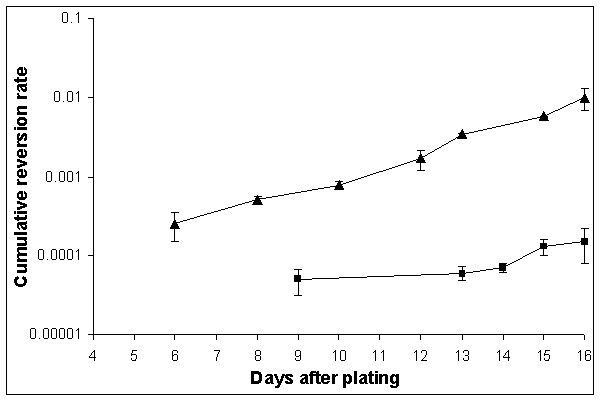
Figure 1
Figure 1
Accumulation of Ade+ revertants in the strains CG379-3-29 (LR) and de3-01-CG during starvation on SDNA-ade plates The revertant rate for the strains CG379-3-29 (LR) (squares ■) and de3-01-CG (triangles ▲) is given as the total number of revertant colonies per plated cell. The mean values from 3 independent experiments are reported on a logarithmic scale (Y axis). Vertical bars represent the standard errors of the mean.
Figure 2
Figure 2
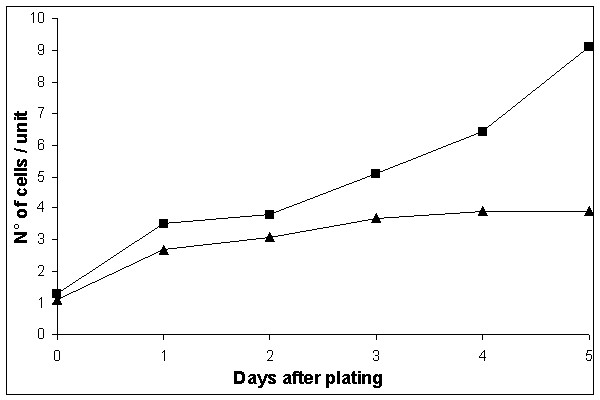
Number of cells/unit on SDNA-ade in the strains CG379-3-29(LR) and de3-01-CG The number of cells per unit was counted at the microscope (400×) in order to estimate the post-plating cellular divisions on SDNA-ade in the strains CG379-3-29 (LR) (squares ■) and de3-01-CG (triangles ▲).
Figure 3
Figure 3
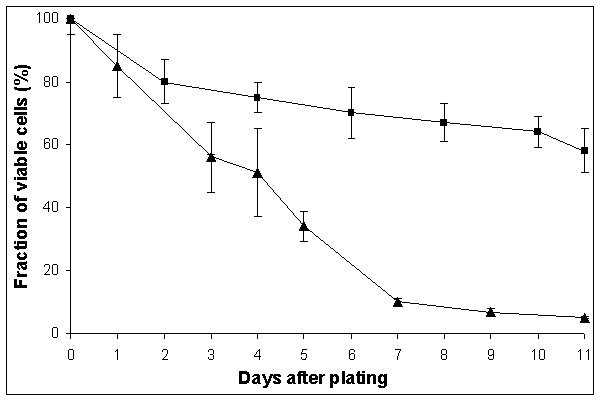
Cell viability in the strains CG379-3-29 (LR) and de3-01-CG during starvation on adenine-free plates The squares (■) represent values for CG379-3-29 (LR), while the triangles (▲) are values for de3-01-CG. The mean values from three independent experiments are reported. The vertical bars correspond to the standard errors of the mean.
Figure 4
Figure 4
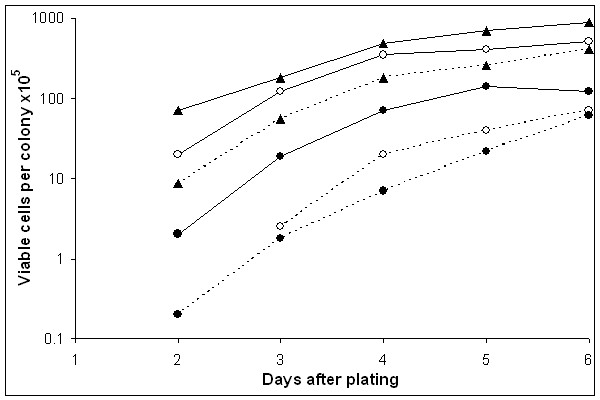
Growth curves of the strains de3-01-CG and of two Ade+ revertants on YEPD and SDNA+ade plates The number of cells/colony (fitness) on SDNA+ade (dotted lines) and on YEPD (continuous lines) is plotted against days in culture. We compared the strain de3-01-CG (triangles ▲) with two Ade+ revertants (strain 10, open circles ○; strain 15, closed circles ●).

References

    1. Sniegowski P. Evolution: bacterial mutation in stationary phase. Curr Biol. 2004;15:R245–246. doi: 10.1016/j.cub.2004.02.058. - DOI - PubMed
    1. Werner-Washburne M, Braun EL, Crawford ME, Peck VM. Stationary phase in Saccharomyces cerevisiae. Mol Microbiol. 1996;19:1159–1166. - PubMed
    1. Ryan FJ. Bacterial mutation in stationary phase and the question of cell turnover. J Gen Microbiol. 1959;21:530–549. - PubMed
    1. Cairns J, Overbaugh J, Miller S. The origin of mutants. Nature. 1988;335:142–145. doi: 10.1038/335142a0. - DOI - PubMed
    1. Foster PL. Mechanisms of stationary phase mutation: a decade of adaptive mutation. Annu Rev Genet. 1999;37:57–88. doi: 10.1146/annurev.genet.33.1.57. - DOI - PMC - PubMed

LinkOut - more resources