


Epitope specificity and longevity of a vaccine-induced human T cell response against HPV18
- PMID: 15623547
- PMCID: PMC7109653
- DOI: 10.1093/intimm/dxh197
Epitope specificity and longevity of a vaccine-induced human T cell response against HPV18
Abstract
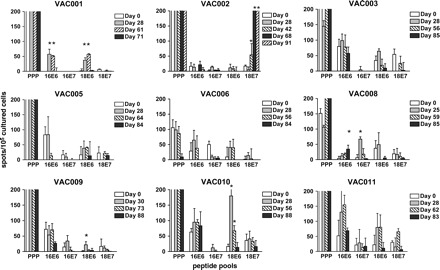
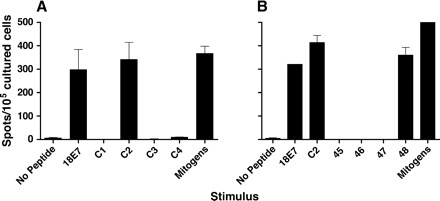
Persistent human papillomavirus (HPV) type 16 and 18 infection can lead to pre-malignant and malignant diseases of the lower genital tract. Several lines of evidence suggest that T cell responses can control HPV infection. However, relative to other human viruses, strong effector memory T cell responses against HPV have been difficult to detect. We used an in vitro stimulation step prior to enzyme-linked immunospot assays to identify IFN-gamma-secreting T cells specific for HPV16 and 18 E6/E7 peptides. This allowed the detection of HPV-specific CD4+ T cells that were not evident in direct ex vivo assays. T cell responses against HPV16 or 18 peptides were detected in healthy volunteers (7/9) and patients with lower genital tract neoplasia (10/20). Importantly, this assay allowed tracking of vaccine-induced T cell responses in nine patients, following inoculation with a live recombinant vaccinia virus (HPV16 and 18 E6/E7, TA-HPV). Novel vaccine-induced T cell responses were demonstrated in five patients, but no clinical responses (lesion regressions) were seen. For one vaccinated patient, the T cell response was mapped to a single dominant HPV18 E7 epitope and this response was sustained for >3 years. Our data suggest that systemic memory T cells against HPV16 and 18, induced naturally or by TA-HPV vaccination, are relatively rare. Nevertheless, the assay system developed allowed estimation of magnitude, epitope specificity, and longevity of vaccine-induced CD4+ T cell responses. This will be useful for vaccine design and measurement of immunological endpoints in clinical trials.
Figures



References
-
- Frazer, I. H. 2004. Prevention of cervical cancer through papillomavirus vaccination. Nat. Rev. Immunol. 4:46. - PubMed
-
- Koutsky, L. A., Ault, K. A., Wheeler, C. M. et al.2002. A controlled trial of a human papillomavirus type 16 vaccine. N. Engl. J. Med. 347:1645. - PubMed
-
- Cannistra, S. A. and Niloff, J. M. 1996. Cancer of the uterine cervix. N. Engl. J. Med. 334:1030. - PubMed
-
- Fiander, A. and Man, S. 2002. Anti-viral vaccination for treating intraepithelial neoplasia. In Maclean, A., Singer, A. and Critchley, H., eds, Lower Genital Tract Neoplasia, p. 192. Royal College of Obstetricians and Gynaecologists, London.
-
- Kono, K., Ressing, M. E., Brandt, R. M. P. et al.1996. Decreased expression of signal transducing zeta chain in peripheral T cells and natural killer cells in patients with cervical cancer. Clin. Cancer Res. 2:1825. - PubMed
Publication types
MeSH terms
Substances
LinkOut - more resources
Full Text Sources
Other Literature Sources
Molecular Biology Databases
Research Materials
