


Exposure to environmental tobacco smoke and cognitive abilities among U.S. children and adolescents
- PMID: 15626655
- PMCID: PMC1253717
- DOI: 10.1289/ehp.7210
Exposure to environmental tobacco smoke and cognitive abilities among U.S. children and adolescents
Abstract
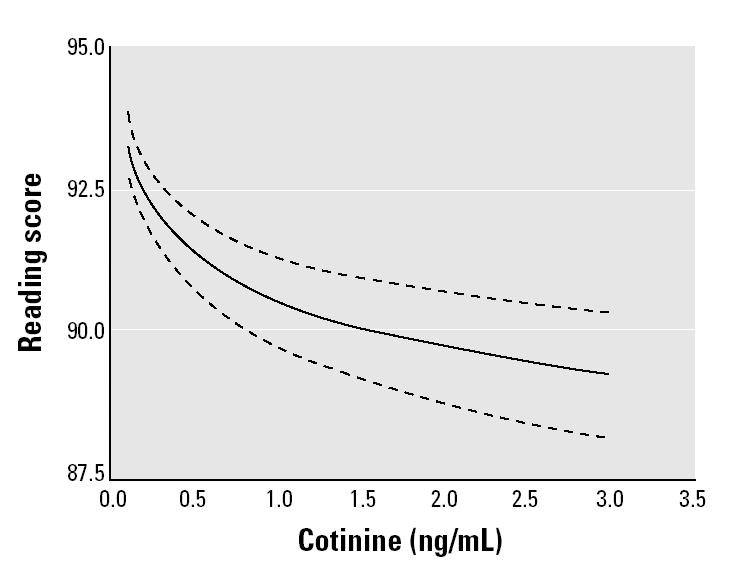
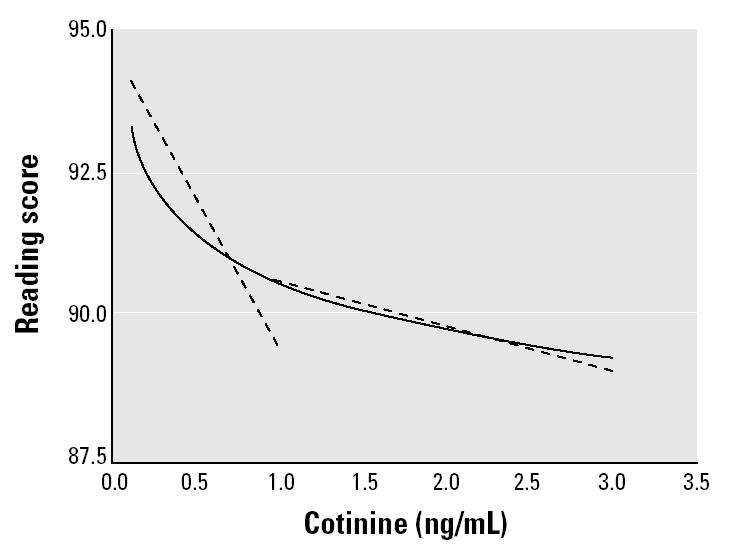
We used the Third National Health and Nutrition Examination Survey (NHANES III), conducted from 1988 to 1994, to investigate the relationship between environmental tobacco smoke (ETS) exposure and cognitive abilities among U.S. children and adolescents 6-16 years of age. Serum cotinine was used as a biomarker of ETS exposure. Children were included in the sample if their serum cotinine levels were less than or equal to 15 ng/mL, a level consistent with ETS exposure, and if they denied using any tobacco products in the previous 5 days. Cognitive and academic abilities were assessed using the reading and math subtests of the Wide Range Achievement Test-Revised and the block design and digit span subtests of the Wechsler Intelligence Scale for Children-III. Analyses were conducted using SUDAAN software. Of the 5,365 6- to 16-year-olds included in NHANES III, 4,399 (82%) were included in this analysis. The geometric mean serum cotinine level was 0.23 ng/mL (range, 0.035-15 ng/mL); 80% of subjects had levels < 1 ng/mL. After adjustment for sex, race, region, poverty, parent education and marital status, ferritin, and blood lead concentration, there was a significant inverse relationship between serum cotinine and scores on reading (beta = -2.69, p = 0.001), math (beta = -1.93, p = 0.01), and block design (beta = -0.55, p < 0.001) but not digit span (beta = -0.08, p = 0.52). The estimated ETS-associated decrement in cognitive test scores was greater at lower cotinine levels. A log-linear analysis was selected as the best fit to characterize the increased slope in cognitive deficits at lower levels of exposure. These data, which indicate an inverse association between ETS exposure and cognitive deficits among children even at extremely low levels of exposure, support policy to further restrict children's exposure.
Figures
Comment in
-
Exposure to environmental tobacco smoke and cognitive abilities among U.S. children and adolescents.Environ Health Perspect. 2005 May;113(5):A296. doi: 10.1289/ehp.113-a296a. Environ Health Perspect. 2005. PMID: 15866750 Free PMC article. No abstract available.
References
-
- Audesirk T, Cabell L. Nanomolar concentrations of nicotine and cotinine alter the development of cultured hippocampal neurons via non-acetylcholine receptor-mediated mechanisms. Neurotoxicology. 1999;20:639–646. - PubMed
-
- Bauman KE, Flewelling RL, LaPrelle J. Parental cigarette smoking and cognitive performance of children. Health Psychol. 1991;10:282–288. - PubMed
-
- Benowitz NL. Cotinine as a biomarker of environmental tobacco smoke exposure. Epidemiol Rev. 1996;18:188–204. - PubMed
-
- Bernert JT, Jr, Turner WE, Pirkle JL, Sosnoff CS, Akins JR, Waldrep MK, et al. Development and validation of sensitive method for determination of serum cotinine in smokers and nonsmokers by liquid chromatography/atmospheric pressure ionization tandem mass spectrometry. Clin Chem. 1997;43:2281–2291. - PubMed
-
- Byrd RS, Weitzman ML. Predictors of early grade retention among children in the United States. Pediatrics. 1994;93:481–487. - PubMed
MeSH terms
Substances
LinkOut - more resources
Full Text Sources
Other Literature Sources
Medical