


Dent Disease with mutations in OCRL1
- PMID: 15627218
- PMCID: PMC1196371
- DOI: 10.1086/427887
Dent Disease with mutations in OCRL1
Erratum in
- Am J Hum Genet. 2007 Sep;81(3):634
Abstract
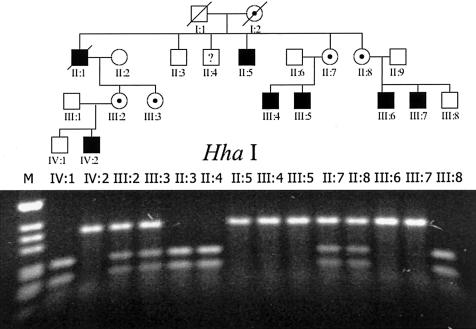
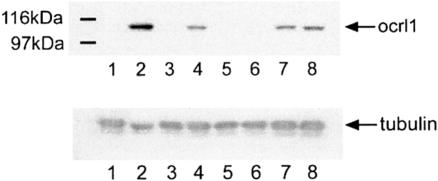
Dent disease is an X-linked renal proximal tubulopathy associated with mutations in the chloride channel gene CLCN5. Lowe syndrome, a multisystem disease characterized by renal tubulopathy, congenital cataracts, and mental retardation, is associated with mutations in the gene OCRL1, which encodes a phosphatidylinositol 4,5-bisphosphate (PIP(2)) 5-phosphatase. Genetic heterogeneity has been suspected in Dent disease, but no other gene for Dent disease has been reported. We studied male probands in 13 families, all of whom met strict criteria for Dent disease but lacked mutations in CLCN5. Linkage analysis in the one large family localized the gene to a candidate region at Xq25-Xq27.1. Sequencing of candidate genes revealed a mutation in the OCRL1 gene. Of the 13 families studied, OCRL1 mutations were found in 5. PIP(2) 5-phosphatase activity was markedly reduced in skin fibroblasts cultured from the probands of these five families, and protein expression, measured by western blotting, was reduced or absent. Slit-lamp examinations performed in childhood or adulthood for all five probands showed normal results. Unlike patients with typical Lowe syndrome, none of these patients had metabolic acidosis. Three of the five probands had mild mental retardation, whereas two had no developmental delay or behavioral disturbance. These findings demonstrate that mutations in OCRL1 can occur with the isolated renal phenotype of Dent disease in patients lacking the cataracts, renal tubular acidosis, and neurological abnormalities that are characteristic of Lowe syndrome. This observation confirms genetic heterogeneity in Dent disease and demonstrates more-extensive phenotypic heterogeneity in Lowe syndrome than was previously appreciated. It establishes that the diagnostic criteria for disorders resulting from mutations in the Lowe syndrome gene OCRL1 need to be revised.
Figures
References
Electronic-Database Information
-
- Lowe Syndrome Mutation Database, http://research.nhgri.nih.gov/lowe/ocrl1_mut_db.shtml
-
- Online Mendelian Inheritance in Man (OMIM), http://www.ncbi.nlm.nih.gov/Omim/ (for Dent disease and Lowe syndrome)
References
-
- Bottema CD, Sommer SS (1993) PCR amplification of specific alleles: rapid detection of known mutations and polymorphisms. Mutat Res 288:93–102 - PubMed
-
- Charnas LR, Bernardini I, Rader D, Hoeg JM, Gahl WA (1991) Clinical and laboratory findings in the oculocerebrorenal syndrome of Lowe, with special reference to growth and renal function. N Engl J Med 324:1318–1325 - PubMed
-
- Charnas LR, Nussbaum RL (2001) The oculocerebrorenal syndrome of Lowe (Lowe syndrome). In: Scriver CR, Beaudet AL, Sly WS, Valle D (eds) The metabolic and molecular bases of inherited disease. McGraw-Hill, New York, pp 6257–6266
-
- Christensen EI, Devuyst O, Dom G, Nielsen R, Van Der Smissen P, Verroust P, Leruth M, Guggino WB, Courtoy PJ (2003) Loss of chloride channel ClC-5 impairs endocytosis by defective trafficking of megalin and cubilin in kidney proximal tubules. Proc Natl Acad Sci USA 100:8472–847710.1073/pnas.1432873100 - DOI - PMC - PubMed
Publication types
MeSH terms
Substances
Grants and funding
LinkOut - more resources
Full Text Sources
Other Literature Sources
Medical
Molecular Biology Databases
Miscellaneous
