The effects of McKenzie and Brunkow exercise program on spinal mobility comparative study
- PMID: 15628984
- PMCID: PMC7245530
- DOI: 10.17305/bjbms.2004.3466
The effects of McKenzie and Brunkow exercise program on spinal mobility comparative study
Abstract
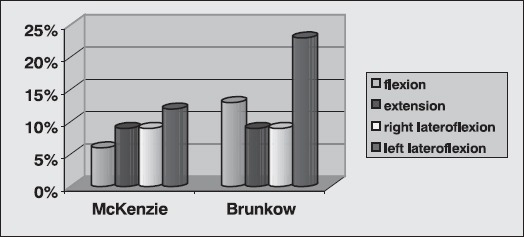
This study encompassed 64 participants with symptoms of low back pain, 33 in McKenzie group and 31 in Brunkow group. Patients attended exercise program daily and they were asked to do the same exercise at home--five times a day in series of 5 to 10 repetition each time, depending of stage of disease and pain intensity. All patients were assessed for the spinal motion, before and after the treatment. All parameters for spinal movements showed improvement after exercising McKenzie program for lower back pain with a significant difference of p<0.01 for all motions. Also, in Brunkow group, all of the parameters showed statistically significant improvement at the end of treatment in relation to pre-treatment values, with significant difference of p<0.01 for all motions. Statistically comparison between McKenzie and Brunkow difference in score at the end of the treatment showed statistically significant improvement in McKenzie group, for extension, right and left side flexion, while flexion score didn't show statistically significant difference. McKenzie exercises seemed to be more effective than Brunkow exercises for improvement in spinal motion. Both, McKenzie and Brunkow exercises can be used for spinal mobility improvement in patients with lower back pain, but is preferable to use McKenzie exercises first, to decrease the pain and increase spinal mobility, and then Brunkow exercises to strengthen the paravertebral muscles.
Figures
References
-
- Rockville. Acute low back problems in adults. US Department of Health and Human Services. Public Health Service, AHCPR; 1994 160, Clinical practice guideline; No 14
-
- Randall B. Physical medicine and Rehabilitation. Vol. 39. W.B. Saunders; 1996. pp. 813–840.
-
- Faas A. Exercises: which ones are worth trying, for which patients, and when? Spine. 1996;21(24):2874–8. - PubMed
-
- Faas A, van Ejik JT, Chavannes AW. A randomised trial of exercise therapy in patients with acut6e low back pain. Efficacy on sickness absence. Spine. 1995;20(8):941–7. - PubMed
-
- Szmelskyj A. Do complementary therapies stimulate the body’s natural painkilling medications?A literature review. Complementary - Ther - Med. 1998;1:36–41.