Mice exclusively expressing the short isoform of Smad2 develop normally and are viable and fertile
- PMID: 15630024
- PMCID: PMC540233
- DOI: 10.1101/gad.1243205
Mice exclusively expressing the short isoform of Smad2 develop normally and are viable and fertile
Abstract
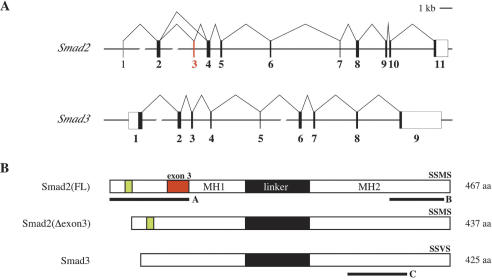
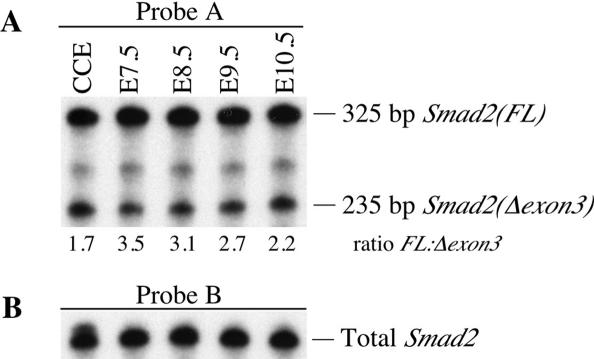
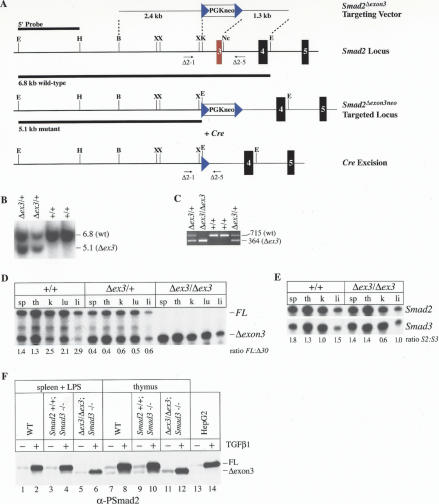
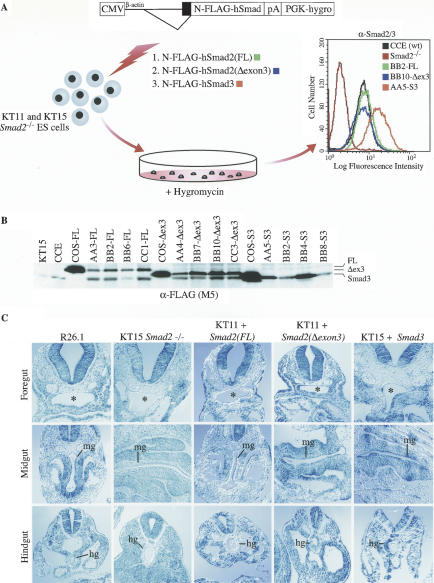
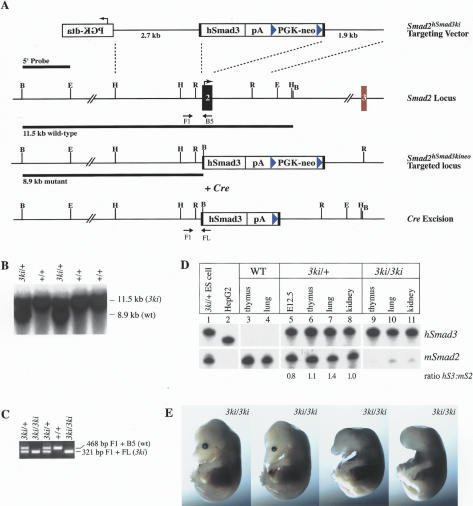
Smad2 and Smad3 are closely related effectors of TGFbeta/Nodal/Activin-related signaling. Smad3 mutant mice develop normally, whereas Smad2 plays an essential role in patterning the embryonic axis and specification of definitive endoderm. Alternative splicing of Smad2 exon 3 gives rise to two distinct protein isoforms. The short Smad2(Deltaexon3) isoform, unlike full-length Smad2, Smad2(FL), retains DNA-binding activity. Here, we show that Smad2(FL) and Smad2(Deltaexon3) are coexpressed throughout mouse development. Directed expression of either Smad2(Deltaexon3) or Smad3, but not Smad2(FL), restores the ability of Smad2-deficient embryonic stem (ES) cells to contribute descendants to the definitive endoderm in wild-type host embryos. Mice engineered to exclusively express Smad2(Deltaexon3) correctly specify the anterior-posterior axis and definitive endoderm, and are viable and fertile. Moreover, introducing a human Smad3 cDNA into the mouse Smad2 locus similarly rescues anterior-posterior patterning and definitive endoderm formation and results in adult viability. Collectively, these results demonstrate that the short Smad2(Deltaexon3) isoform or Smad3, but not full-length Smad2, activates all essential target genes downstream of TGFbeta-related ligands, including those regulated by Nodal.
Figures
References
-
- Arai T., Akiyama, Y., Okabe, S., Ando, M., Endo, M., and Yuasa, Y. 1998. Genomic structure of the human Smad3 gene and its infrequent alterations in colorectal cancers. Cancer Lett. 122: 157–163. - PubMed
-
- Beck S., Le Good, J.A., Guzman, M., Ben Haim, N., Roy, K., Beermann, F., and Constam, D.B. 2002. Extraembryonic proteases regulate Nodal signalling during gastrulation. Nat. Cell Biol. 4: 981–985. - PubMed
-
- Bourillot P.Y., Garrett, N., and Gurdon, J.B. 2002. A changing morphogen gradient is interpreted by continuous transduction flow. Development 129: 2167–2180. - PubMed
-
- Brennan J., Lu, C.C., Norris, D.P., Rodriguez, T.A., Beddington, R.S., and Robertson, E.J. 2001. Nodal signalling in the epiblast patterns the early mouse embryo. Nature 411: 965–969. - PubMed
Publication types
MeSH terms
Substances
Grants and funding
LinkOut - more resources
Full Text Sources
Molecular Biology Databases