Comparative Study
. 2005 Jan;43(1):340-7.
doi: 10.1128/JCM.43.1.340-347.2005.

Sequence typing and comparison of population biology of Campylobacter coli and Campylobacter jejuni

Affiliations
Comparative Study

Sequence typing and comparison of population biology of Campylobacter coli and Campylobacter jejuni

Kate E Dingle et al. J Clin Microbiol. 2005 Jan.

Abstract

A multilocus sequence typing (MLST) scheme that uses the same loci as a previously described system for Campylobacter jejuni was developed for Campylobacter coli. The C. coli-specific primers were validated with 53 isolates from humans, chickens, and pigs, together with 15 Penner serotype reference isolates. The nucleotide sequence of the flaA short variable region (SVR) was determined for each isolate. These sequence data were compared to equivalent information for 17 C. jejuni isolates representing the known genetic diversity of this species. C. coli and C. jejuni share approximately 86.5% identity at the nucleotide sequence level within the MLST loci. There is evidence of genetic exchange of the housekeeping genes between the two species, but at a very low rate; only one sequence type from each species showed evidence of imported DNA. The flaA gene was more variable and has been exchanged many times between the two species, making it an unreliable marker for species identification but useful for distinguishing closely related strains. All but 3 of 21 human C. coli clinical isolates were distinct, according to the combined MLST and SVR sequences. The use of a common MLST scheme allows direct comparisons of the population biology and molecular epidemiology of these two closely related human pathogens.


Figures
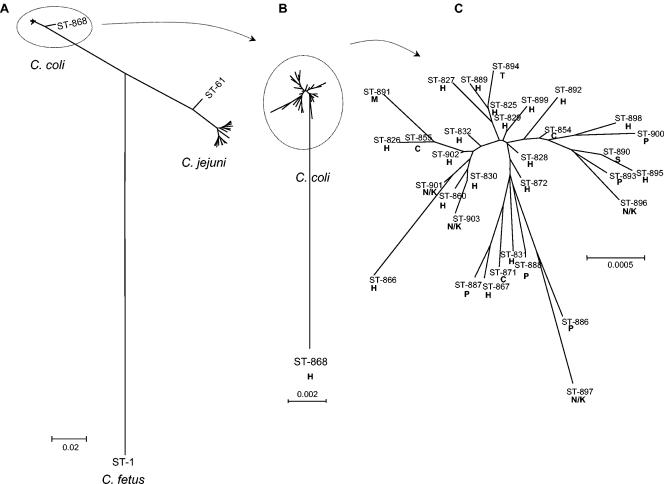
FIG. 1.
FIG. 1.
Radial neighbor-joining trees constructed with concatenated MLST allele sequences to indicate the relationships between and within C. coli and C. jejuni. (A) Tree constructed with the nucleotide sequences of 34 C. coli STs and the STs of the 17 central genotypes of the C. jejuni clonal complexes described to date (5); (B) tree constructed with the nucleotide sequences of C. coli STs alone; (C) tree constructed with the nucleotide sequences of C. coli STs (excluding divergent ST-868) and their isolation sources, indicated in boldface by H, human; C, chicken; T, turkey; P, pig; S, sheep; and N/K, Penner serotyping scheme reference isolate for which the source is not known.
FIG. 2.
FIG. 2.
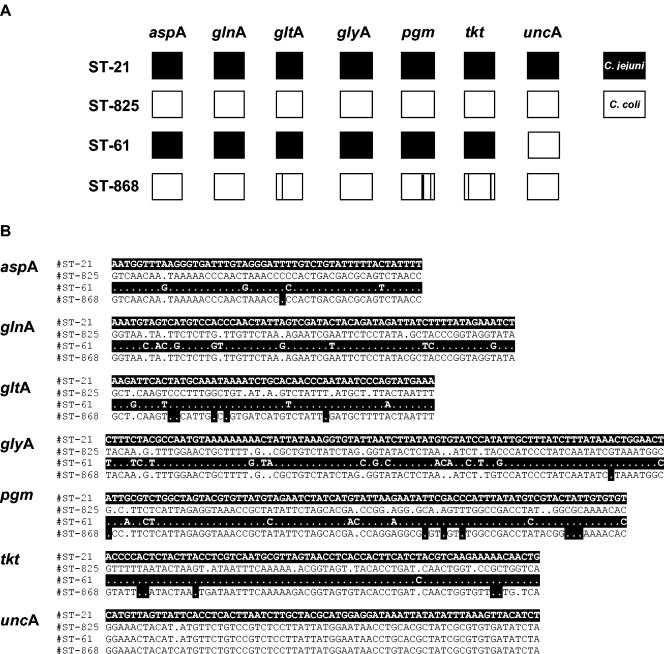
Analysis of the C. jejuni and C. coli housekeeping genes used to detect nucleotide polymorphisms in the MLST loci of each species characteristic of the other. Black boxes and white text on black highlighting, sequences characteristic of C. jejuni; white boxes and black text with white highlighting, sequences characteristic of C. coli. (A) Diagrammatic output of the STRUCTURE program. The seven MLST loci are represented by seven squares, and four STs are shown. ST-21 and ST-825 are examples of C. jejuni and C. coli, respectively. C. jejuni ST-61 contains an uncA allele characteristic of C. coli. Polymorphisms in C. coli ST-868 which are characteristic of C. jejuni are indicated by vertical black lines. (B) Alignment of the variable nucleotide sites within the MLST loci represented in panel A.
FIG. 3.
FIG. 3.
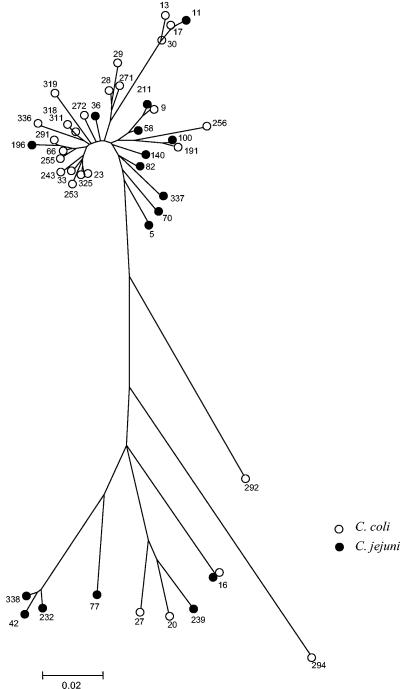
Radial neighbor-joining tree constructed to indicate (i) the genetic diversity detected among the flaA SVR sequences of C. coli and C. jejuni and (ii) the lack of segregation by species. The C. jejuni sequences were from isolates representing the central genotypes of 17 clonal complexes described to date. The numbers indicate the flaA SVR allele numbers within the SVR database, and the letters C and J represent C. coli and C. jejuni, respectively. Allele 16 was found in both C. jejuni and C. coli isolates.

References

    1. Aeschbacher, M., and J. Piffaretti. 1989. Population genetics of human and animal enteric Campylobacter strains. Infect. Immun. 57:1432-1437. - PMC - PubMed
    1. De Boer, P., B. Duim, A. Rigter, J. van der Plas, W. F. Jacobs-Reitsma, and J. A. Wagenaar. 2000. Computer-assisted analysis and epidemiological value of genotyping methods for Campylobacter jejuni and Campylobacter coli. J. Clin. Microbiol. 38:1940-1946. - PMC - PubMed
    1. Dingle, K. E., F. M. Colles, D. R. Wareing, R. Ure, A. J. Fox, F. E. Bolton, H. J. Bootsma, R. J. Willems, R. Urwin, and M. C. Maiden. 2001. Multilocus sequence typing system for Campylobacter jejuni. J. Clin. Microbiol. 39:14-23. - PMC - PubMed
    1. Dingle, K. E., N. Van Den Braak, F. M. Colles, L. J. Price, D. L. Woodward, F. G. Rodgers, H. P. Endtz, A. Van Belkum, and M. C. Maiden. 2001. Sequence typing confirms that Campylobacter jejuni strains associated with Guillain-Barré and Miller-Fisher syndromes are of diverse genetic lineage, serotype, and flagella type. J. Clin. Microbiol. 39:3346-3349. - PMC - PubMed
    1. Dingle, K. E., F. M. Colles, R. Ure, J. A. Wagenaar, B. Duim, F. J. Bolton, A. J. Fox, D. R. Wareing, and M. C. Maiden. 2002. Molecular characterization of Campylobacter jejuni clones: a basis for epidemiologic investigation. Emerg. Infect. Dis. 8:949-955. - PMC - PubMed

Publication types

MeSH terms