


Temperature-driven Campylobacter seasonality in England and Wales
- PMID: 15640174
- PMCID: PMC544220
- DOI: 10.1128/AEM.71.1.85-92.2005
Temperature-driven Campylobacter seasonality in England and Wales
Abstract
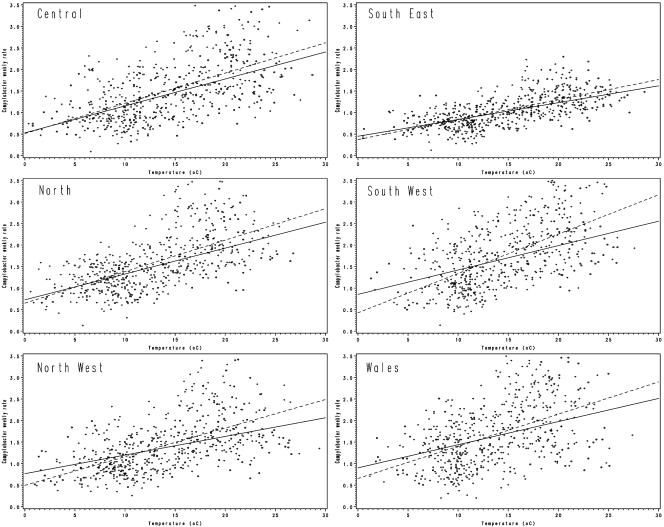
Campylobacter incidence in England and Wales between 1990 and 1999 was examined in conjunction with weather conditions. Over the 10-year interval, the average annual rate was determined to be 78.4 +/- 15.0 cases per 100,000, with an upward trend. Rates were higher in males than in females, regardless of age, and highest in children less than 5 years old. Major regional differences were detected, with the highest rates in Wales and the southwest and the lowest in the southeast. The disease displayed a seasonal pattern, and increased campylobacter rates were found to be correlated with temperature. The most marked seasonal effect was observed for children under the age of 5. The seasonal pattern of campylobacter infections indicated a linkage with environmental factors rather than food sources. Therefore, public health interventions should not be restricted to food-borne approaches, and the epidemiology of the seasonal peak in human campylobacter infections may best be understood through studies in young children.
Figures
References
-
- Allos, B. M. 2001. Campylobacter jejuni infections: update on emerging issues and trends. Clin. Infect. Dis. 32:1201-1206. - PubMed
-
- Buswell, C. M., Y. M. Herlihy, L. M. Lawrence, J. T. McGuiggan, P. D. Marsh, C. W. Keevil, and S. A. Leach. 1998. Extended survival and persistence of Campylobacter spp. in water and aquatic biofilms and their detection by immunofluorescent-antibody and -rRNA staining. Appl. Environ. Microbiol. 64:733-741. - PMC - PubMed
-
- Buzby, J. C., and T. Roberts. 1997. Economic costs and trade impacts of microbial foodborne illness. World Health Stat. Q. 50:57-66. - PubMed
MeSH terms
LinkOut - more resources
Full Text Sources
Medical
