Monoclonal antibody-based antigen capture enzyme-linked immunosorbent assay reveals high sensitivity of the nucleocapsid protein in acute-phase sera of severe acute respiratory syndrome patients
- PMID: 15642998
- PMCID: PMC540218
- DOI: 10.1128/CDLI.12.1.135-140.2005
Monoclonal antibody-based antigen capture enzyme-linked immunosorbent assay reveals high sensitivity of the nucleocapsid protein in acute-phase sera of severe acute respiratory syndrome patients
Abstract
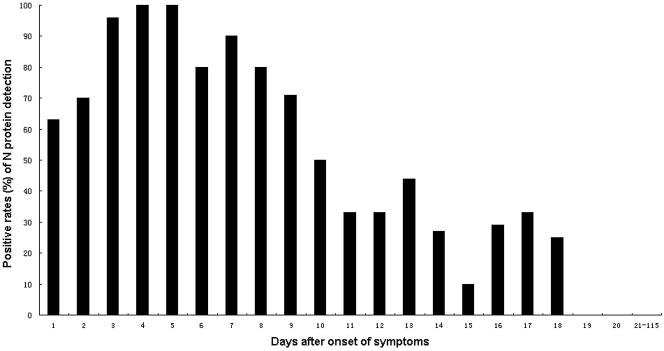
Accurate and timely diagnosis of severe acute respiratory syndrome coronavirus (SARS-CoV) infection is a critical step in preventing another global outbreak. In this study, 829 serum specimens were collected from 643 patients initially reported to be infected with SARS-CoV. The sera were tested for the N protein of SARS-CoV by using an antigen capture enzyme-linked immunosorbent assay (ELISA) based on monoclonal antibodies against the N protein of SARS-CoV and compared to 197 control serum samples from healthy donors and non-SARS febrile patients. The results of the N protein detection analysis were directly related to the serological analysis data. From 27 SARS patients who tested positive with the neutralization test, 100% of the 24 sera collected from 1 to 10 days after the onset of symptoms were positive for the N protein. N protein was not detected beyond day 11 in this group. The positive rates of N protein for sera collected at 1 to 5, 6 to 10, 11 to 15, and 16 to 20 days after the onset of symptoms for 414 samples from 298 serologically confirmed patients were 92.9, 69.8, 36.4, and 21.1%, respectively. For 294 sera from 248 serological test-negative patients, the rates were 25.6, 16.7, 9.3, and 0%, respectively. The N protein was not detected in 66 patients with cases of what was initially suspected to be SARS but serologically proven to be negative for SARS and in 197 serum samples from healthy donors and non-SARS febrile patients. The specificity of the assay was 100%. Furthermore, of 16 sera collected from four patients during the SARS recurrence in Guangzhou, 5 sera collected from 7 to 9 days after the onset of symptoms were positive for the N protein. N protein detection exhibited a high positive rate, 96 to 100%, between day 3 and day 5 after the onset of symptoms for 27 neutralization test-positive SARS patients and 298 serologically confirmed patients. The N protein detection rate continually decreased beginning with day 10, and N protein was not detected beyond day 19 after the onset of symptoms. In conclusion, an antigen capture ELISA reveals a high N protein detection rate in acute-phase sera of patients with SARS, which makes it useful for early diagnosis of SARS.
Figures
References
-
- Che, X. Y., L. W. Qiu, Y. X. Pan, K. Wen, W. Hao, L. Y. Zhang, Y. D. Wang, Z. Y. Liao, X. Hua, V. C. Cheng, and K. Y. Yuen. 2004. Sensitive and specific monoclonal antibody-based capture enzyme immunoassay for detection of nucleocapsid antigen in sera from patients with severe acute respiratory symdrome. J. Clin. Microbiol. 42:2629-2635. - PMC - PubMed
-
- Che, X. Y., L. W. Qiu, Y. X. Pan, X. Hua, W. Hao, Z. Y. Liao, Y. B. Mei, L. Y. Zhang, Z. Y. Wan, K. Y. Yuen, and Z. Huang. 2003. Rapid and efficient preparation of monoclonal antibodies against SARS-associated coronavirus nucleocapsid protein by immunizing mice. Di Yi Jun Yi Da Xue Xue Bao 23:640-642. (In Chinese.) - PubMed
Publication types
MeSH terms
Substances
LinkOut - more resources
Full Text Sources
Other Literature Sources
Miscellaneous