. 2005 Jan 19;33(2):e15.
doi: 10.1093/nar/gni017.

SNP identification in unamplified human genomic DNA with gold nanoparticle probes

Affiliations

SNP identification in unamplified human genomic DNA with gold nanoparticle probes

Y Paul Bao et al. Nucleic Acids Res. .

Abstract

Single nucleotide polymorphisms (SNPs) comprise the most abundant source of genetic variation in the human genome. SNPs may be linked to genetic predispositions, frank disorders or adverse drug responses, or they may serve as genetic markers in linkage disequilibrium analysis. Thus far, established SNP detection techniques have utilized enzymes to meet the sensitivity and specificity requirements needed to overcome the high complexity of the human genome. Herein, we present for the first time a microarray-based method that allows multiplex SNP genotyping in total human genomic DNA without the need for target amplification or complexity reduction. This direct SNP genotyping methodology requires no enzymes and relies on the high sensitivity of the gold nanoparticle probes. Specificity is derived from two sequential oligonucleotide hybridizations to the target by allele-specific surface-immobilized capture probes and gene-specific oligonucleotide-functionalized gold nanoparticle probes. Reproducible multiplex SNP detection is demonstrated with unamplified human genomic DNA samples representing all possible genotypes for three genes involved in thrombotic disorders. The assay format is simple, rapid and robust pointing to its suitability for multiplex SNP profiling at the 'point of care'.


Figures
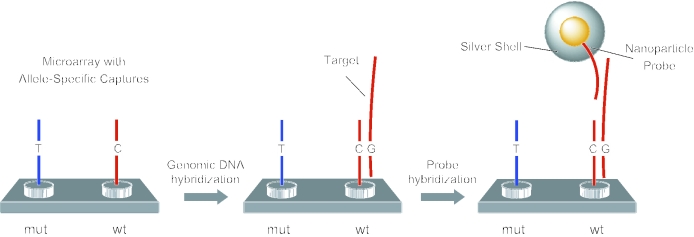
Figure 1
Figure 1
Fragmented unamplified genomic DNA and gold nanoparticle probes are sequentially hybridized to the SNP microarray containing capture probes representing the two possible alleles. After the two hybridization steps, the array is subjected to stringency washes and a silver development step. The scatter signal from the test sites is imaged subsequently to obtain genotyping results.
Figure 2
Figure 2
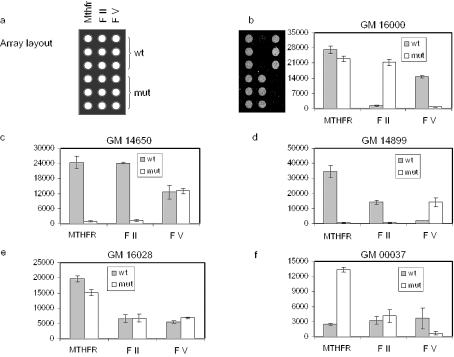
Multiplex detection of SNPs from unamplified genomic DNA from five different genomic DNA samples. (a) Allele-specific capture oligonucleotides for the hypercoagulation genes (MTHFR, FII and FV) were spotted in triplicate in the arrangement indicated. The microarrays (bf) were subjected to unamplified genomic DNA from the different samples followed by gene-specific probes. The abbreviations used to identify the different DNA samples were adopted from the vendor (Coriell Institute). The samples embodied all three genotypes for the individual genes (wild-type, mutant and heterozygous) and can be identified by the presence or absence of signal at the respective captures [see image in (b)]. The graphs associated with individual images represent average net signal values from the triplicate spots for the wild-type (wt) or mutant (mut) capture spots, respectively. Error bars correspond to 1 SD.
Figure 3
Figure 3
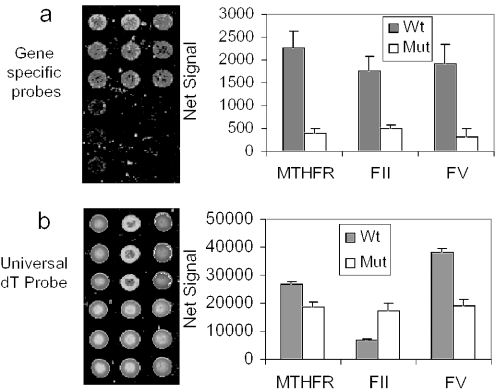
SNP discrimination requires the specificity provided by the sequential hybridization of target-specific capture and probes. Fragmented human placenta DNA (wild-type for FV, FII and MTHFR) was tailed with poly(dA) by terminal transferase. The poly(dA) tailed genomic DNA was hybridized to SNP arrays (5 μg/array) at 35% formamide, 4× SSC, 0.01% Tween and 0.01% SDS at 40°C for 1 h. After removing unbound genomic DNA targets, the arrays were further hybridized with either gene-specific probes (a) or poly(dT) nanoparticle probes (b) for 30 min and followed by a silver enhancing step, respectively. (a) Gene-specific probes employed for SNP discrimination of the poly-dA labeled genomic DNA showed clear differences between the intensities at the wt and mut captures permitting SNP discrimination even in the presence of non-target homologous DNA at the test sites. (b) With the poly(dT) probes, strong signals were observed both at the wt and mut capture oligonucleotides but SNP discrimination was not possible indicating that the signals derive from non-target homologous DNA.
Figure 4
Figure 4
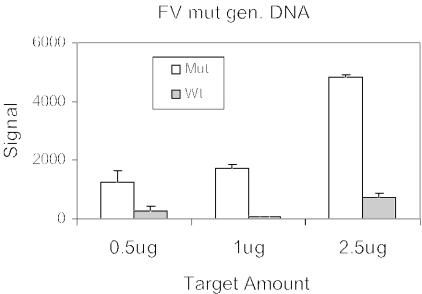
Detection sensitivity of the SNP discrimination assays in genomic DNA. SNP arrays for the factor V gene were hybridized with 2.5 μg (750 000 copies), 1 μg (300 000 copies) and 500 ng (150 000 copies) of unamplified human genomic DNA genotyped to be mutant for the factor V gene in a target titration experiment. Clear SNP discrimination was possible even at 500 ng total genomic DNA.
Figure 5
Figure 5
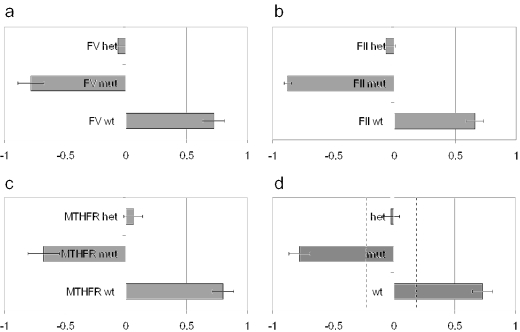
Discrimination factors [DF = (SwtSmut)/(Swt + Smut)] were derived from a reproducibility study comprising 25 independent assays reflecting a total of 75 separate genotyping determinations. Of these, 35 determinations were from wild-type placenta DNA. The remaining 40 determinations (30 heterozygous and 10 mutants) came from genomic DNA samples from Coriell Institute (refer to Table 1). From the individual DF values for each gene, the average DF values were calculated for wt, mut and het, respectively (ac). Average DF values for all three genes were plotted and a threshold to distinguish between heterozygous and homozygous genotypes was set at ±0.4 after factoring in 3 SD values above the average heterozygous signal (d).

References

    1. Sachidanandam R. A map of human genome sequence variation containing 1.42 million single nucleotide polymorphisms. Nature. 2001;409:928–933. - PubMed
    1. Venter J.C., Adams M.D., Myers E.W., Li P.W., Mural R.J., Sutton G.G., Smith H.O., Yandell M., Evans C.A., Holt R.A., et al. The sequence of the human genome. Science. 2001;291:1304–1351. - PubMed
    1. Gabriel S.B., Schaffner S.F., Nguyen H., Moore J.M., Roy J., Blumenstiel B., Higgins J., DeFelice M., Lochner A., Faggart M., et al. The structure of haplotype blocks in the human genome. Science. 2002;296:2225–2229. - PubMed
    1. Ardlie K.G., Kruglyak L., Seielstad M. Patterns of linkage disequilibrium in the human genome. Nature Rev. Genet. 2002;3:299–309. - PubMed
    1. Wall J.D., Pritchard J.K. Haplotype blocks and linkage disequilibrium in the human genome. Nature Rev. Genet. 2003;4:587–597. - PubMed

Publication types