. 2005 Feb;73(2):872-7.
doi: 10.1128/IAI.73.2.872-877.2005.

Staphylococcus aureus virulence factors identified by using a high-throughput Caenorhabditis elegans-killing model

Affiliations

Staphylococcus aureus virulence factors identified by using a high-throughput Caenorhabditis elegans-killing model

Jakob Begun et al. Infect Immun. 2005 Feb.

Abstract

Staphylococcus aureus is an important human pathogen that is also able to kill the model nematode Caenorhabditis elegans. We constructed a 2,950-member Tn917 transposon insertion library in S. aureus strain NCTC 8325. Twenty-one of these insertions exhibited attenuated C. elegans killing, and of these, 12 contained insertions in different genes or chromosomal locations. Ten of these 12 insertions showed attenuated killing phenotypes when transduced into two different S. aureus strains, and 5 of the 10 mutants correspond to genes that have not been previously identified in signature-tagged mutagenesis studies. These latter five mutants were tested in a murine renal abscess model, and one mutant harboring an insertion in nagD exhibited attenuated virulence. Interestingly, Tn917 was shown to have a very strong bias for insertions near the terminus of DNA replication.


Figures
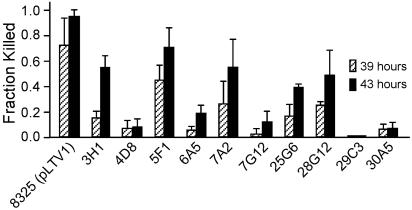
FIG. 1.
FIG. 1.
C. elegans killing by transduced S. aureus 8325 mutants. Shown are the fractions of nematodes killed after 39 and 43 h of feeding on S. aureus 8325(pLTV1) and transduced isogenic Tn917 insertion mutants. Following the growth of bacteria on TS agar plates, 25 to 35 L4-stage hermaphroditic N2 worms were transferred to each plate. Nematode death was determined after 39 and 43 h of feeding. The data represent the mean + standard deviation (error bar) of three sets of plates and are representative of three independent experiments.
FIG. 2.
FIG. 2.
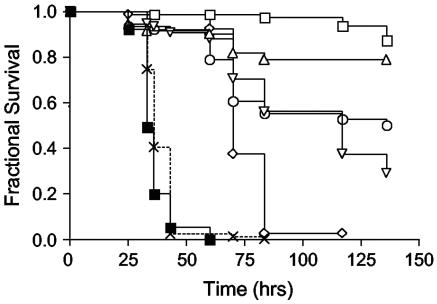
Survival of C. elegans on S. aureus Newman mutants. Shown is the survival of nematodes fed S. aureus Newman (wild type, closed squares; n = 77) and transduced isogenic mutants 6A5 (nagD, open diamonds; n = 79), 7G12 (citG, open squares; n = 80), 15G12 (SA1241, ×; n = 79), 28G12 (5′ yacA, open circles; n = 76), 29C3 (5′ fbp, open triangles; n = 71), and 30A5 (pyrAA, open inverted triangles; n = 76). Survival was plotted by the Kaplan-Meier method. Pairwise comparisons (log-rank test) by strain were as follows: Newman versus 6A5, P < 0.0001; Newman versus 7G12, P < 0.0001; Newman versus 15G12, P not significant; Newman versus 28G12, P < 0.0001; Newman versus 29C3, P < 0.0001; and Newman versus 30A5, P < 0.0001.
FIG. 3.
FIG. 3.
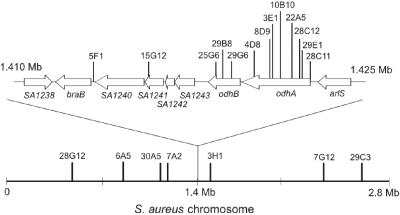
Distribution of Tn917 insertion sites within the S. aureus genome. Shown is a schematic representation of the Tn917 insertion sites of those mutants with reduced virulence in the C. elegans infection model along a linearized S. aureus chromosome. Lines indicate nucleotide insertion sites. An enlarged depiction of the terminus region, containing a majority of the Tn917 insertion sites, is shown above the chromosome.
FIG. 4.
FIG. 4.
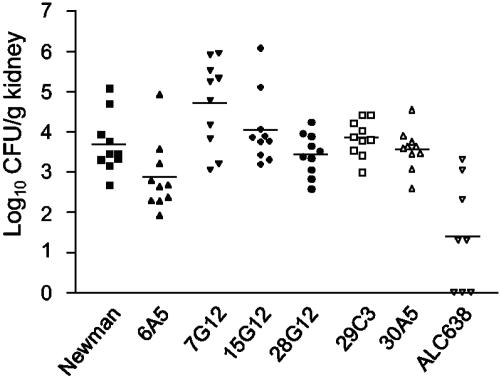
Select S. aureus Newman mutants tested in a murine renal abscess model. Groups of five CD1 mice were inoculated intraperitoneally with the following strains: Newman (wild type; 9.8 × 10⁷ CFU), ALC638 (agr sarA; 1.4 × 10⁸ CFU), 6A5 (nagD; 1.4 × 10⁸ CFU), 7G12 (citG; 6.6 × 10⁷ CFU), 28G12 (5′ yacA; 5.0 × 10⁷ CFU), 29C3 (5′ fbp; 6.0 × 10⁷ CFU), 30A5 (pyrAA; 1.4 × 10⁸ CFU), and 15G12 (ORF SA1241, negative control; 1.6 × 10⁸ CFU). Five days after inoculation, the mice were sacrificed and the kidneys were excised, homogenized, diluted, and plated. CFU of Newman, ALC638, and Tn917 mutants in renal tissue were calculated and plotted after log transformation. Statistical significance was determined using a two-tailed t test; compared to wild-type strain Newman, ALC638 and 6A5 were attenuated in renal tissue bacterial load (P < 0.05). Data are representative of two independent experiments.

References

    1. Akerley, B. J., E. J. Rubin, A. Camilli, D. J. Lampe, H. M. Robertson, and J. J. Mekalanos. 1998. Systematic identification of essential genes by in vitro mariner mutagenesis. Proc. Natl. Acad. Sci. USA 95:8927-8932. - PMC - PubMed
    1. Albus, A., R. D. Arbeit, and J. C. Lee. 1991. Virulence of Staphylococcus aureus mutants altered in type 5 capsule production. Infect. Immun. 59:1008-1014. - PMC - PubMed
    1. Alegado, R. A., M. C. Campbell, W. C. Chen, S. S. Slutz, and M. W. Tan. 2003. Characterization of mediators of microbial virulence and innate immunity using the Caenorhabditis elegans host-pathogen model. Cell Microbiol. 5:435-444. - PubMed
    1. Altschul, S. F., W. Gish, W. Miller, E. W. Myers, and D. J. Lipman. 1990. Basic local alignment search tool. J. Mol. Biol. 215:403-410. - PubMed
    1. Ausubel, F. M. 1988. Current protocols in molecular biology. Greene Publishing Associates and Wiley-Interscience, New York, N.Y.

Publication types

Substances

LinkOut - more resources